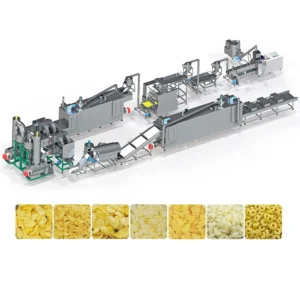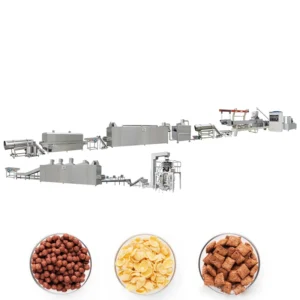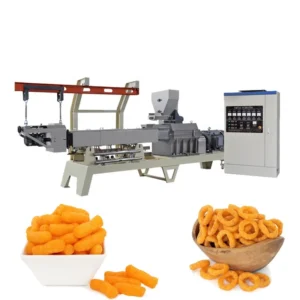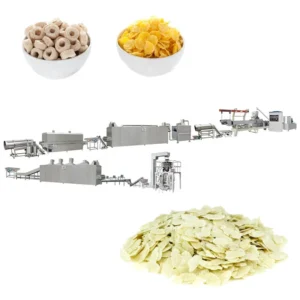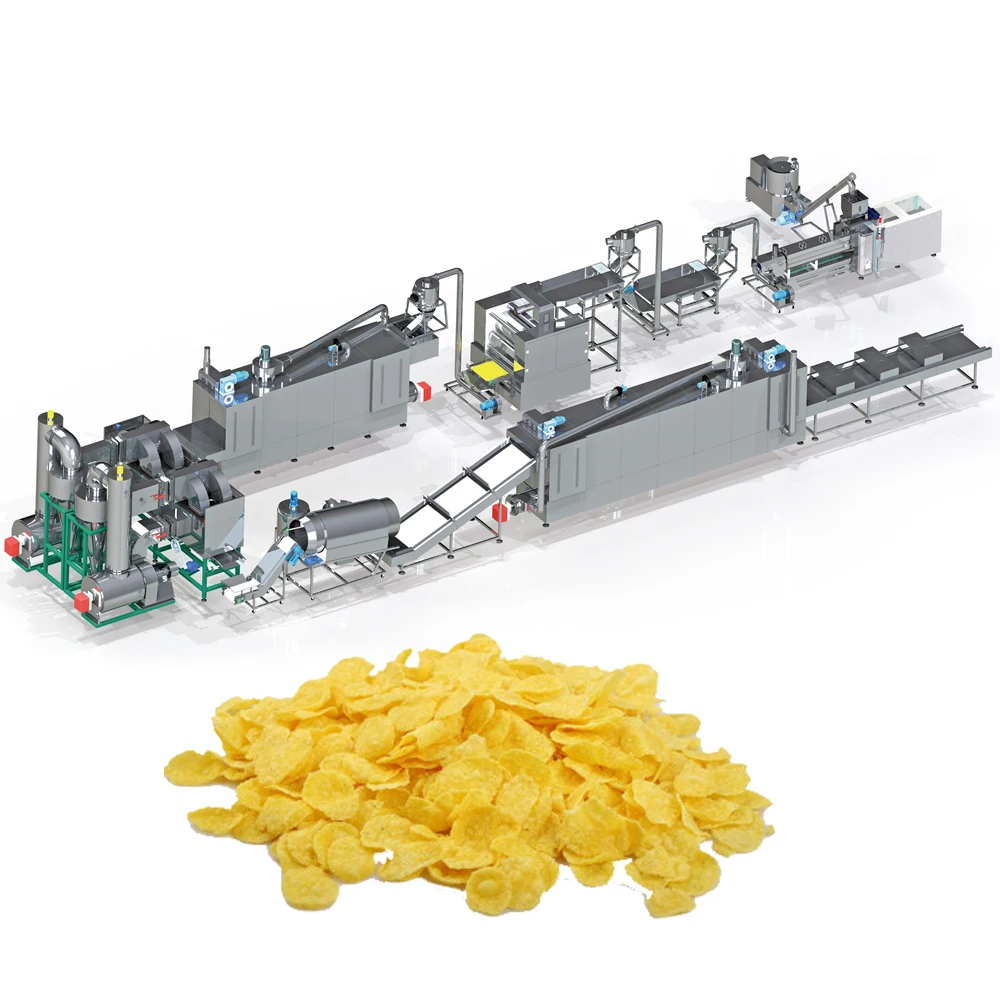
Precision Barrel Control — matched screw configuration and temperature profiling ensure consistent starch gelatinisation across corn, oat, and multigrain breakfast cereal formulations.
Technical Specifications
| Parameter | Value |
|---|---|
| Product Type | Corn Flakes & Breakfast Cereal Extrusion Processing Line |
| Models Available | MT-65 / MT-70 / MT-75 / MT-85 |
| Extruder Type | Twin-screw, co-rotating with sectional screw modules |
| Output Capacity (MT-65) | 120–150 kg/h (basis not stated in source — confirm raw material, moisture, flake thickness) |
| Output Capacity (MT-70) | 200–250 kg/h (basis not stated in source) |
| Output Capacity (MT-75) | 300–400 kg/h (basis not stated in source) |
| Output Capacity (MT-85) | 400–500 kg/h (basis not stated in source) |
| Installed Power Range | 84 kW (MT-65) to 239 kW (MT-85) |
| Real Power Consumption Range | 59 kW (MT-65) to 167 kW (MT-85) |
| Gear Box Lubrication | Oil forced automatic lubrication system |
| Cutting System | Non-stop cutting mechanism |
| Corn Flakes Press Power | 16.12 kW |
| Press Roller Size | 510 × 310 × 1050 mm |
| High-Temperature Oven Heating | Gas-fired, both-side baking system |
| Sugar Spraying System Power | 28.75 kW |
| Control System | PLC and MCC |
| Contact Materials | Food-grade stainless steel |
| Self-Cleaning | Twin-screw self-cleaning function |
| Standards | CE, ISO |
Application Suitability
| Application | Material or Output |
|---|---|
| Traditional corn flakes | Corn grits and corn flour blends |
| Multigrain breakfast cereals | Rice flour, wheat flour, and mixed grain formulations |
| Oat-based snack flakes | Oat flour with adjusted moisture and temperature profiles |
| Fortified cereal production | Grain base with added soya bean, peanut, or walnut protein |
| Sweetened cereal variants | Base flakes with sugar coating via spraying drum |
Why Extrusion Temperature Profiles Matter More Than Quoted Capacity
The degree of starch gelatinisation inside the barrel determines whether your flakes toast evenly or shatter in the bowl.
When evaluating a corn flakes extrusion technology twin screw system, buyers often fixate on hourly output numbers. But a line rated at a certain throughput on standard corn grits may behave completely differently when you introduce high-fibre oat formulations or protein-enriched blends. The barrel temperature profile, moisture injection points, and screw module arrangement all shift when the raw material changes. I once spent weeks re-tuning a line after a client switched from plain corn to an oat-heavy recipe — the gelatinisation temperature was never reached, and every flake cracked during pressing [NEED_CITE: starch gelatinisation thresholds for oat versus corn matrices]. Capacity figures only hold meaning when tied to your specific formulation.
Screw Module Arrangement and Gelatinisation Control
The co-rotating twin-screw design uses sectional screw modules that can be rearranged to alter shear intensity, residence time, and mixing energy within the barrel. For corn grits, a moderate-shear configuration with gradual compression achieves the gelatinisation window needed for uniform flake expansion. When processing oats or multigrain blends with higher fibre content, the screw profile requires adjustment to compensate for different moisture absorption rates and thermal conductivity. This is where corn flakes extrusion technology twin screw engineering diverges from generic builds — each module position influences how completely starches convert before the material reaches the die.
Barrel Temperature Zoning and Moisture Management
Each barrel section operates under independent temperature control, allowing operators to build a precise thermal curve from feed zone to die face. Starch gelatinisation in corn-based formulations typically requires reaching specific thermal thresholds while maintaining controlled moisture levels [NEED_CITE: cereal extrusion thermal profiles and moisture interaction]. Too little heat in the mid-barrel zones leaves raw starch cores that produce brittle flakes; excessive heat near the die causes premature expansion and surface blistering. The interplay between barrel temperature, screw speed, and moisture injection defines the final flake density and bowl-life characteristics that consumers expect from a quality breakfast cereal.
Press Roller Mechanics and Flake Thickness
The corn flakes press station features adjustable roller distance with an integrated cooling system, allowing operators to dial in exact flake thickness before the product enters the oven. Roller gap settings directly influence how the extruded pellet flattens — too tight and the flake fractures during toasting, too loose and it fails to achieve the crispness target. The 510 × 310 × 1050 mm roller dimensions provide a broad contact surface that distributes pressure evenly across the pellet width. Cooling within the press prevents residual heat from continuing to alter the flake structure before it reaches the gas-fired oven for final baking.
When Screw Configuration Does Not Match the Recipe
A screw profile optimised for standard corn grits will produce inconsistent results on high-fibre or high-protein formulations. The material may not reach adequate gelatinisation, resulting in flakes that crumble during pressing or fail to toast uniformly in the oven. Producers who skip the trial run phase often discover these mismatches only after installation, when re-configuring the screw modules and re-establishing temperature curves delays production by weeks [NEED_CITE: extrusion line commissioning delays from unverified screw configurations]. The cost of downtime and wasted raw material during that period frequently exceeds what a pre-shipment trial would have required.
Why the Process Engineering Approach Differs Here
The screw configuration and die design are specified against the buyer’s actual raw material blend rather than copied from a standard template. Before any line ships, the in-house testing workshop runs the buyer’s formulation through the extruder to verify gelatinisation behaviour, flake density, and throughput under real conditions. The twin-screw platform spans four capacity models, allowing selection based on confirmed output rather than nominal claims. Barrel temperature profiles and press settings are documented during the trial so the buyer’s operators start with validated parameters. PLC and MCC control systems are configured to the facility’s voltage and frequency before manufacturing begins, eliminating commissioning surprises.
Documentation & Verification
- Screw and die configuration record matched to your grain formulation and target flake density
- Trial run report using your raw material confirming gelatinisation and output behaviour
- Electrical schematic with voltage and frequency locked to your facility specification
- Line layout showing throughput balance across mixer, extruder, press, oven, and coating stations
- CE declaration of conformity and ISO certificate included with shipment documentation
Installation, Commissioning & Support
- Foundation requirements based on the selected model’s overall dimensions up to 28000 × 1500 × 2800 mm
- Dedicated power circuit sized to the model’s installed power ranging from 84 kW to 239 kW
- PLC interface language and MCC labels confirmed to operator preference before assembly
- First-run parameter validation using the trial report baseline on your actual raw material
- Wear parts list covering screw modules, die inserts, and press roller surfaces for initial spares planning
- Oil forced lubrication system maintenance schedule provided for gear box longevity
Preparing Your Inquiry
To configure the right extrusion setup, share your primary grain formulation along with any secondary ingredients like oat, soya, or nut components. Specify your target flake thickness, desired bowl-life characteristics, and daily production volume so the appropriate model can be selected. Include your facility’s voltage, frequency, and preferred PLC control language to ensure electrical compatibility from day one.
Frequently Asked Questions
Q: How is screw configuration determined for different grain formulations?
A: Each grain type — corn, oat, rice, wheat — has distinct starch structures and moisture absorption rates. The screw module arrangement is adjusted to deliver the right shear and residence time for complete gelatinisation without over-processing. A trial run on your specific blend confirms the configuration before the line ships.
Q: What barrel temperature and moisture range produce the target flake density?
A: The optimal range depends on your formulation’s starch composition and fibre content. Corn-based recipes typically need different thermal curves than oat-heavy blends. Temperature zones and moisture injection are mapped during the pre-shipment trial to match your density and crispness targets.
Q: How is output capacity verified on the actual raw material?
A: The buyer’s raw material is run through the extruder in the testing workshop before dispatch. Output rate, flake quality, and press behaviour are measured under real conditions, and the results are documented in a trial report shared with the buyer for review.
Q: How does press roller gap affect final toasted flake texture?
A: The roller gap sets flake thickness before oven baking. Thinner flakes toast faster and achieve greater crispness but may become brittle if the gap is too tight. The integrated cooling system stabilises the flake structure immediately after pressing to preserve the intended texture.
Q: How are voltage and control language confirmed before production?
A: The buyer provides facility voltage, frequency, and preferred PLC language during the specification phase. The electrical schematic is built to those parameters and documented before manufacturing begins, preventing delays during on-site commissioning.