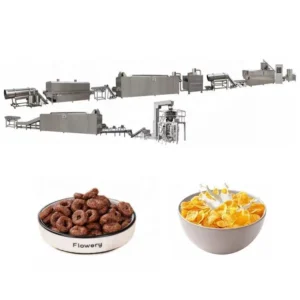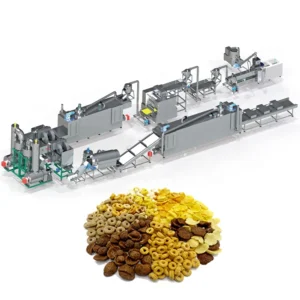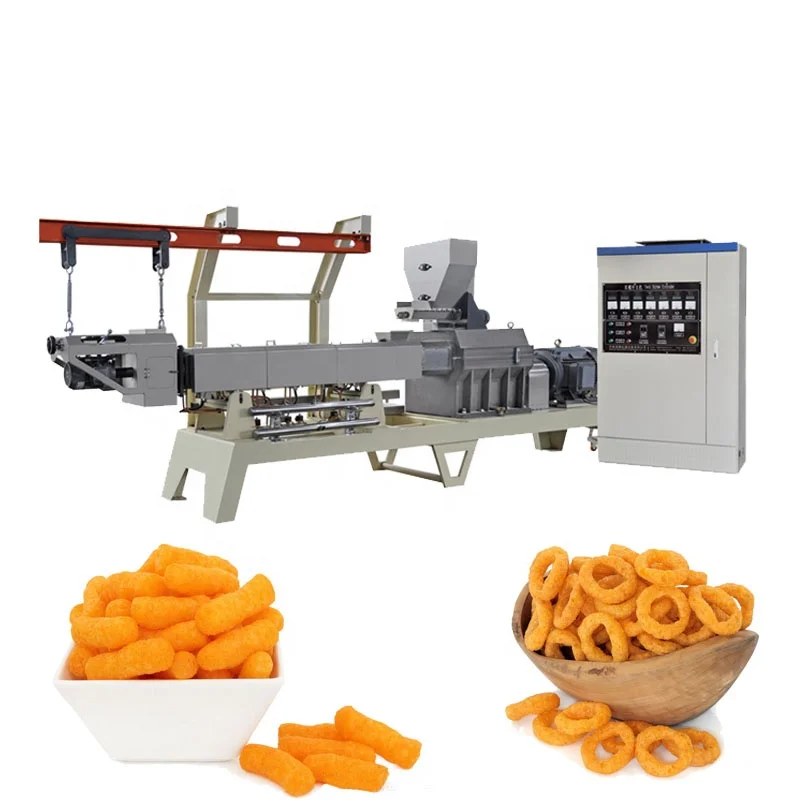
Configurable Screw Elements — Die design and barrel zone profiles matched to your specific corn, oat, or multi-grain formulation rather than a generic build.
Technical Specifications
| Parameter | Value |
|---|---|
| Model | MT75 |
| Product Type | Twin Screw Corn Flakes Extrusion Production Line |
| Screw Type | Twin-screw |
| Installed Power | 210 kW |
| Power Consumption | 150 kW |
| Output Capacity | 300–500 kg/h (basis not stated in source — confirm raw material, moisture content and product format) |
| Overall Dimensions | 45 × 1.5 × 3.5 m |
| Control System | PLC and MCC; flaking unit with PLC control, hydraulic system, infrared sensor temperature control |
| Dryer Heating Source | Gas or Electric |
| Flaking Machine | Double motors, hydraulic system, infrared sensor |
| Hot Air Roasting Oven | Vibrating pan, conciliation burner, dual circulating fans, cyclone dust removal |
| Coating System | Double tumble, elevator, coating drum, spraying nozzle |
| Standards | CE, ISO |
Application Suitability
| Application | Material or Output |
|---|---|
| Natural corn flakes | Corn, rice, wheat, oat, barley powder |
| Sugar-coated corn flakes | Corn, rice, wheat, oat, barley powder with sugar coating |
| Shaped breakfast cereals | Ball, tube, stick, ring, fruit loop, star, wheel, flower, heart via die adjustment |
Why Generic Screw Configurations Fail Breakfast Cereal Lines
The twin screw corn flakes extrusion technology you specify must account for the actual starch structure of your raw material, not just a catalogue capacity figure. A screw profile tuned for pure corn will produce dense, uneven flakes the moment your formula includes oats, barley, or bran. I once supplied an extruder to a producer running a 30% oat blend; the standard corn configuration caused the dough to stick and tear at the flaking rollers, and the roasted output lacked any bowl-life crispness. We spent three nights rebuilding the barrel temperature curve and rearranging the screw elements before density and texture returned to specification. [NEED_CITE: starch gelatinisation behaviour differences across cereal grains]
How Screw Configuration and Barrel Profile Shape the Flake
The extruder barrel is divided into feeding, extruding, and heating zones, each with independently controllable temperature. The twin-screw design generates shear and pressure that cook the starch matrix under moisture and heat. For corn-dominant recipes, a moderate shear profile with a longer residence zone achieves the gelatinisation level needed for a uniform sheet at the flaking rollers. When the raw material shifts toward multi-grain blends, the screw element arrangement must be reconfigured to handle different moisture absorption rates and gelatinisation temperatures.
Die Design and Moisture Control at the Flaking Station
The die opening geometry determines the shape and thickness of the extruded rope before it reaches the flaking unit. The PLC-controlled flaking machine uses a hydraulic double-roller system with an infrared sensor that monitors temperature across the roller surface, keeping the sheet thickness even across the full width. If the extrudate moisture is too high entering the rollers, the sheet tears and produces ragged edges that burn during hot air roasting. Too low, and the sheet shatters into undersized fragments that cannot meet the target flake dimension. [NEED_CITE: moisture content range and flake integrity in cereal processing]
Reading the Parameter Sheet Against Your Production Target
The MT75 carries an installed power of 210 kW with a rated consumption of 150 kW, reflecting the combined draw of the feeding, extruding, cutting, heating, gearing, and control systems. The screw features automatic lubricating and cooling, which reduces thermal buildup during continuous runs and extends screw service life through a wear-resistant surface treatment. The line stretches 45 metres end-to-end, covering mixing, extruding, flaking, drying, hot air roasting, cooling, and packing — every station sized to match throughput so no single unit bottlenecks the sequence. The hot air roasting oven uses a conciliation burner with dual circulating fans and a cyclone dust removal device, providing the consistent surface blistering and internal moisture reduction that define a crisp corn flake.
The Cost of Skipping a Raw Material Trial Run
Producers who accept a generic line configuration often discover problems only after installation, when the extruder is bolted to the floor and utilities are connected. Flakes that are too dense sink in milk within seconds, violating the bowl-life expectation consumers hold for breakfast cereal. Flakes that are too fragile break during the coating drum stage, generating fines that clog the packing system and reduce saleable yield. These issues trace back to a screw and die combination that was never tested against the buyer’s actual grain blend, moisture content, and target flake density. [NEED_CITE: breakfast cereal density and bowl-life consumer expectations]
Why This Line Is Engineered Around Your Formulation
The screw configuration and die design are specified to your raw material and target flake density, not copied from a default build. The in-house testing workshop runs your actual grain blend through the extruder, flaking unit, and roaster before shipment, generating a documented trial run report. Every station — mixing, extruding, flaking, drying, roasting, coating, cooling, packing — is throughput-matched so capacity is not constrained by a single undersized unit. The PLC and MCC control architecture is confirmed against your local voltage, frequency, and preferred operating language before production begins. Engineering support covers the full scope from layout design through on-site installation, commissioning, and operator training.
Documentation & Verification
- Line layout and capacity calculation matched to your grain formula and target flake density
- Screw and die configuration record for your specific corn, oat, or multi-grain blend
- Trial run report on your raw material covering expansion, texture, and flake thickness
- Electrical schematic with voltage, frequency, and control language confirmed pre-production
- Operation and maintenance manual with wear parts list for screws, dies, and roller surfaces
Installation, Commissioning & Support
- 45-metre line footprint requires level concrete flooring with utility trenches for gas and drainage
- 210 kW installed power demands a dedicated three-phase circuit with confirmed voltage and frequency
- Modular station design allows phased assembly from extruder through roaster and packing
- Commissioning includes barrel temperature curve tuning and flaking roller gap calibration on your material
- PLC interface configured in your preferred language before the control panels are energised
- Wear parts inventory covers screw elements, die plates, flaking roller segments, and spray nozzles
Before You Request a Quote
Share your raw material composition including the percentage split of corn, oats, wheat, or barley in your recipe. Confirm your target flake thickness, density, and whether the final product requires sugar coating. Provide your workshop dimensions, ceiling height, and local voltage and frequency so the line layout and electrical specification can be drafted to match your facility conditions.
Frequently Asked Questions
Q: How is screw configuration selected for different cereal raw materials?
A: We map the gelatinisation temperature, moisture absorption, and starch structure of each grain in your blend, then arrange the screw elements and barrel heating zones accordingly. A pure corn recipe requires a different shear profile and residence time than a multi-grain formula containing oats or barley, and the die geometry is adjusted to match the target rope shape before flaking.
Q: How is output capacity verified against my actual raw material?
A: We run your grain blend through the extruder and flaking unit in the testing workshop before shipment. The trial run measures extrudate moisture, flake thickness, expansion rate, and roasted density, and the results are documented in a report so the capacity figure reflects your material, not a generic rating.
Q: What barrel temperature profile produces the target flake density?
A: The profile depends on your grain blend and moisture content. Each barrel zone is independently heated and monitored, and the temperature curve is tuned during the trial run to achieve the gelatinisation level that produces a sheet with the correct thickness and internal structure for consistent roasting and bowl-life crispness.
Q: How do you prevent bottlenecks between line stations?
A: Every station from mixing through packing is sized against the extruder output calculated for your raw material. The flaking unit, dryer, hot air roasting oven, and coating drum are all rated to handle the same throughput range, so no single machine restricts the line or forces the extruder to idle.
Q: Can I run a trial with my own raw material before shipment?
A: Yes. Send your grain formula to the testing workshop, and we run it through the MT75 extruder, flaking rollers, and roaster. The trial run report covers flake density, texture, expansion, and thickness, and any screw or die adjustments needed are made and recorded before the line is packed for dispatch.