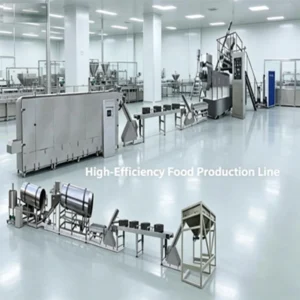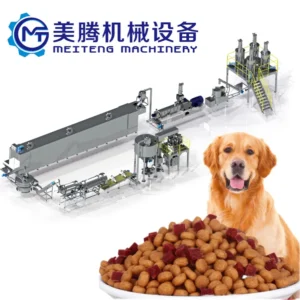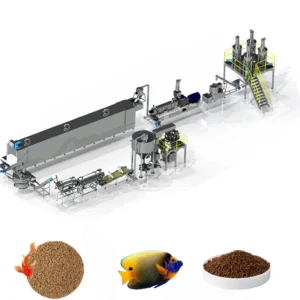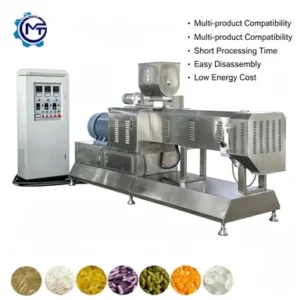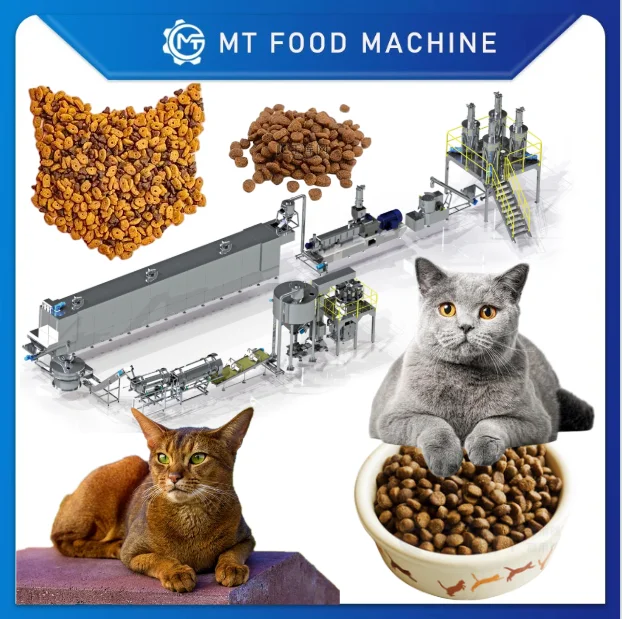
Precision extrusion engineering — screw geometry and barrel temperature profiles are matched to your raw material behaviour before any cat food kibble leaves our Jinan testing workshop.
Technical Specifications
| Parameter | Value |
|---|---|
| Product Type | Pet Food Extrusion Production Line |
| Output Capacity | 250–300 kg/h (basis not stated in source — confirm raw material formulation, moisture content, and kibble size) |
| Screw Type | Twin-screw |
| Control System | PLC Controlled |
| Automation Level | Full Automation |
| Product Formats | Dry kibble, semi-moist, treats |
| Target Species | Cat, dog, and multi-species companion animals |
| Line Stations | Batching → Extrusion → Drying → Coating/Flavouring → Cooling → Packing |
| Certification | CE (since 2014), ISO |
Application Suitability
| Application | Material or Output |
|---|---|
| Commercial dry cat kibble production | Poultry meal, fish meal, corn, rice, and vitamin premix blends |
| Semi-moist pet food manufacturing | High-moisture meat slurries with starch binders |
| Pet treat extrusion | Dense protein and starch formulations in small-format shapes |
| Multi-species co-production | Switching between cat, dog, and companion animal recipes on one platform |
| Capacity expansion for existing pet food plants | Replacing single-screw lines with twin-screw extrusion for broader formulation range |
Why Nominal Capacity Numbers Mislead Pet Food Buyers
A twin-screw extrusion cat food processing line specifications sheet often quotes a headline throughput figure that assumes a standard corn-based formulation at moderate moisture — the same number rarely holds when the recipe shifts to high fresh meat content. Capacity is a function of formulation, not a fixed property of the machine.
I have watched a 250–300 kg/h line struggle during commissioning in the Middle East because the screw profile was copied from a generic build. The buyer’s high-fresh-meat recipe generated more slip inside the barrel, and output dropped noticeably below the quoted range. We had to ship a replacement screw configuration set from Shandong to correct it on site. That kind of mismatch is entirely avoidable when the twin-screw extrusion cat food processing line specifications are developed against the buyer’s actual raw material rather than a catalogue default. [NEED_CITE: relationship between screw profile and material slip in food extrusion]
Barrel Temperature Profiling and Starch Gelatinisation
Cat food kibble demands a higher degree of starch gelatinisation than most aquatic feed or snack products because palatability and digestibility are directly tied to how completely the starch granules are broken down. A PLC-controlled barrel temperature profile lets operators set independent heat values across multiple zones, so the material experiences a gradual thermal ramp rather than a single shock. This controlled progression is what allows the twin-screw extrusion cat food processing line specifications to deliver consistent gelatinisation even when the recipe contains a mix of fast- and slow-gelatinising starches.
Screw Configuration as a Formulation Variable
The screw elements — kneading blocks, reverse-flight sections, and conveying segments — are arranged in a sequence that determines residence time, shear intensity, and pressure build-up before the die. A high-meat recipe needs a gentler shear profile to prevent protein denaturation that would collapse expansion at the die face. A starch-heavy kibble formula can tolerate more aggressive kneading. This is why screw configuration is never a one-size-fits-all choice; it is rebuilt around each buyer’s target kibble density and expansion ratio. [NEED_CITE: screw element arrangement and residence time distribution in twin-screw extruders]
Die Geometry, Moisture Range, and Kibble Density
The die plate determines the cross-section of each kibble piece, but its influence goes well beyond shape. The number of die holes, the land length, and the compression ratio together govern how much pressure is retained at the moment of exit — and that pressure differential is what drives expansion. A shorter land length produces a more open, lower-density kibble suited to grazing-style feeding, while a longer land compresses the extrudate into a denser piece. Moisture content at the die face further modulates this: higher moisture increases expansion potential but demands more drying capacity downstream. Understanding these interactions is the core reason the twin-screw extrusion cat food processing line specifications must be finalised against a specific recipe rather than assumed from a brochure.
The Hidden Cost of a Mismatched Extrusion Setup
When the screw configuration is wrong for the recipe, the problems do not stop at reduced throughput. Kibble density drifts outside what the market expects, causing complaints about feeding guides and caloric content. Starch gelatinisation stays incomplete, reducing digestibility and triggering returns from retail partners. The extruder motor draws higher current as it fights unplanned resistance, accelerating wear on bearings and gearboxes. These failures accumulate quietly until a full production stop forces an expensive unplanned intervention. [NEED_CITE: impact of incomplete starch gelatinisation on pet food digestibility]
Why Sourcing This Line Through Our Extrusion Technology Practice
Every screw configuration and die design is documented against your raw material and target kibble specification — you receive the configuration record, not a generic default list. Our in-house testing workshop runs trial batches on your actual formulation before shipment, so the expansion ratio, density, and gelatinisation are confirmed in advance and recorded in a formal trial run report. Throughput matching across batching, extrusion, drying, and coating stations means no single section bottlenecks the others — a frequent problem when lines are assembled from separate vendors. Electrical schematics are prepared with your destination voltage, frequency, and control language confirmed before fabrication, eliminating commissioning delays. Twin-screw expertise spans pet food, aquatic feed, snacks, and cereals, so cross-application knowledge informs every barrel temperature profile and screw build we deliver.
Documentation & Verification
- Line layout and capacity calculation for your kibble size and formulation
- Screw and die configuration record matched to your raw material batch
- Trial run report documenting expansion ratio, density, and gelatinisation on your recipe
- Electrical schematic with voltage, frequency, and PLC language confirmation
- CE declaration of conformity and ISO certificate for import clearance
- Operation and maintenance manual with wear parts list
Installation, Commissioning & Support
- Foundation load requirements calculated from the full line footprint and twin-screw extruder weight
- Dedicated power circuit specification based on PLC-controlled motor and heating zone ratings
- Barrel and screw assembly alignment verified during on-site commissioning against your recipe
- PLC parameter sets loaded and tuned for your target kibble density and moisture range
- Operator training on screw changeover procedures and die plate replacement intervals
- Wear parts inventory list covering screws, dies, and barrel liners with reorder lead times
Preparing Your Extrusion Line Inquiry
To size the screw configuration and barrel profile accurately, share your raw material formulation including meat meal percentage, starch sources, and target moisture content at the die face. Specify the kibble shape, size, and density range your market requires, along with your destination voltage and frequency standard. If you have existing upstream batching or downstream drying equipment, provide throughput data so we can confirm station-to-station balance across the line.
Frequently Asked Questions
Q: How is screw configuration and die design determined for my specific raw material?
A: We analyse your formulation’s protein-to-starch ratio, fat content, and moisture target to select kneading block placement, conveying segment pitch, and die land length. A trial run in our testing workshop then validates the configuration against your actual kibble density and expansion requirements before the final design is locked.
Q: What barrel temperature profile is needed for proper starch gelatinisation in cat food kibble?
A: Cat food recipes typically require a progressive temperature ramp across the barrel zones, starting moderate to hydrate starch granules and rising toward the die to complete gelatinisation. The PLC control allows each zone to be set independently, and exact values are confirmed during the pre-shipment trial run on your specific recipe.
Q: How is the capacity verified on my actual formulation during the trial run?
A: We run your raw material through the twin-screw extruder in our testing workshop, measuring throughput over a sustained period at your target moisture and kibble size. The trial run report documents the observed output alongside density and gelatinisation data, giving you a verified baseline rather than a nominal catalogue figure.
Q: What voltage, frequency, and control language options are confirmed before shipment?
A: We confirm your facility’s supply voltage, frequency, and preferred PLC interface language during the specification phase. The electrical schematic is then prepared to match those parameters, so the line is ready for connection on arrival without rewiring or reprogramming delays.
Q: How do I request a trial run, and what does the report include?
A: Send a representative sample of your raw material blend along with your target kibble specification. The trial run report covers observed throughput, kibble density, expansion ratio, starch gelatinisation degree, and the exact screw and die configuration used, forming the reference document for your production start-up.