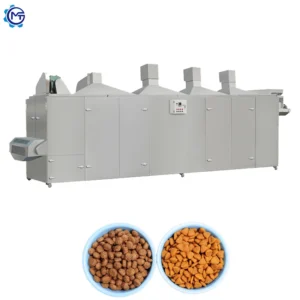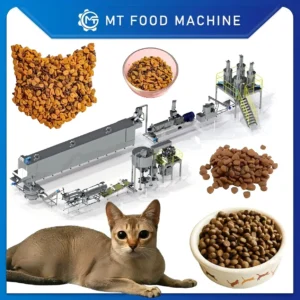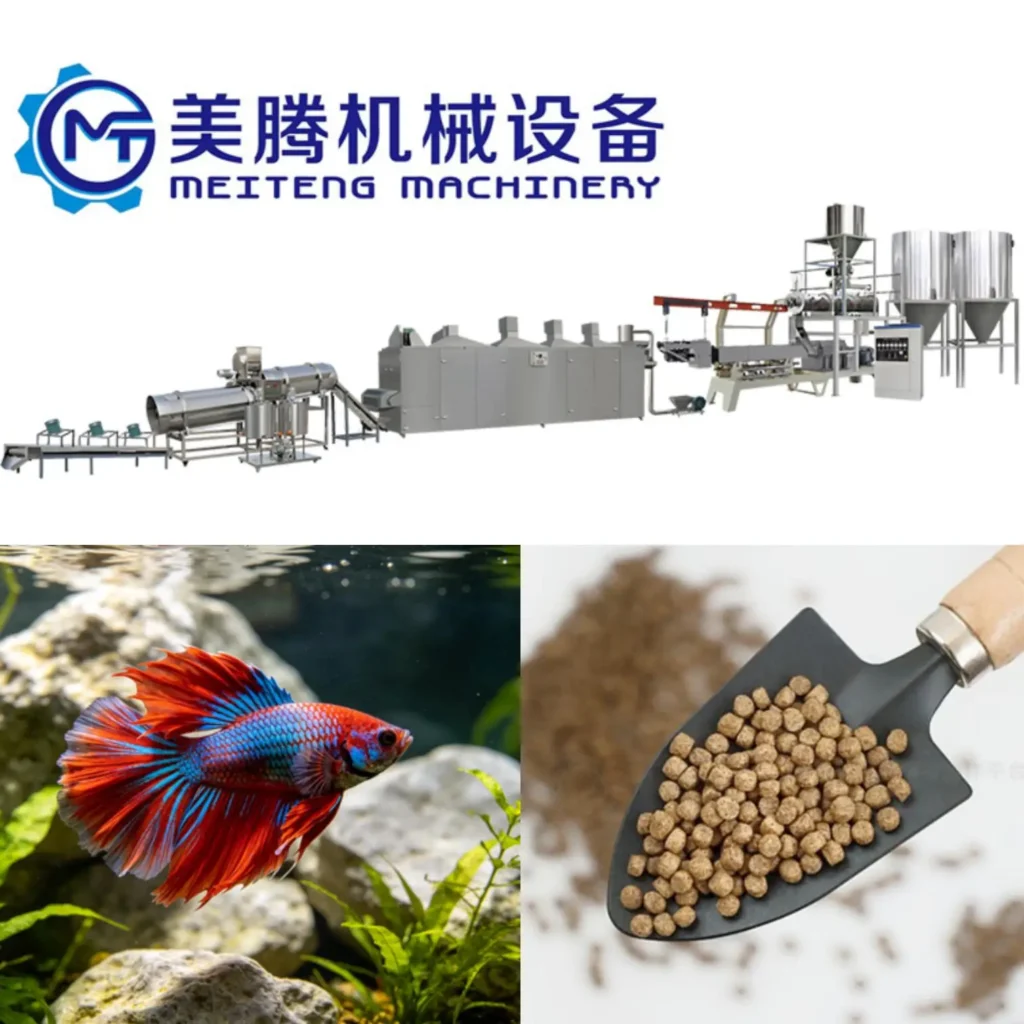
Matched screw geometry to formulation — Every screw element sequence and die orifice is specified against the buyer’s actual starch-protein matrix, not copied from a generic aquatic feed build.
Technical Specifications
| Parameter | Value |
|---|---|
| Product Type | Fish Feed Extrusion Production Line |
| Extruder Type | Twin-screw extruder |
| Output Capacity | 1.0–1.2 t/h (basis not stated in source — confirm raw material formulation, moisture content, pellet diameter) |
| Construction Material | 304 stainless steel (food-grade contact parts) |
| Control System | PLC and MCC control (verify against project quotation) |
| Line Configuration | Batching → Extrusion → Drying → Coating/Seasoning → Cooling → Packing |
| Target Species | Trout, salmon, catfish, and other aquatic species |
| Pellet Type | Floating and sinking aquatic feed |
| Screw Configuration | Matched to buyer’s raw material and target pellet specification |
| Voltage & Frequency | Configurable per buyer market (to be confirmed) |
| Standards | CE certified, ISO certified |
Application Suitability
| Application | Material or Output |
|---|---|
| Commercial trout and salmon feed production | High-protein formulations requiring slow-sinking pellets with water stability |
| Catfish and tilapia floating feed | Starch-rich formulations expanded to target buoyancy through controlled gelatinisation |
| Multi-species feed mill operations | Flexible screw and die changeovers between floating and sinking pellet runs |
| Shrimp feed processing | Fine-grind raw materials compressed into small-diameter sinking pellets |
Why Floating Pellets Sink: The Screw Configuration Gap Most Buyers Miss
Buoyancy failures trace back to screw element sequencing and die geometry, not motor power or barrel size.
I have watched feed producers in West Africa receive twin-screw extruders rated for a given throughput, only to find that floating pellets designed for catfish came out dense and sank within seconds. The extruder was not undersized — the screw configuration was built around a fish-meal formulation while the buyer was running local cassava and soybean meal blends. Gelatinisation happened too early in the barrel, expansion collapsed at the die face, and two months of screw and die replacements followed before the line produced marketable feed. [NEED_CITE: starch gelatinisation temperature ranges in aquatic feed extrusion]
The fish feed extrusion technology twin-screw processing sequence demands that every element — from the first mixing zone to the final metering section — be selected for the buyer’s specific raw material profile, not pulled from a reference build.
Barrel Temperature Zoning and Shear Control in Aquatic Feed
A twin-screw extruder divides the barrel into independently heated zones, each governing a different stage of the starch-protein transformation. In fish feed extrusion technology twin-screw processing, the early zones hydrate and mix the conditioned mash, the middle zones generate the shear needed for starch gelatinisation, and the final metering zone stabilises pressure before the die. When zone temperatures are too uniform, gelatinisation occurs unevenly, producing pellets with weak spots that absorb water rapidly and lose buoyancy.
Moisture and steam injection work alongside barrel heat to control the gelatinisation window. A high-protein salmonid formulation requires different moisture levels and shear intensity than a grain-heavy catfish formula. The screw element profile — including the ratio of forward-conveying, kneading, and reverse elements — determines how aggressively mechanical energy supplements thermal input at each stage.
Die Geometry and the Post-Die Pressure Drop
The die plate is where extrudate transitions from high-pressure, high-temperature mass to an expanded pellet. Orifice diameter, land length, and the number of open holes together define the pressure drop that governs expansion ratio. For floating feed, a sharp pressure drop at the die face triggers rapid steam flash-off, creating the open cell structure that keeps pellets on the water surface. Sinking feed requires a more restricted die — longer land length or smaller orifice — to limit expansion and produce a denser pellet.
Coordinating die design with post-extrusion drying is essential. [NEED_CITE: pellet density and water stability testing standards in aquaculture] A pellet that expands correctly but enters a dryer with insufficient residence time or uneven air distribution will retain too much internal moisture, compromising both buoyancy and shelf life. The dryer must be sized to match extruder output at the specific moisture level dictated by the formulation.
Reading the Specification Sheet Beyond Capacity Numbers
The output capacity of 1.0–1.2 t/h applies only when raw material formulation, moisture content, and pellet diameter align with the test conditions — and those conditions must be confirmed before the line is built. The twin-screw extruder’s screw configuration record documents the element sequence chosen for the buyer’s formulation, and this record should be reviewed alongside the die design drawing before production begins.
PLC and MCC control allows operators to monitor barrel temperature zones, screw speed, and feeder rates from a central interface, maintaining batch-to-batch consistency once process parameters are established during the trial run. Food-grade 304 stainless steel on all contact surfaces resists corrosion from high-moisture, high-salt aquatic formulations and meets hygiene requirements across export markets. The line architecture — from batching through extrusion, drying, coating, cooling, and packing — ensures each station is throughput-matched so no single section bottlenecks the others.
The Hidden Cost of Generic Screw Builds
When a twin-screw extruder ships with screw elements selected for a standard formulation rather than the buyer’s actual raw material, the consequences unfold gradually. Pellets that should float begin sinking in the pond, feed conversion ratios climb because fish cannot access submerged feed, and the producer faces complaints from farmers who trusted the pellet specification. [NEED_CITE: feed conversion ratio impact of sinking pellets in pond aquaculture]
I have seen producers spend weeks adjusting moisture, steam, and temperature at the control panel, not realising the root cause was a kneading block positioned two elements too far upstream. By the time the correct screw configuration is identified and replacement parts arrive, the line has sat idle or run substandard product. Trial runs on the buyer’s actual raw material in the testing workshop before shipment eliminate this risk entirely.
Why Sourcing This Line Here Matters
Complete line integration from batching to packing means the dryer capacity, coating drum volume, and cooler conveyor length are all calculated against the extruder’s output at your specific formulation — not assembled from unrelated vendor catalogues.
Screw configuration and die design are specified to the buyer’s raw material and target pellet specification, documented in the configuration record and verified during the in-house trial run before shipment.
The testing workshop allows trial runs on the buyer’s actual raw material, producing real pellets that can be measured for density, buoyancy, and water stability before the line leaves the factory.
Twin-screw expertise spans pet food, aquatic feed, snacks, cereals, starch, and protein applications, so process knowledge from adjacent formulations informs the screw and die choices for aquatic diets.
Pre-sales consultation through engineer design, on-site installation, commissioning, and ongoing maintenance support ensures process parameters transfer from the workshop trial to full production. [NEED_CITE: twin-screw extrusion process scale-up considerations]
Documentation & Verification
- Screw and die configuration record matched to your aquatic feed formulation and target species
- Trial run report on your raw material showing pellet density, buoyancy, and expansion data before dispatch
- Barrel temperature profile and moisture range documentation for process transfer to your facility
- Line layout and capacity calculation confirming throughput matching across all stations at your formulation
- Electrical schematic with voltage and frequency confirmation for your local power supply
- CE declaration of conformity and ISO certificate for import and regulatory compliance
Installation, Commissioning & Support
- Foundation and floor space requirements calculated from the complete line layout including batching, extrusion, and packing stations
- Dedicated power circuit specification based on the line’s total connected load and your local voltage and frequency
- Pre-assembled modules arrive with clearly marked connections to reduce on-site assembly time for the twin-screw extruder and dryer
- First-run commissioning includes screw speed, barrel zone temperature, and moisture calibration against your trial run parameters
- Operator training covers PLC and MCC interface navigation, screw changeover procedures, and die replacement routines
- Wear parts list with screw element and die specifications for timely reorder before first replacement is due
Before You Request a Quote
To configure this fish feed extrusion technology twin-screw processing line correctly, share your raw material formulation — including protein sources, starch percentage, and fat content — along with target pellet diameter and whether you need floating, sinking, or both. Specify your local voltage and frequency, preferred control language for the PLC interface, and whether you can send a raw material sample to the testing workshop for a pre-shipment trial run.
Frequently Asked Questions
Q: How is screw configuration determined for a specific fish feed formulation?
A: The buyer provides the complete raw material formulation — protein sources, starch type and percentage, fat content, and fibre level. From this, the screw element sequence is designed: conveying elements, kneading blocks, and reverse elements are arranged to control shear intensity and residence time at each barrel zone. The configuration is documented and verified during a trial run on the buyer’s actual material before the extruder ships.
Q: What controls whether a pellet floats or sinks?
A: Buoyancy is governed by the expansion ratio at the die face, which depends on die orifice geometry, land length, melt temperature, and moisture content. Floating pellets require a sharp pressure drop for rapid steam expansion and open cell structure. Sinking pellets need restricted dies for denser output. Post-extrusion drying parameters must be coordinated to preserve the target density without over-drying or moisture retention.
Q: How is output capacity verified on the buyer’s raw material?
A: The stated 1.0–1.2 t/h capacity is confirmed only against a specific formulation, moisture level, and pellet diameter. Before shipment, a trial run is conducted in the testing workshop using the buyer’s actual raw material. Throughput is measured at steady state, and the resulting pellets are tested for density, buoyancy, and dimensional accuracy to ensure they meet the buyer’s market specification.
Q: What barrel temperature profile is needed for high-protein aquatic feed?
A: High-protein formulations such as salmonid diets require lower peak barrel temperatures than grain-heavy feeds because protein denaturation occurs at different thresholds than starch gelatinisation. Moisture levels and screw shear must compensate to maintain adequate binding. The exact zone-by-zone profile is established during the trial run and documented for transfer to the buyer’s production environment.
Q: How are starch gelatinisation and water stability tested during the factory trial?
A: Pellets from the trial run are measured for expansion ratio, bulk density, and sinking velocity in water columns. Gelatinisation degree is assessed through standard laboratory methods. Water stability is tested by submerging pellets and measuring nutrient leaching over time intervals relevant to the target species’ feeding behaviour. Results are recorded in the trial run report provided to the buyer.