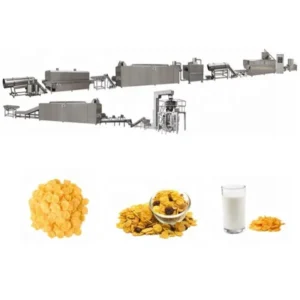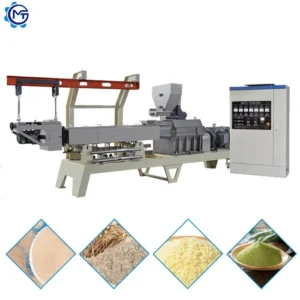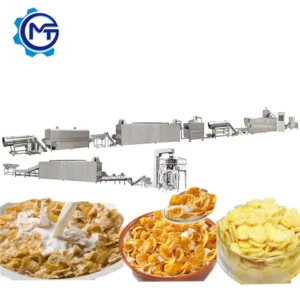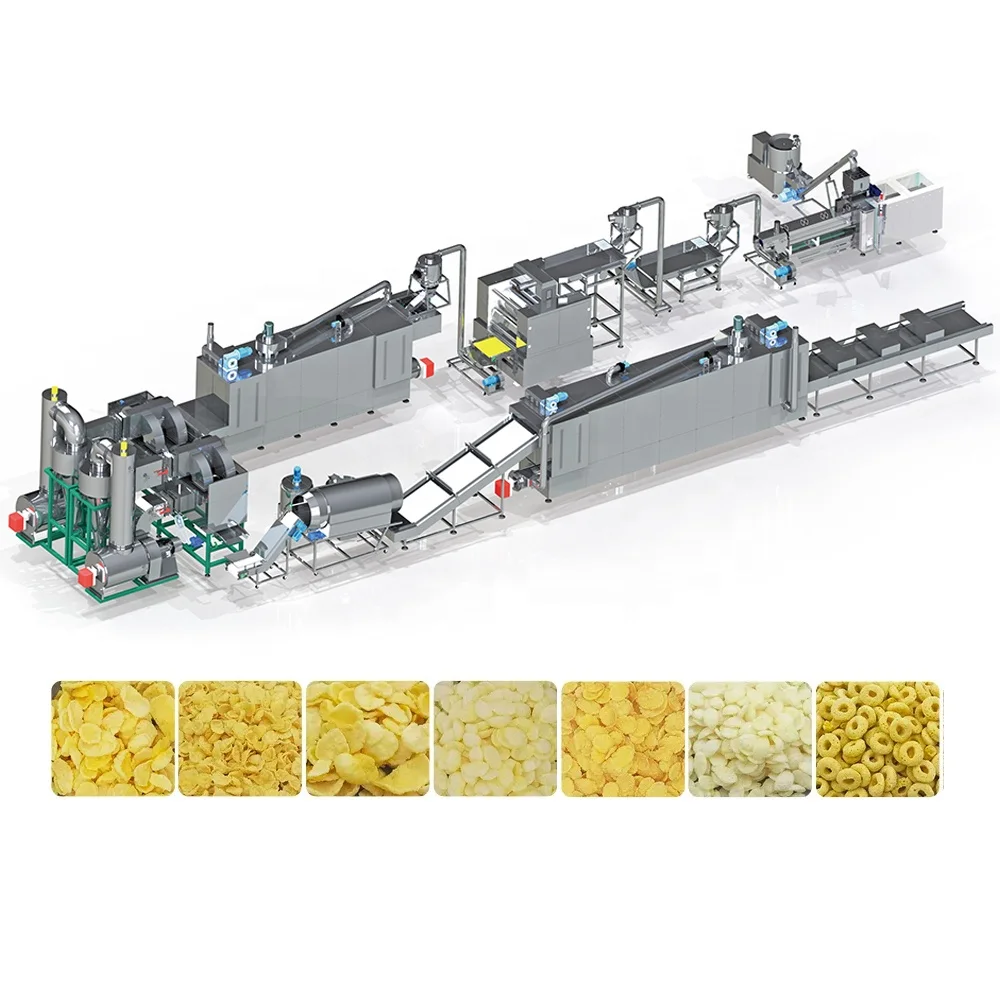
Twin Screw Extrusion Line for Breakfast Cereals & Corn Flakes — Screw Configuration, Barrel Profile & Density Control
Screw geometry matched to grain formulation — every MT-75 barrel and die set is configured against the buyer’s actual corn, rice or oat recipe before shipment, preventing the density drift that turns crisp flakes soggy within minutes of hitting milk.
Technical Specifications
| Parameter | Value |
|---|---|
| Model | MT-75 |
| Product Type | Twin Screw Breakfast Cereal Extrusion Line |
| Screw Type | Co-rotating twin screw, sectional modules |
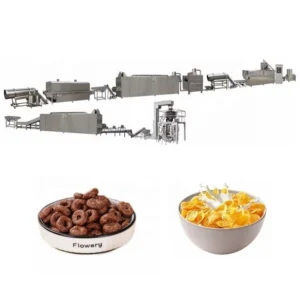
| Line Configuration | Flour Mixer → Screw Elevator → Extruder → Elevator → Dryer → Elevator → Coating Line → Vibrating Spreader → Elevator → Dryer → Cooling Conveyor → Packing Machine |
| Mixer Tank Size | φ600 × 500 mm |
| Mixer Power | 4 kW |
| Screw Conveyor Power | 0.75 kW |
| Corn Flakes Press Machine Power | 16.12 kW |
| Press Roller Dimension | 510 × 310 × 1050 mm |
| High-temperature Oven Heating | Gas-fired, both-side baking |
| High-temperature Oven Size | 4.5 × 1.4 × 1.8 m |
| Sugar Spraying System Roller Size | Ø600 × 2700 mm |
| Die Configuration | Interchangeable moulds (ring, ball, star, stick) |
| Contact Material | Stainless steel (food-grade) |
| Voltage & Frequency | Customizable (e.g., 3ph 380V 50Hz / 3ph 415V 60Hz) |
| Certification | CE |
Application Suitability
| Application | Material or Output |
|---|---|
| Corn flakes production | Corn grits, rice flour, oat powder |
| Choco hoops and fruit loops | Mixed grain powder with cocoa or fruit additives |
| Fortified breakfast cereals | Grain base with vitamin and mineral premix |
| Honey-coated grain rings | Extruded cereal shapes with sugar syrup or honey spray |
| Direct-consumption snack cereals | Corn, rice and oat formulations for instant milk-soaked or dry eating |
What "Rated Capacity" Means When Your Grain Mix Changes
A line rated on standard corn grits will behave differently on high-fibre or vitamin-enriched formulations.
I once watched a cereal line run perfectly on white corn flour during the factory test, then ship to a site where the buyer switched to a whole-grain premix with added bran. The die blocked within the first hour, expansion dropped, and the flakes came out dense and flat. The rated throughput figure on the nameplate meant nothing because the raw material had changed. [NEED_CITE: starch gelatinisation behaviour across grain formulations]
This is the gap that causes the most disputes in breakfast cereal projects. The twin screw extrusion breakfast cereal production line must be configured for the specific moisture content, fibre ratio and particle size of the grain you actually intend to run — not a generic benchmark material.
Co-Rotating Screw Modules and Starch Gelatinisation Control
The MT-75 uses sectional screw modules that can be rearranged along the barrel to create distinct zones for feeding, mixing, de-gassing, cooking and forming. Each zone applies a different level of shear and residence time to the grain dough.
For corn flakes, the cooking zone must achieve full starch gelatinisation without over-shearing, which would destroy the flake structure before it even reaches the press. The twin screw extrusion breakfast cereal production line allows operators to swap forward and reverse elements to fine-tune this balance, something a fixed-geometry single screw cannot do.
Barrel Temperature Profile and Flake Density
Barrel sections are independently heated, letting the process engineer set a temperature gradient from the feed end to the die. A gradual rise prevents premature expansion inside the barrel, while the final zone holds the dough at the exact temperature needed for consistent die output.
Gas-fired high-temperature baking after pressing then locks in the crispness. Both-side baking in the 4.5 m oven ensures flakes on the centre of the belt receive the same heat exposure as those at the edges, eliminating the soft-centre problem common in single-pass dryers. [NEED_CITE: heat distribution uniformity in continuous cereal dryers]
Reading the Specs That Matter for Cereal Texture
The press roller dimension of 510 × 310 × 1050 mm defines the maximum flake width and the nip gap range. A wider roller gap produces thicker, crunchier flakes suited to premium packaging, while a tighter gap yields thinner flakes that soften faster in milk — a choice driven by market preference, not machine limitation.
The sugar spraying system’s Ø600 × 2700 mm roller provides the contact surface for syrup adhesion. The melting tank maintains syrup at a controlled temperature so viscosity stays constant throughout the shift, preventing the patchy coating that leads to consumer complaints about uneven sweetness.
The interchangeable die set — ring, ball, star, stick — means the same extruder can produce multiple cereal shapes without a capital equipment change. Switching from hoops to flakes only requires a die swap and screw module adjustment, not a new line.
The Cost of Skipping the Raw Material Trial
When a cereal line ships without a trial run on the buyer’s actual grain premix, the first production run becomes the experiment. Die blockage, inconsistent expansion and coating failures surface only after the machine is installed, utilities are connected and the buyer’s packaging schedule is already committed.
Reworking the screw configuration on-site costs time and often requires flying in a process engineer. [NEED_CITE: commissioning delays caused by untested raw material compatibility] The avoidable expense is not the trial itself but the production downtime that follows an untested installation.
Why Source This Line From MT Machinery
The complete line runs from flour mixer through cooling conveyor under one supplier, so throughput at every station is calculated against the others rather than assembled from mismatched standalone machines.
Screw configuration and die design are specified to the buyer’s grain formulation and target cereal shape, not copied from a generic build. The in-house testing workshop runs the buyer’s actual raw material before shipment, producing a trial run report that documents expansion rate, flake density and coating adhesion under controlled conditions.
Twin screw expertise spans corn flakes, choco hoops, fortified grain rings and oat-based formats, meaning the process parameters for each cereal category are already established in the engineering library rather than developed from scratch on your project. [NEED_CITE: twin screw extrusion process parameter libraries for grain cereals]
Pre-sales consultation covers line layout, utility planning and electrical confirmation through to on-site installation, commissioning and operator training.
Documentation & Verification
- Line layout and capacity calculation matched to your grain formulation and target cereal shape
- Screw and die configuration record documenting module selection for your raw material
- Factory trial run report on your actual premix before dispatch
- Electrical schematic with confirmed voltage, frequency and control language
- CE declaration of conformity for the complete line assembly
- Operation and maintenance manual with wear parts list for extruder screws and press rollers
Installation, Commissioning & Support
- Foundation must accommodate the full line footprint including the 4.5 m gas-fired oven with adequate ventilation clearance
- Dedicated electrical circuit required for the 28.75 kW sugar spraying system and 16.12 kW press machine
- Line arrives in sectional assemblies; extruder barrel and screw modules are installed and aligned on-site
- First-run commissioning includes screw speed, barrel temperature and press gap calibration against your grain recipe
- Operator training covers die changeover procedure and screw module rearrangement for different cereal shapes
- Wear parts inventory includes replacement screw elements, die plates and press roller surfaces
Preparing Your Inquiry
Share your grain formulation — corn, rice, oat or a blended premix — along with the target cereal shape, coating type and daily output requirement. Specify your workshop’s available floor space, ceiling height, local voltage and frequency, and the preferred control panel language. If you have existing upstream milling or downstream packing equipment, note the interface specifications so the line can be matched to your current setup.
Frequently Asked Questions
Q: How is line capacity determined for my specific cereal product?
A: Output depends on your raw material moisture content, grain type, target shape and coating weight. We calculate throughput based on these parameters and confirm it with a trial run in the testing workshop using your actual premix before finalising the line configuration.
Q: Can the same line produce both corn flakes and extruded hoops?
A: Yes. The MT-75 uses interchangeable dies and rearrangeable screw modules. Switching from flakes to hoops requires a die change, screw module adjustment and press bypass, which can be completed during a planned product changeover.
Q: What happens if my local voltage differs from the standard configuration?
A: Voltage and frequency are confirmed during the engineering stage before production begins. We match motor ratings, heater elements and control transformers to your site supply, and document the configuration in the electrical schematic provided with the shipment.
Q: Is a factory trial run mandatory before shipping?
A: We strongly recommend it. The testing workshop runs your raw material through the complete extrusion, pressing and drying sequence, generating a trial report that documents product density, expansion and coating quality. This report ships with the line as the baseline for on-site commissioning.
Q: How do I prevent die blockage when using high-fibre or fortified formulations?
A: The screw configuration is adjusted to manage fibre content and particle size. Reverse elements and de-gassing zones are positioned to prevent dough build-up at the die face. This is validated during the pre-shipment trial run on your specific formulation.