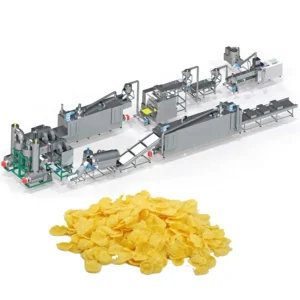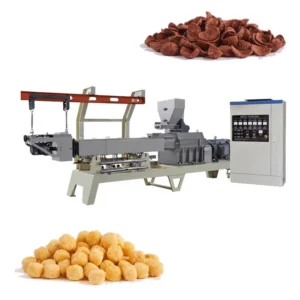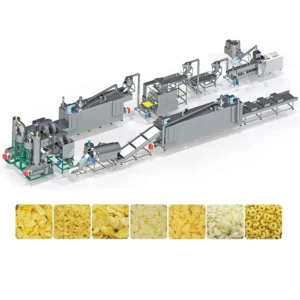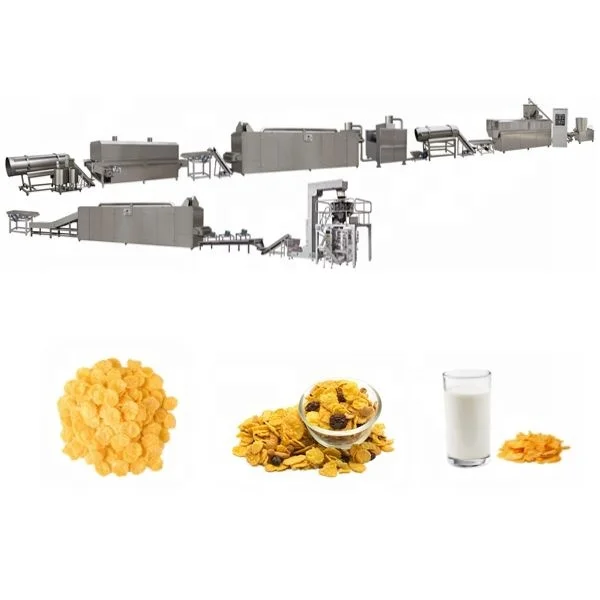
Process-matched throughput — Every station from the mixer through the sugar coating drum is sized against the extruder’s actual output on your grain formulation, preventing the dryer or coater from becoming a hidden bottleneck.
Technical Specifications
| Parameter | Value |
|---|---|
| Model | MT65 / MT70 / MT85 |
| Product Type | Corn Flakes Production Line |
| Screw Type | Twin screw, co-rotating sectional modules |
| Screw Material | Alloy 38CrMoAL, nitriding process |
| Installed Power | MT65 70 kW / MT70 100 kW / MT85 200 kW |
| Real Power Consumption | MT65 40 kW / MT70 70 kW / MT85 150 kW |
| Output Capacity | MT65 100–150 kg/h (basis not stated in source — confirm raw material and moisture) |
| Output Capacity | MT70 200–240 kg/h (basis not stated in source — confirm raw material and moisture) |
| Output Capacity | MT85 300–400 kg/h (basis not stated in source — confirm raw material and moisture) |
| Overall Dimensions | MT65 20000×1200×2200 mm / MT70 25000×1500×2200 mm / MT85 30000×3500×4300 mm |
| Motor | SIEMENS (China) |
| Gearbox | Automatic lubrication function |
| Control System | Delta inverters on feeding, extrusion, and cutting |
| Cutting System | Rotary cutting by V-belt drive, knife fixed on die head seat |
| Dryer Type | Multilayer, stainless steel double-layer mesh belt |
| Dryer Options | 3-layer 5 m / 5-layer 5 m / 5-layer 7 m / 5-layer 8 m / 7-layer 8 m / 5-layer 11 m |
| Dryer Temperature Range | 0–200 °C |
| Corn Flakes Press Power | 16.12 kW |
| Corn Flakes Press Roller Size | 510×310×1050 mm |
| Contact Materials | Food-grade stainless steel |
| Key Features | CE and ISO certified, automatic gearbox lubrication, frequency converter speed regulation |
Application Suitability
| Application | Material or Output |
|---|---|
| Traditional corn flakes production | Maize grits and whole corn meal |
| Multigrain breakfast cereal flakes | Rice, wheat, oat, and rye blends |
| Fortified breakfast cereals | Grain blends with added vitamin and mineral premix |
| Extruded pellet shapes for cereal lines | Round, triangle, square, star, and flower die profiles |
| Sweetened and coated cereal products | Sugar-coated, honey-coated, or chocolate-coated flakes |
Why Nominal Capacity Figures Mislead Corn Flakes Buyers
A capacity number without a raw material basis is a guess, not a specification.
When a corn flakes extrusion machine manufacturer quotes a line at a certain throughput, that figure is often based on ideal conditions — a specific corn grit particle size, a controlled moisture percentage, and a flake thickness that may not match your market’s expectation. I have walked into facilities where the extruder ran fine but the dryer could not keep up, or the flake press choked because the cooked pellet temperature dropped too much during conveying. The corn flakes extrusion machine manufacturer you choose should document exactly what grain formulation, moisture level, and flake thickness the capacity figure assumes. [NEED_CITE: starch gelatinisation temperature and moisture requirements for flake pressing]
Screw Configuration and Barrel Profile for Corn Flake Pellets
Corn flakes demand a specific cooking profile inside the extruder barrel. The twin-screw design on the MT65, MT70, and MT85 uses sectional modules that can be arranged for forward transport, mixing, de-gassing, and forming in distinct zones. This matters because corn grits require thorough starch gelatinisation before the pellet exits the die — undercooked pellets will crack during flake pressing, while overcooked pellets become too sticky to separate cleanly. The 38CrMoAL nitrided alloy screws resist the abrasive wear that maize and coarse grain blends cause over long production runs.
Die Geometry and Flake Press Coordination
The die design determines the shape and cross-section of the extruded pellet before it reaches the corn flakes press machine. For traditional flat corn flakes, a round or oval die opening produces pellets that flatten uniformly under the press rollers. The press itself has an adjustable roller gap — set too tight and the flakes shatter at the edges, set too wide and they lack the crisp snap that breakfast cereal consumers expect. Coordinating die diameter with roller gap and press speed is where many lines fail to hold consistent flake density across an entire shift.
Reading the Power and Dryer Specifications Correctly
The installed power versus real power consumption gap on these models is significant — the MT85 draws from 200 kW installed capacity but typically runs around 150 kW depending on load. This headroom matters during startup surges and when processing higher-moisture formulations. The multilayer dryer offers six configurations ranging from a 3-layer 5 m unit to a 5-layer 11 m unit, and selecting the right one depends entirely on the extruder output rate and the target moisture content of the finished flake. A dryer that is undersized will force the line to slow down regardless of how fast the extruder can run. [NEED_CITE: multilayer belt dryer residence time and moisture removal rates for breakfast cereal]
How Moisture and Shear Define the Final Flake Texture
Inside the twin-screw barrel, moisture content and mechanical shear work together to determine starch gelatinisation degree. Corn flakes require a higher degree of gelatinisation than puffed snacks — typically above a certain threshold that depends on the corn variety and grit particle size. The barrel temperature profile, screw speed, and moisture addition rate must all be tuned as a system. The Delta inverter control on feeding, extrusion, and cutting allows operators to adjust these variables independently and maintain stable conditions once the correct parameters are found.
The Cost of Mismatched Line Stations
When a line is assembled from separate vendors, the extruder supplier guarantees throughput at the die, but nobody guarantees that the downstream dryer, sugar spraying drum, or cooling conveyor can handle that volume. The result is a line that runs at a fraction of its nameplate capacity, with operators constantly adjusting speeds to prevent pile-ups or starved stations. I have seen corn flakes lines where the sugar spraying system roller could not coat flakes fast enough, forcing the entire upstream process to idle. [NEED_CITE: throughput balancing across sequential food processing stations]
Why Source the Complete Line Under One Supplier
Every station on this corn flakes production line — from the mixer through screw conveyor, twin-screw extruder, corn flakes press, high-temperature oven, sugar spraying system, cooling conveyor, sifter, and packing machine — is specified together so that throughput is matched end to end. The screw configuration and die design are selected based on your specific grain formulation and target flake density rather than copied from a generic build. Before shipment, your raw material runs through our in-house testing workshop so parameters are documented before the line reaches your floor. Voltage, frequency, and control language are confirmed against your local electrical standards before production begins. The gearbox features automatic lubrication to extend service intervals under continuous operation.
Documentation & Verification
- Line layout with throughput calculation showing matched capacity at each station
- Screw and die configuration record matched to your grain blend and target flake thickness
- Trial run report on your actual raw material from the in-house testing workshop
- Electrical schematic with confirmed voltage, frequency, and control panel language
- Operation and maintenance manual covering all stations from mixer to packing
- CE declaration of conformity and ISO certificate for the complete line
Installation, Commissioning & Support
- Foundation plan accounts for the MT85’s 30000×3500×4300 mm footprint and dryer length
- Dedicated electrical circuit sized to the line’s real power draw of up to 150 kW on the MT85
- Arrives in modular sections for sequential assembly from mixer through packing station
- First-run commissioning includes screw speed, barrel temperature, and press roller gap calibration
- Operator training covers Delta inverter adjustment on feeding, extrusion, and cutting systems
- Wear parts list specifies 38CrMoAL screw elements and die inserts with reorder codes
What to Share When Requesting a Quotation
To configure the line accurately, we need your target grain formulation — whether you are running pure maize grits, a multigrain blend, or a fortified recipe with added premix. Share your daily production target, available workshop floor space and ceiling height, and local voltage and frequency so we can specify the correct motor and control panel. If you have existing upstream or downstream equipment you plan to integrate, let us know the interface requirements.
Frequently Asked Questions
Q: How is the capacity figure verified for my specific corn flake recipe?
A: Capacity figures listed for the MT65, MT70, and MT85 are based on reference conditions that may differ from your grain blend, moisture level, and flake thickness target. We run your actual raw material in our testing workshop before shipment and document the achievable throughput under your specific formulation and process parameters.
Q: How do you match the screw and die to my grain formulation?
A: The twin-screw configuration uses sectional modules arranged for the gelatinisation profile your grain blend requires. Die opening diameter is selected in relation to the corn flakes press roller gap to produce the flake thickness and density your market expects.
Q: Can I send my raw material for a trial run before the line ships?
A: Yes. Our in-house testing workshop conducts trial runs on your actual grain formulation. We document screw speed, barrel temperature profile, moisture addition rate, and press settings so the line arrives with a known starting parameter set.
Q: What electrical and control details are confirmed before production?
A: We confirm your site voltage, frequency, and preferred control panel language before the electrical schematic is finalized. Delta inverters on the feeding, extrusion, and cutting systems are configured to match your power supply specifications.
Q: How are the dryer and sugar coating drum sized against the extruder?
A: Dryer configuration — from 3-layer 5 m to 5-layer 11 m — is selected based on the extruder output rate and the moisture reduction required. The sugar spraying roller diameter and drum speed are matched so coating capacity does not constrain upstream throughput.