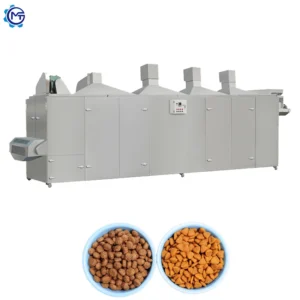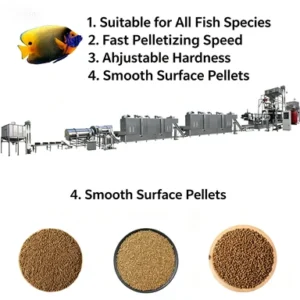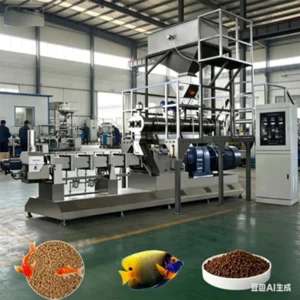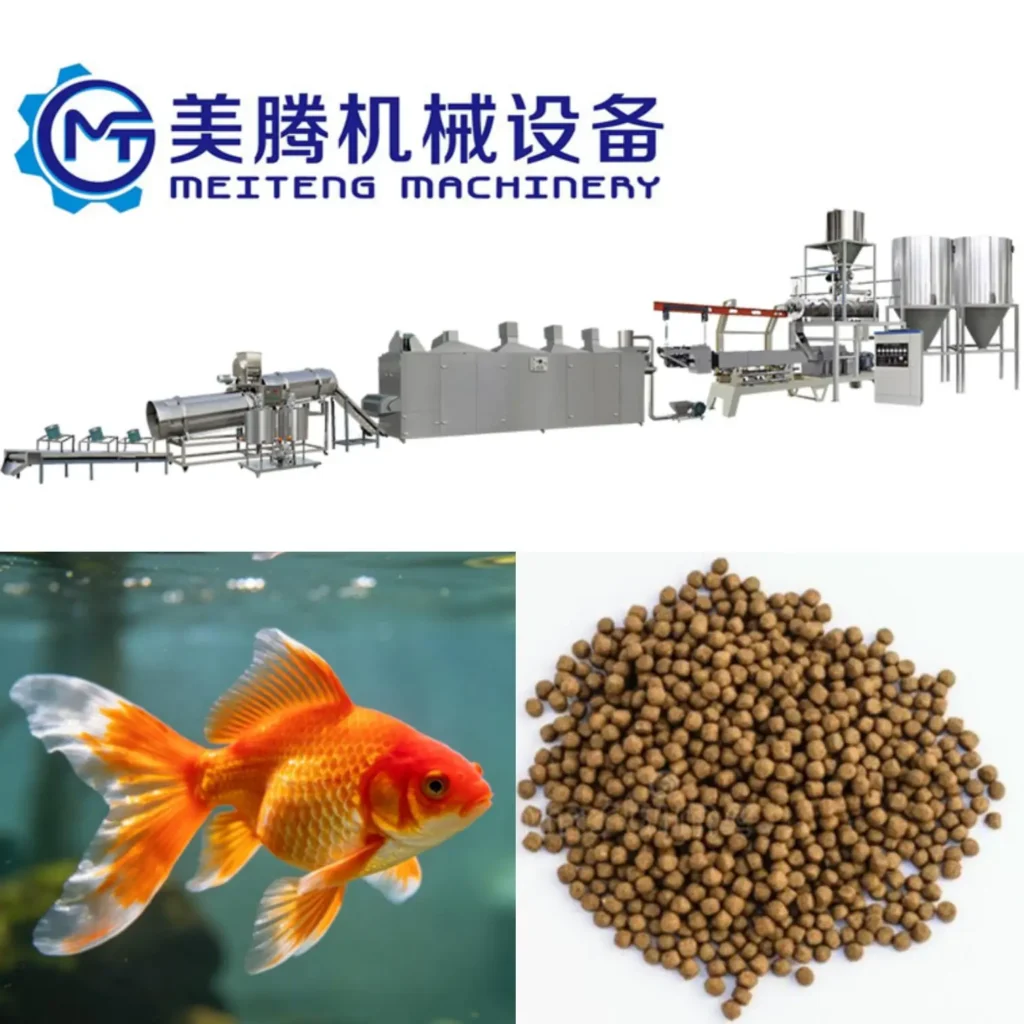
Extrusion profile control — screw geometry and die land length are matched to the buyer’s formulation and target pellet density, ensuring predictable floating or sinking behaviour across species formats.
Technical Specifications
| Parameter | Value |
|---|---|
| Product Type | Twin-Screw Fish Feed Extrusion Line |
| Extruder Type | Twin-screw |
| Contact Material | 304 stainless steel (food-grade wetted surfaces) |
| Output Capacity | Up to 600 kg/h (basis to be confirmed — depends on raw material, moisture content, and pellet size) |
| Target Species | Trout, salmon, catfish, tilapia, shrimp |
| Control System | PLC and MCC control (configuration to be confirmed per market) |
| Voltage & Frequency | Configurable to target market requirement |
| Line Configuration | Complete processing line: mixing, extrusion, drying, coating, packing |
| Certifications | CE, ISO (manufacturer certified) |
Application Suitability
| Application | Material or Output |
|---|---|
| Sinking aquaculture feed | High-density pellets for bottom-feeding species like trout, formulated with fish meal and starch binders |
| Floating aquatic feed | Low-density expanded pellets for surface-feeding catfish and tilapia, requiring high starch gelatinisation |
| Slow-sinking premium feed | Intermediate-density pellets for salmon, balancing expansion control with water stability |
| Multi-species production | Shared raw material base processed through variable screw configurations and die changes |
Why the Screw Profile Dictates the Pellet, Not the Motor Size
Pellet density is an extrusion geometry problem, not a horsepower problem. A motor can force material through a barrel, but the screw flight depth, compression ratio, and shear profile determine whether starch granules rupture and expand, or remain dense and sink. When buyers evaluate a twin-screw fish feed extrusion line based primarily on rated output, they miss the parameter that actually determines market acceptance: does the pellet behave the way the target species expects? [NEED_CITE: extrusion shear and starch gelatinisation mechanisms]
Generic screw builds copied from a standard catalogue will produce floating pellets when sinking feed is required, or vice versa. The barrel temperature profile must work in concert with the screw compression zones to achieve the correct degree of gelatinisation without destroying heat-sensitive nutritional additives. This is where specification sheets fall short — the configuration record tied to your specific raw material formulation is the document that matters.
Shear Zones and Starch Gelatinisation Behaviour
The twin-screw fish feed extrusion line relies on controlled mechanical shear to rupture starch granules within the barrel. Different starch sources — cassava, corn, wheat — require distinct shear profiles to achieve full gelatinisation without degrading protein structures. The screw configuration determines where and how intensely this shear occurs along the barrel length, directly influencing the expansion ratio at the die face.
Die Land Length and Expansion Ratio Control
The die design governs how rapidly the superheated moisture within the extrudate flashes to steam upon atmospheric exposure. Longer die land lengths restrict expansion, producing denser sinking pellets suitable for trout and shrimp. Shorter die lands allow rapid expansion, creating the low-density floating pellets that catfish and tilapia producers require. Switching between formats requires both die changes and corresponding adjustments to the barrel temperature profile. [NEED_CITE: die geometry influence on extrudate expansion]
Reading the Specification Sheet Correctly
The L:D ratio of the barrel determines residence time, which directly affects how completely the raw material cooks before reaching the die. Longer barrels provide more gradual thermal processing, beneficial for formulations with high protein content that can denature under rapid heating. The moisture range and steam or water injection capability dictate the plasticity of the material within the barrel — too dry, and the material fractures rather than flows; too wet, and expansion collapses upon exit. The control system maintains these parameters within tight tolerances across production runs, preventing batch-to-batch density variation that buyers detect immediately upon water testing.
What Happens When Configuration Is Guesswork
When screw and die combinations are selected from generic builds rather than matched to the buyer’s actual formulation, the consequences appear at the pond, not the factory. Sinking feed that floats washes away uneaten and inflates feed conversion ratios. Floating feed that sinks is invisible to surface-feeding species. The production line runs, output numbers are met, but the product fails the only test that matters. Correcting this after shipment requires new screw elements, new dies, and often a complete reassessment of the barrel temperature profile. [NEED_CITE: aquaculture feed conversion ratios and pellet water stability]
Why Configuration Precedes Quotation
Complete processing lines require throughput matching across every station — the extruder output must align with dryer capacity, coating drum residence time, and packing speed. When stations are sourced separately or specified without considering the upstream extrusion profile, bottlenecks emerge that no amount of motor power can resolve. The line layout and capacity calculation must account for the specific pellet format being produced, as floating and sinking feeds have different drying requirements and moisture removal profiles.
Screw configuration and die design are documented against the buyer’s raw material before production begins, not after. Trial runs in the testing workshop confirm that the target density and float/sink behaviour are achieved on the customer’s actual formulation, not a generic substitute. The electrical schematic and voltage confirmation are locked in before manufacturing, preventing commissioning delays caused by mismatched frequency or control language. Food-grade 304 stainless steel contact materials are standard across all wetted surfaces, meeting hygiene requirements for aquatic feed production. Documentation includes the machine specification sheet, screw and die configuration record, and factory test record on the buyer’s raw material — the papers that matter when production begins.
Documentation & Verification
- Line layout and capacity calculation matching throughput across extrusion, drying, and coating stations
- Screw and die configuration record documented against buyer’s specific raw material formulation
- Trial run report confirming target pellet density and float/sink behaviour on customer material
- Electrical schematic with voltage and frequency confirmed for destination market
- Machine specification sheet detailing barrel profile, control configuration, and utility requirements
- Factory test record and packing photographs before dispatch
Installation, Commissioning & Support
- Foundation requirements assessed against line footprint and extruder vibration characteristics
- Dedicated power circuits sized for extruder main drive, dryer heating, and control system loads
- Barrel sections and screw elements assembled on-site with alignment verification
- Initial temperature profile and screw speed parameters set against trial run baseline data
- Operator training covering screw configuration changes and die swaps for different pellet formats
- Wear parts list specifying screw flights, die plates, and barrel liner replacement intervals
What We Need to Configure Your Line
Provide the raw material formulation you intend to process, including starch source and protein content, along with the target pellet diameter and whether floating or sinking behaviour is required for each species format. Specify your local voltage and frequency standards, preferred control language, and available workshop floor space. If you have existing mixing or packing equipment that must integrate with the new extrusion line, share the interface specifications so throughput matching can be calculated accurately.
Frequently Asked Questions
Q: How is the screw configuration specified for different fish species feed formats?
A: The screw profile — flight depth, compression ratio, and shear zone placement — is designed around the buyer’s raw material formulation and target pellet density. Sinking feeds for trout require high compression with restricted expansion, while floating feeds for catfish need shear profiles that maximise starch gelatinisation and expansion at the die. Configuration records are documented per formulation.
Q: How do you verify floating versus sinking behaviour before the line ships?
A: Trial runs are conducted in the testing workshop using the buyer’s actual raw material. Pellets are water-tested to confirm density, float or sink behaviour, and water stability over time. The trial run report documents these results alongside the screw configuration and barrel temperature profile that achieved them, establishing the baseline for commissioning.
Q: Can the same line switch between floating and sinking feed production?
A: Yes, format changeover involves swapping die plates and adjusting the screw configuration elements within the barrel. The barrel temperature profile and moisture parameters are updated accordingly. Changeover time depends on the number of barrel sections and the complexity of the screw rearrangement required for the new pellet format.
Q: What starch gelatinisation degree is achievable across different raw materials?
A: Gelatinisation depends on starch source, barrel temperature profile, moisture content, and shear intensity. Cassava, corn, and wheat starches each respond differently to the same extrusion parameters. The screw configuration and barrel heating zones are adjusted during the trial run to achieve consistent gelatinisation on the buyer’s specific formulation before shipment.