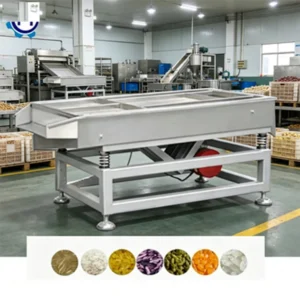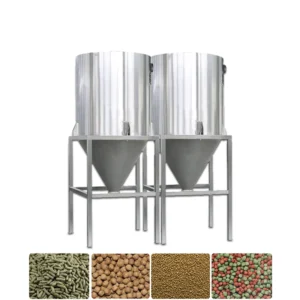
Screw Profile Matched to Formulation — Configuration and die geometry are set only after testing the buyer’s actual aquatic feed raw material in our workshop.
Technical Specifications
| Parameter | Value |
|---|---|
| Product Type | Fish Feed Extrusion Production Line |
| Extruder Type | Twin-screw |
| Output Capacity | 4-5 t/h (basis not stated in source — confirm raw material formulation, moisture content, pellet diameter and density) |
| Contact Material | 304 stainless steel (food-contact parts) |
| Control System | PLC and MCC (configurable) |
| Voltage & Frequency | Configurable to target market standard |
| Certification | CE, ISO |
| Application Scope | Floating and sinking pellets for trout, salmon, catfish, tilapia, shrimp |
Application Suitability
| Application | Material or Output |
|---|---|
| Floating feed for trout and salmon | High-protein formulations requiring controlled expansion and low bulk density |
| Sinking pellets for catfish and tilapia | Dense formulations requiring high shear and complete starch gelatinisation |
| Shrimp feed production | Fine particle formulations needing precise moisture control and uniform pellet size |
| Multi-species facility conversion | Lines replacing single-screw extruders for broader formulation flexibility |
What "4-5 Tons per Hour" Leaves Out on a Twin-Screw Fish Feed Extrusion Line
Output claims collapse when screw configuration is copied from a generic build instead of matched to the buyer’s actual formulation.
I once watched a commissioning team spend weeks on-site because the twin-screw fish feed extrusion line was set up for a standard corn-soy blend, but the buyer ran a high-fishmeal, high-fat recipe. The screws couldn’t generate enough shear, pellets sank when they were supposed to float, and throughput dropped noticeably below the quoted figure. The problem wasn’t the machine — it was that nobody had tested the buyer’s specific raw material before the line shipped [NEED_CITE: common commissioning failures in aquatic feed extrusion].
How Screw Configuration Determines Pellet Floatability
The screw profile inside a twin-screw fish feed extrusion line controls how much mechanical energy transfers into the dough. Forward-flight elements push material through quickly with minimal shear, while reverse-flight and kneading blocks generate intense mixing and heat. For floating pellets, the configuration must create enough expansion at the die face to trap air pockets inside each pellet. Sinking pellets require the opposite: a tighter screw arrangement that compresses the material and drives out voids before it exits the die.
Barrel Temperature Zones and Starch Gelatinisation
Each barrel section has independent heating and cooling, creating a temperature gradient that the operator adjusts based on the formulation. Starch gelatinisation typically requires the material to reach a specific temperature range while under pressure inside the barrel. If the profile is too cool, the starch remains raw and the pellet crumbles in water. Too hot, and proteins denature before expansion occurs. Getting this right means running the buyer’s exact raw material through the extruder during pre-shipment trials [NEED_CITE: starch gelatinisation temperature ranges in aquaculture feed processing].
Reading the Specification Sheet Against Your Formulation
The L:D ratio determines how long material stays inside the barrel. A longer barrel gives more residence time, which helps when processing high-moisture or high-protein formulations that need extended cooking. Die configuration — the number of holes, their diameter, and the land length — directly sets pellet size and density. Moisture range specifications tell you whether the extruder can handle your recipe without pre-conditioning adjustments. Control system options, whether PLC or MCC, affect how precisely operators can maintain barrel zone temperatures and screw speed across production shifts.
The Hidden Cost of Skipping Pre-Shipment Trials
When a twin-screw fish feed extrusion line ships without running the buyer’s raw material first, all the parameter tuning happens on the factory floor after installation. That means paying for engineer travel, burning raw material during test runs, and delaying production start while the screw combination and barrel zones are reconfigured. In some cases, the die plate itself needs replacement because the original hole pattern produces the wrong pellet diameter for the target species. All of this is avoidable if the line is tested with the actual formulation before crating [NEED_CITE: cost of post-installation commissioning delays in feed processing].
Why Buyers Specify This Line for Aquatic Feed Projects
The twin-screw fish feed extrusion line is configured as a complete system from mixing through packing, so throughput at each station is matched rather than assembled from separate vendors who optimise independently. Screw and die combinations are selected based on the buyer’s raw material analysis and target pellet specification, not pulled from a standard catalogue. An in-house testing workshop runs the buyer’s formulation before shipment, generating a trial report that confirms pellet density, expansion ratio, and floatability. The 304 stainless steel construction across food-contact surfaces meets hygiene requirements for export markets with strict contamination standards [NEED_CITE: food-grade material requirements for aquaculture feed equipment].
Documentation & Verification
- Screw and die configuration record matched to your aquatic feed formulation and target pellet density
- Trial run report on your raw material confirming floatability and expansion before shipment
- Electrical schematic and voltage confirmation aligned to your facility’s power supply standard
- Line layout drawing showing throughput matching across mixing, extrusion, drying, coating, and packing stations
- CE declaration of conformity and ISO certificate for market entry documentation
Installation, Commissioning & Support
- Foundation requirements based on extruder weight and vibration characteristics at rated screw speed
- Dedicated power circuit sized to the main drive motor and barrel heating zones
- Barrel and screw assembly verification on-site after transit to confirm alignment
- First-run parameter setting using the pre-shipment trial report as baseline
- Operator training on barrel zone adjustment and die changeover procedures
- Wear parts list covering screws, barrel liners, and die plates with replacement intervals
What We Need to Configure Your Line
To specify the screw profile, die geometry, and downstream station sizing, we need your raw material formulation including protein, fat, and starch percentages along with target moisture content. Confirm the pellet diameter range and whether you need floating, sinking, or both formats. Provide your facility voltage and frequency, control language preference, and available floor space for line layout planning.
Frequently Asked Questions
Q: How is screw and die configuration determined for floating versus sinking fish feed pellets?
A: Floating pellets require a screw profile that generates high expansion at the die face, using kneading blocks to build pressure and then releasing it suddenly through a specific die geometry. Sinking pellets use tighter screw arrangements that compress material and reduce voids. The configuration is set after testing your raw material to confirm pellet density meets the target species specification.
Q: What barrel temperature profile and moisture settings are needed for different raw material formulations?
A: High-protein formulations typically need lower barrel temperatures to prevent protein denaturation before expansion, while high-starch recipes require higher temperatures for complete gelatinisation. Moisture content entering the extruder affects how much steam generation occurs inside the barrel. These parameters are established during pre-shipment trials on your specific formulation rather than assumed from generic references.
Q: Can a trial run be done on my raw material before the line ships?
A: Yes, the testing workshop runs your actual formulation through the extruder with the configured screw and die setup. The trial generates a report documenting pellet density, expansion ratio, floatability, and throughput under your specific conditions. This eliminates guesswork during on-site commissioning and confirms the line will produce to specification from the first production shift.
Q: How is starch gelatinisation and expansion controlled to hit the target pellet density?
A: Barrel zone temperatures, screw speed, and moisture content together determine how completely starch granules rupture and absorb water inside the extruder. The die geometry then controls how much the material expands when pressure drops at the exit. Adjusting these variables during the trial run establishes the parameter window that produces consistent pellet density across production batches.
Q: What downstream stations are matched to the extruder throughput to avoid bottlenecks?
A: The dryer capacity, coating drum volume, cooler conveyor length, and packing speed are all calculated based on the extruder output rate and the pellet characteristics. If any station is undersized, it restricts the entire line. The layout proposal confirms throughput matching across every station so the extruder can run at its rated capacity without material backing up downstream.