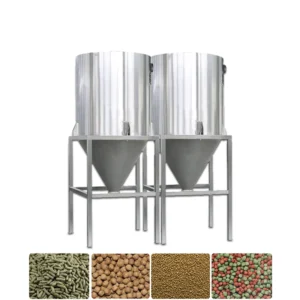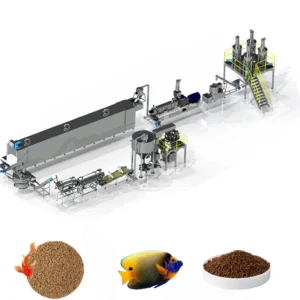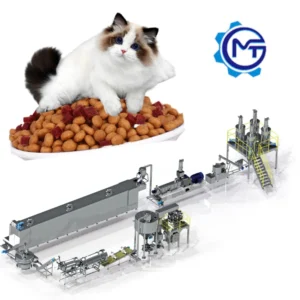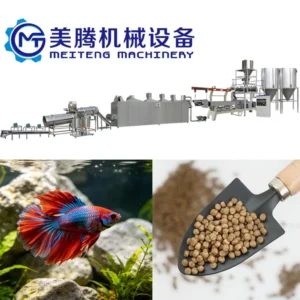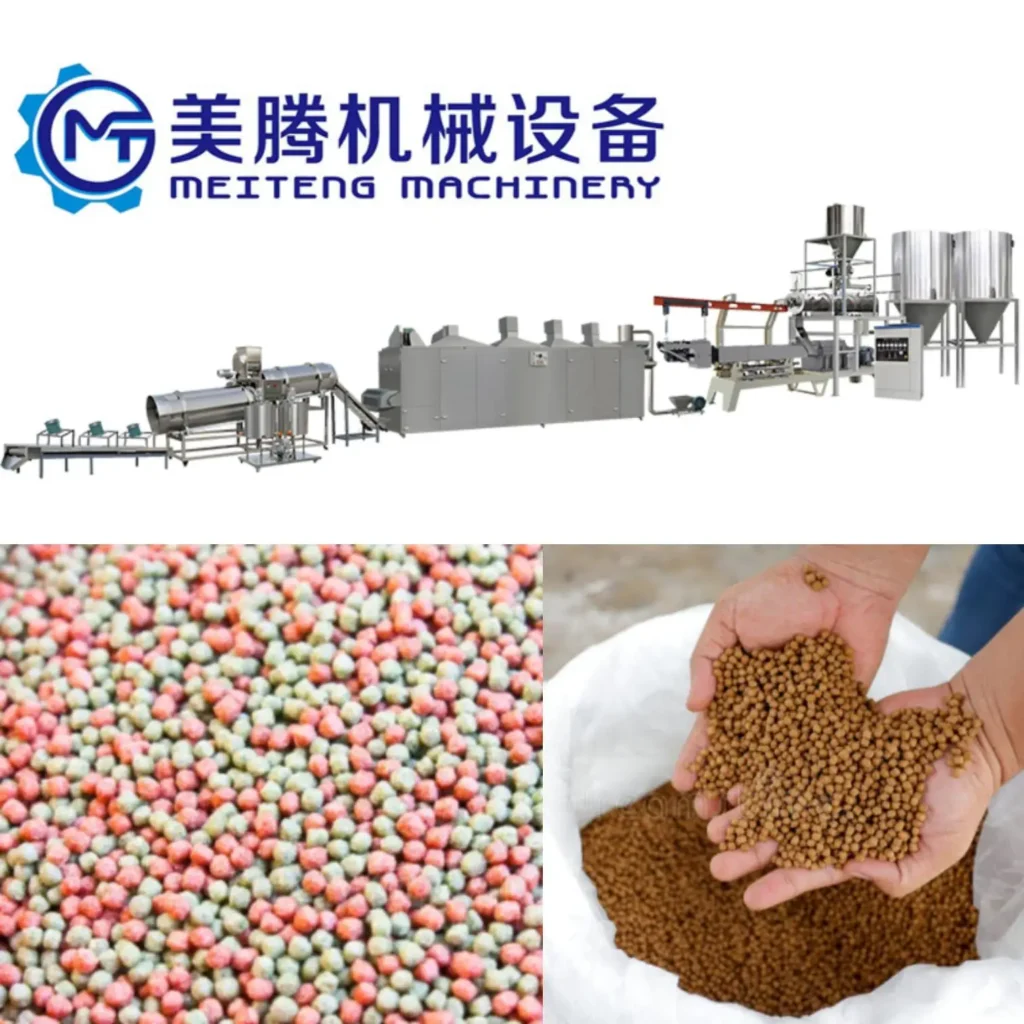
Precision-Matched Extrusion Parameters — screw configuration and die design are specified to the buyer’s actual raw material and target pellet density, not copied from a generic build.
Technical Specifications
| Parameter | Value |
|---|---|
| Product Type | Twin-Screw Fish Feed Extrusion Line |
| Output Capacity | Up to 3 t/h (basis not stated in source — confirm raw material formulation, moisture content and pellet diameter) |
| Screw Type | Twin-screw |
| Construction Material | 304 stainless steel (food-grade contact parts) |
| Control System | PLC and MCC (per company standard, verify per quotation) |
| Line Stations | Batching → Extrusion → Drying → Coating/Seasoning → Cooling → Packing |
| Die Configuration | Matched to target pellet size and density (floating or sinking, per species requirement) |
| Screw Configuration | Specified to buyer’s raw material and target product |
| Target Species | Trout, salmon, catfish |
| Certification | CE, ISO |
| Assembly State | Complete line, throughput matched across stations |
| Trial Run | In-house testing workshop on customer raw material before shipment |
Application Suitability
| Application | Material or Output |
|---|---|
| Floating feed for trout and salmon | High-protein formulations with fishmeal, soy protein concentrate and starch binders |
| Sinking pellets for catfish | Corn-based and grain-heavy formulations with moderate protein content |
| Multi-species feed mill expansion | Switching between floating and sinking formats on a single line via screw and die reconfiguration |
| High-capacity aquaculture feed production | Continuous output for commercial hatchery and grow-out operations |
Why Pellet Density Drifts Outside Market Specification
Floating feed sinks, or sinking pellets drift — and the root cause is almost always an extrusion configuration that was never matched to the actual raw material.
Buyers often receive a twin-screw fish feed extrusion line technology package quoted on a nominal capacity, only to find that their local fishmeal has a different fat content or particle size than the supplier’s trial batch. The pellets look correct at the die face but crumble at the dryer inlet or fail the float test after packing. I have seen entire production runs scrapped because the screw configuration was copied from a standard build rather than adjusted for the buyer’s specific formulation [NEED_CITE: raw material variability in aquaculture feed production]. The twin-screw fish feed extrusion line technology must be configured around the raw material, not the other way around.
Barrel Temperature Profile and Starch Gelatinisation
The degree of starch gelatinisation inside the barrel determines whether the pellet expands enough to float or remains dense enough to sink. A twin-screw fish feed extrusion line technology setup with independently controlled barrel heating zones allows the operator to set a precise temperature gradient — typically starting lower at the feed inlet and rising toward the die. This controls the point at which starch granules rupture and absorb moisture, which directly governs the expansion ratio of the pellet as it exits the die.
Screw Configuration as the Primary Control Variable
Screw element arrangement — the sequence of conveying, kneading and reverse-screw elements — defines the shear intensity and residence time inside the barrel. For a high-fat trout formulation, excessive shear can cause lipid separation and surface oiliness, while too little shear leaves starch under-gelatinised and the pellet fragile. The configuration must be specified after reviewing the buyer’s exact formulation, including fat percentage, protein source and particle mesh [NEED_CITE: screw element arrangement and shear control in twin-screw extrusion]. This is the step most generic quotations skip.
Reading the Parameter Sheet Beyond Nominal Capacity
The output capacity figure quoted for this line requires confirmation against the buyer’s raw material formulation, moisture content and target pellet diameter — these three variables together determine actual throughput. The PLC and MCC control architecture provides the operator with real-time feedback on barrel temperature, screw speed and feeder rate, which is essential for maintaining batch-to-batch consistency when switching between floating and sinking formats. The 304 stainless steel contact surfaces meet food-grade requirements and resist corrosion from the high-moisture, high-salt environment typical of aquaculture feed production. The die configuration record should show the exact orifice diameter and land length selected for the buyer’s target species, as these dimensions govern pellet cut length and surface density.
The Hidden Cost of Skipping the Trial Run
When a supplier ships an extrusion line without running the buyer’s actual raw material through the testing workshop, the first weeks of production become an expensive experiment. Screw configurations that worked on the supplier’s test formulation may produce pellets with the wrong water stability, causing them to disintegrate before fish can consume them. The dryer may be undersized for the moisture content of the actual extrudate, creating a bottleneck that forces the extruder to run below capacity [NEED_CITE: throughput bottleneck between extruder and dryer in feed lines]. These problems are not visible in a factory acceptance test that uses generic corn starch.
Why This Line Is Engineered Differently
Complete throughput matching from batching through extrusion to packing means no single station creates a bottleneck — the dryer, coating drum and cooler are all sized to the extruder’s actual output on the buyer’s formulation. Screw and die configurations are specified after reviewing the buyer’s raw material data sheet, not pulled from a catalogue. The in-house testing workshop runs trial batches on the buyer’s actual material before shipment, so product development begins before installation rather than after. The PLC control system stores recipes for different species and feed formats, allowing changeover between floating and sinking production with documented parameter sets. CE and ISO certification covers the full line assembly, not just individual machines.
Documentation & Verification
- Screw and die configuration record matched to your raw material formulation and target pellet density
- Trial run report produced on your actual raw material in the testing workshop before shipment
- Line layout showing throughput calculation across every station from batching to packing
- Electrical schematic with voltage, frequency and control language confirmed before production begins
- Factory test record documenting barrel temperature profile and pellet density measurements at each zone
Installation, Commissioning & Support
- Foundation and floor space planning based on the full line footprint from batching silos to packing station
- Power supply review confirming voltage, frequency and dedicated circuit capacity for the extruder main drive and dryer heating
- Mechanical assembly and alignment of twin-screw barrel sections with torque verification on all flange bolts
- First-run commissioning with parameter logging across barrel zones, screw speed and feeder rate for your formulation
- Operator training covering recipe selection on the PLC, screw element inspection and die changeover procedure
- Wear parts list specifying screw elements, barrel liners and die plates with recommended replacement intervals
Preparing Your Inquiry
To receive a line configuration that reflects your actual production requirements, provide the raw material formulation including protein source, fat percentage and starch type, along with the target pellet diameter and whether you need floating or sinking output. Confirm your local voltage, frequency and the control language your operators will use. If you have existing upstream or downstream equipment that must integrate with the new line, share the interface specifications so the layout accounts for those connection points.
Frequently Asked Questions
Q: How is screw configuration chosen for different fish species and feed formulations?
A: The screw element sequence is selected based on the protein-to-starch ratio, fat content and particle size of your raw mix. High-protein formulations for trout require lower shear to prevent lipid separation, while grain-heavy catfish feeds need more kneading elements for complete gelatinisation. The configuration record documents every element position and is validated during the pre-shipment trial run on your material.
Q: What determines whether the pellet floats or sinks during extrusion?
A: Floatability is controlled by the expansion ratio at the die exit, which depends on barrel temperature, moisture content and the degree of starch gelatinisation achieved inside the barrel. Higher expansion produces lower-density floating pellets; restricting expansion through screw configuration and die land length yields sinking pellets. Both formats can be produced on the same line by changing screw elements and die plates.
Q: How is barrel temperature set for different starch and protein ratios?
A: Each barrel heating zone is set independently to create a temperature profile that matches the thermal behaviour of your formulation. High-starch mixes require a gradual temperature rise to allow full gelatinisation before the die, while high-protein formulations may need lower peak temperatures to prevent protein denaturation and pellet shrinkage. The PLC stores these profiles as named recipes.
Q: Can the same line produce both floating and sinking feed?
A: Yes, by reconfiguring the screw element arrangement and installing a different die plate. Floating feed requires a screw profile that generates higher shear and expansion, while sinking feed uses more conveying elements and a die with longer land length. The PLC recipe function stores the parameter set for each format, reducing changeover time and operator error.
Q: What moisture and shear levels are needed for proper gelatinisation?
A: Typical aquaculture feed formulations require preconditioning moisture between 22% and 28%, with shear intensity governed by the kneading block arrangement inside the barrel. Insufficient moisture leaves starch granules intact, producing brittle pellets; excessive moisture reduces expansion and increases dryer load. The pre-shipment trial run establishes the correct moisture window for your specific raw material.