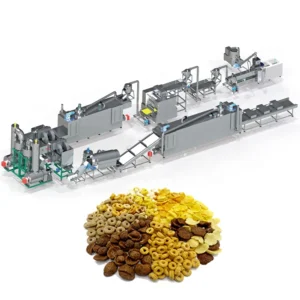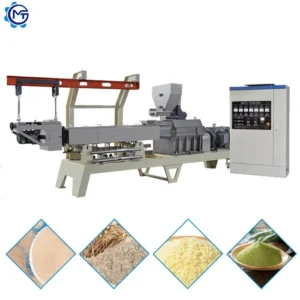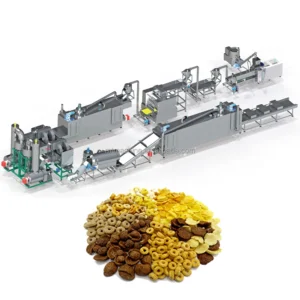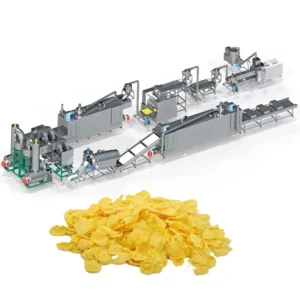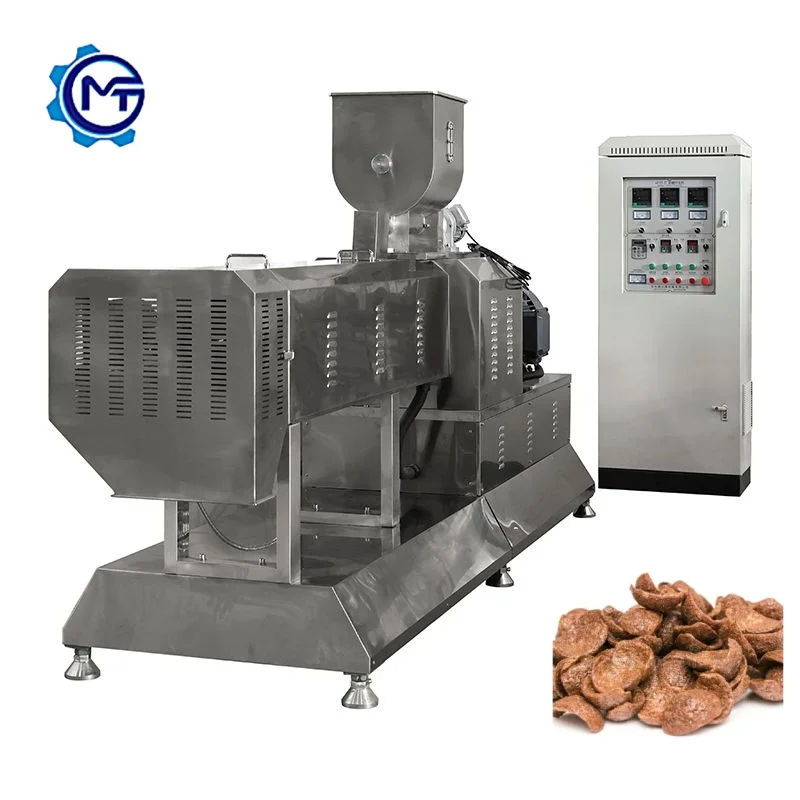
Screw Configuration Matched to Formulation — Trial runs on customer grain blends validate barrel profiles and die geometry before the line ships, preventing gelatinisation failures at startup.
Technical Specifications
| Parameter | Value |
|---|---|
| Product Type | Corn Flakes and Breakfast Cereal Extrusion Production Line |
| Model Options | MT70 / MT75 / MT85 |
| Screw Configuration | Twin-screw with automatic lubrication and cooling |
| Installed Power (MT70) | 160 kW |
| Installed Power (MT75) | 210 kW |
| Installed Power (MT85) | 190 kW |
| Power Consumption (MT70) | 120 kW |
| Power Consumption (MT75) | 150 kW |
| Power Consumption (MT85) | 140 kW |
| Output Capacity (MT70) | 150–200 kg/h (basis to be confirmed) |
| Output Capacity (MT75) | 300–500 kg/h (basis to be confirmed) |
| Output Capacity (MT85) | 300–400 kg/h (basis to be confirmed) |
| Overall Dimensions (MT70) | 41 × 1.5 × 2.2 m |
| Overall Dimensions (MT75) | 45 × 1.5 × 3.5 m |
| Overall Dimensions (MT85) | 43 × 1.5 × 3.2 m |
| Control System | PLC and MCC |
| Flaking Station | Hydraulic double-roller with infrared temperature sensor |
| Dryer Heating Source | Gas / Electric / Steam (multi-fuel option) |
| Roasting Oven | Hot air with dual circulating fans and cyclone dust removal |
| Basic Materials | Corn, rice, wheat, oat, barley powder |
| Certification | CE, ISO |
Application Suitability
| Application | Material or Output |
|---|---|
| Natural corn flakes production | Corn grits and corn flour blends |
| Sugar-coated breakfast cereals | Corn, wheat and oat base with syrup coating |
| Shaped cereal snacks (rings, stars, loops) | Multi-grain formulations via extruder die changes |
| Cocoa-flavoured puffed cereals | High-fat whole corn flour and cocoa powder blends |
| Fortified grain flakes | Rice, barley and oat powder with nutritional additives |
What "300–500 kg/h" Actually Means on Your Grain Blend
A capacity rating detached from raw material moisture, fat content and starch composition is not a capacity rating — it is a guess.
I have stood next to corn flakes extrusion lines where the nameplate promised a throughput the machine could never sustain once the buyer’s actual grain formulation hit the barrel. On one cocoa flour puffed cereal project, we ran the pre-shipment trial with standard corn grits and the flakes came off the die perfectly. Then the customer’s high-fat whole corn flour arrived. The barrel temperature profile collapsed — under-gelatinised mass, zero expansion, die pressure spiking toward the safety limit. We tore down the screw configuration, reprofiled the heating zones and ran the line for three straight days before the output matched what the buyer’s market expected. That experience is why corn flakes extrusion production line specifications must always state the raw material assumption behind every throughput number [NEED_CITE: starch gelatinisation temperature ranges for different grain formulations].
Barrel Temperature Profiling Across Grain Varieties
Every grain carries its own gelatinisation window. Corn grits typically gelatinise between 150°C and 170°C under shear, while oat-heavy blends demand lower barrel temperatures to prevent scorching before the material reaches the die. The twin-screw extruder on this line divides the barrel into independently heated zones, allowing process engineers to build a gradient — gentle hydration in the feed section, controlled shear in the mixing section, then precise melt temperature at the die face. Getting that gradient wrong means the extrudate leaves the die either under-expanded or degraded, and no downstream roaster can correct a poorly gelatinised pellet.
Die Geometry and Flake Density Control
The die opening diameter, land length and number of orifices together determine the extrudate strand diameter and internal pressure at the moment of exit. For corn flakes destined for the flaking rollers, the die must produce a strand that will compress into a flake of target thickness without cracking or laminating. Multi-grain blends behave differently at the die face — higher fibre content from oat or barley shortens the land length requirement, while pure corn formulations tolerate longer lands for denser strands. The screw configuration record and die design sheet for this line are specified to the buyer’s actual formulation, not pulled from a generic build [NEED_CITE: twin-screw extrusion die design parameters for breakfast cereal applications].
Reading the Specification Sheet Beyond Installed Power
Installed power tells you the motor capacity; power consumption tells you what the meter will actually register during production. On the MT75 model, installed power sits at 210 kW while typical consumption runs at 150 kW — the gap reflects the startup torque requirement and the headroom needed when high-viscosity formulations increase barrel resistance. The flaking station uses a hydraulic double-roller system with separate motors driving each roller, which prevents the common failure of one roller stalling under uneven feed. The roasting oven relies on a conciliation burner with dual circulating fans to distribute hot air evenly across the vibrating pan, and the cyclone dust removal device captures fines before they can scorch on the heating elements. PLC and MCC control ties these stations together so that parameter changes at the extruder propagate through drying and roasting without manual recalculation.
The Hidden Cost of a Generic Screw Build
A screw configuration copied from a previous customer’s corn grits line will fail when your formulation includes high-fat cocoa powder, rice bran or whey protein concentrate. The failure does not announce itself on day one — it shows up as inconsistent flake density, a roaster that cannot achieve target moisture, or a sugar coating drum that produces clumped output because the flake surface texture is wrong. I have seen lines where the buyer spent weeks chasing the problem through dryer temperature adjustments and roaster airflow changes before realising the extruder screw profile was the root cause. Every adjustment downstream of a mismatched screw is a compromise, and compromises in breakfast cereal production become visible on the supermarket shelf [NEED_CITE: effect of screw element arrangement on extrudate expansion and density].
Why Source This Line From Meiteng
Complete throughput matching across every station — extruder, flaking rollers, dryer and roaster — is calculated against your target output rather than assembled from independent vendor ratings. Screw configuration and die design are selected specifically for your grain blend and target flake density, documented in a configuration record that ships with the machine. The in-house testing workshop runs your actual raw material before dispatch, producing a trial report that becomes the baseline for commissioning parameters on your factory floor. Pre-sales engineering covers line layout and utility planning, and on-site installation includes operator training on PLC parameter adjustment and screw changeover procedures.
Documentation & Verification
- Line layout and capacity calculation matched to your target throughput across all stations
- Screw and die configuration record specific to your grain formulation
- Trial run report on your actual raw material from the in-house testing workshop
- Electrical schematic with voltage and frequency confirmation for your facility
- Operation and maintenance manual with wear parts identification list
Installation, Commissioning & Support
- Foundation planning accounts for the 45-metre line length and vibrating roaster pan load
- Dedicated power circuit sized for MT75 peak draw at 210 kW installed capacity
- Hydraulic flaking station arrives pre-assembled with roller alignment verified at factory
- PLC language and HMI labels confirmed to your operator requirements before shipment
- Screw element and die wear parts list provided with recommended replacement intervals
- Commissioning includes barrel temperature profiling on your grain blend at production speed
Preparing Your Inquiry
To configure the correct model and screw build, we need your primary grain formulation with moisture and fat percentages, target flake thickness and density, and daily production volume. Confirm your facility voltage, frequency and available heating fuel for the dryer and roaster. If you plan to run multiple product formats, indicate which die shapes you require and whether the sugar coating station is needed for your product range.
Frequently Asked Questions
Q: How is output capacity verified against my raw material?
A: Capacity ratings for each model assume specific moisture and starch conditions that vary by grain type. We run your actual formulation through the in-house testing workshop and document throughput, barrel temperatures and die pressure in a trial report. That report becomes the reference for your production parameters at commissioning.
Q: How are screw elements selected for multi-grain blends?
A: Screw configuration is built from your formulation’s fibre, fat and starch ratios. High-fibre blends like oat-heavy recipes require different kneading block arrangements than pure corn grits. We record the element sequence and die land length in a configuration sheet so replacement parts match the original build.
Q: What barrel temperature profile produces correct corn flake expansion?
A: The barrel is divided into heating zones that progress from hydration to melt temperature. For corn grits, the profile typically peaks near the die face to achieve full starch gelatinisation without premature flashing. The PLC stores this profile as a recipe that operators can recall for each product variant.
Q: How is roaster capacity matched to extruder throughput?
A: The roasting oven is sized so that residence time on the vibrating pan achieves target moisture reduction at the extruder’s rated output. Undersized roasters force slower line speed and reduce actual throughput below the extruder’s capacity. We calculate this match during line layout design.
Q: What does the pre-shipment trial run cover?
A: The trial processes your raw material through the extruder at target throughput, recording barrel temperatures, screw speed, die pressure and extrudate density. Flaking and roasting parameters are also captured. The resulting report defines the starting point for on-site commissioning and operator training.