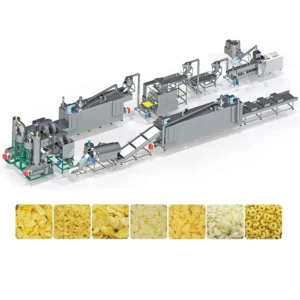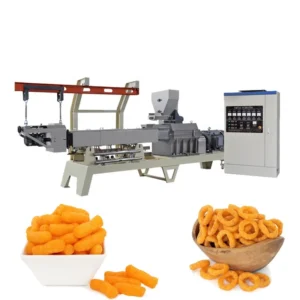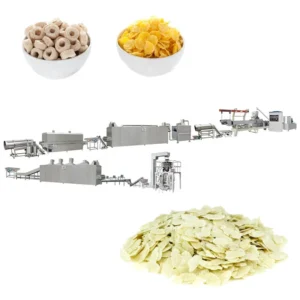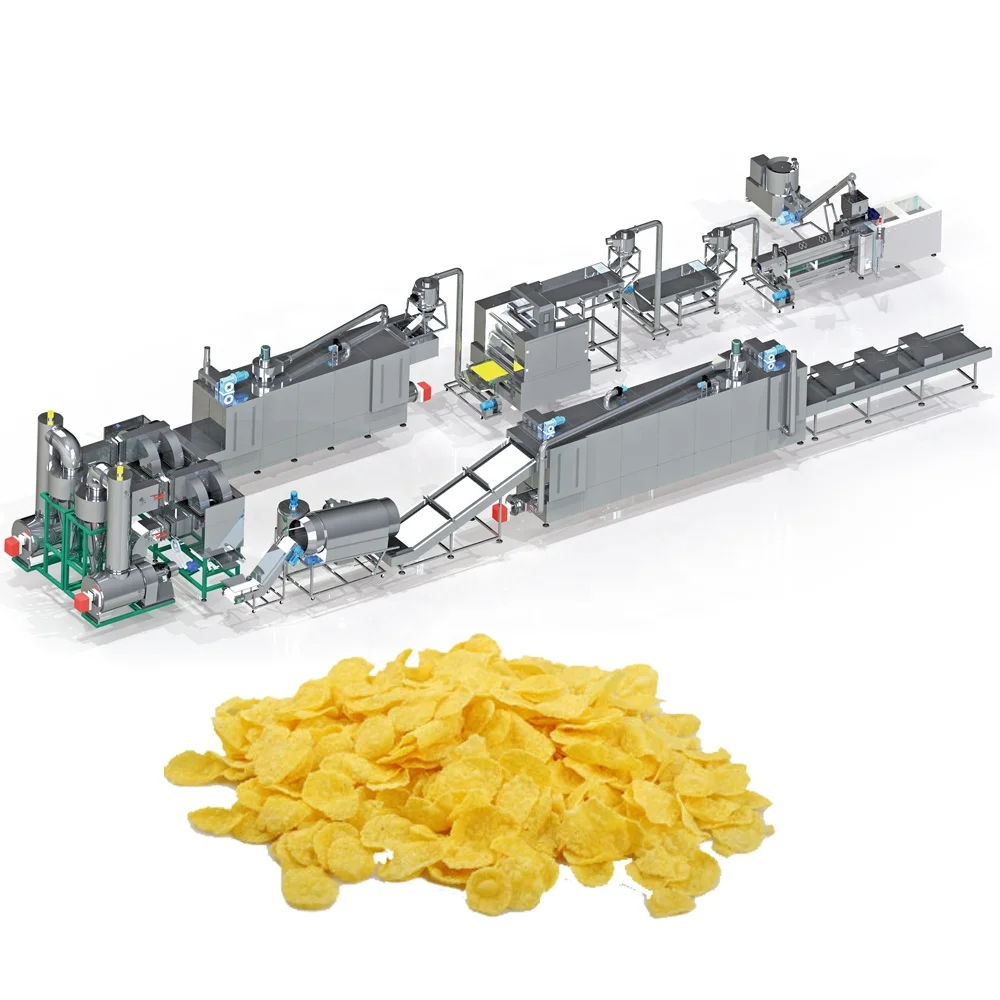
Precision-Matched Extrusion Engineering — Every screw configuration, die geometry, and barrel temperature profile is specified against your actual corn flour formulation to guarantee target flake density before the line ships.
Technical Specifications
| Parameter | Value |
|---|---|
| Model | MT70 / MT85 / MT75 |
| Product Type | Corn Flakes Processing Line / Breakfast Cereal Extrusion Line |
| Screw Type | Twin-screw |
| Installed Power | MT70: 160 kW / MT85: 190 kW / MT75: 210 kW |
| Power Consumption | MT70: 120 kW / MT85: 140 kW / MT75: 150 kW |
| Capacity | MT70: 150–200 kg/h (basis to be confirmed); MT85: 300–400 kg/h (basis to be confirmed); MT75: 300–500 kg/h (basis to be confirmed) |
| Line Dimensions (L×W×H) | MT70: 41×1.5×2.2 m / MT85: 43×1.5×3.2 m / MT75: 45×1.5×3.5 m |
| Voltage | 380V / 220V (frequency to be confirmed) |
| Control System | PLC (flaking station); overall line architecture confirmed per project |
| Contact Material | Stainless steel (food-grade) |
| Flaking System | Hydraulic double-roller, dual-motor drive, infrared temperature control |
| Dryer Heating Source | Gas or electric (selectable) |
| Roasting Oven | Vibrating pan, high-temperature spray tubes, separate circulating fans, cyclone dust removal |
| Coating System | Double tumble sugar melting, elevator, coating drum, spray nozzle |
| Extruder Features | Automatic lubrication and cooling, wear-resistant screw treatment |
| Certification | CE, ISO |
| Warranty | 1 year (machine and core components) |
Application Suitability
| Application | Material or Output |
|---|---|
| Natural corn flakes production | Corn flour, corn grits |
| Sugar-coated breakfast flakes | Corn, rice, wheat, oat, barley powder blends |
| Shaped cereal formats (rings, balls, stars, tubes, fruit loops) | Multi-grain formulations via interchangeable dies |
| Fortified breakfast cereals | Grain blends with added vitamin and mineral premixes |
| High-fiber and whole-grain flakes | Oat and barley-based raw materials |
What "Nominal Output" Really Means for Corn Flakes
A corn flakes extrusion line quoted at a fixed hourly tonnage without specifying the raw material moisture, granulation, and starch composition is a line that will underperform the moment your specific formulation enters the barrel.
Capacity is a function of formulation, not a sticker on the nameplate.
Breakfast cereal producers routinely discover that a line rated at a certain throughput on one corn variety drops significantly when switching to a different supplier’s flour or adjusting moisture for a crispier texture. The extruder screw speed, barrel temperature profile, and die back-pressure all shift with raw material behaviour. [NEED_CITE: starch gelatinisation behaviour across different corn varieties and moisture levels] When these variables are not mapped before the machine is built, commissioning becomes an expensive exercise in trial and error on your factory floor rather than a controlled start-up.
How Screw Configuration Controls Flake Texture
The twin-screw extruder at the heart of this line is configured with screw elements selected for the specific starch gelatinisation window of your raw material. Corn flour behaves differently from rice or oat blends under shear and heat, and the arrangement of conveying, kneading, and reverse elements determines residence time and melt temperature. A corn flakes extrusion line technology approach that ignores this matching step produces flakes that either shatter during roasting or remain dense and chewy.
Barrel Temperature Profiling and Moisture Management
Each barrel zone along the extruder is independently heated and monitored, allowing the operator to build a temperature gradient that controls how completely the starch granules break down. Too aggressive a profile causes premature expansion inside the barrel; too gentle a profile leaves ungelatinised cores that produce hard, uneven flakes. The moisture injection rate works in tandem with barrel heat, and both are tuned during the pre-shipment trial run against your actual material. [NEED_CITE: relationship between barrel zone temperature and degree of starch gelatinisation in twin-screw extrusion]
Reading the Specs That Actually Matter
Installed power across the three models ranges from 160 kW to 210 kW, with operating consumption between 120 kW and 150 kW. The gap between installed and consumed power reflects the torque reserve available when the extruder encounters a denser batch or a higher-fibre formulation — a line that runs close to its installed ceiling has no headroom for formulation changes. The hydraulic double-roller flaking station uses dual motors for independent roller drive, which maintains uniform gap pressure even as roller surfaces wear over time. The infrared temperature sensor on the flaking machinery monitors the sheet temperature in real time, preventing the dough from cooling below the threshold where it becomes brittle before pressing. The hot air roasting oven employs separate circulating fans and a cyclone dust collection system, giving precise control over the surface blistering that defines a quality corn flake’s appearance and crunch.
When the Dryer Becomes the Bottleneck
An extruder that runs ahead of the dryer’s evaporation capacity forces the entire line to slow down, and producers who specify extrusion throughput without matching downstream drying and roasting capacity discover this constraint during the first week of production. [NEED_CITE: throughput imbalance between extrusion and drying stages in cereal processing lines] The consequence is not merely lower output — inconsistent moisture entering the roasting oven produces flakes with variable colour and texture across the same batch, leading to sorting losses and customer complaints about product uniformity.
Why Source the Complete Line Here
Throughput matching across every station — from the batching mixer through extrusion, flaking, drying, roasting, coating, and packing — is calculated before the layout is drawn, so no single machine dictates the line speed. Screw configuration and die geometry are documented against your raw material sample and target flake specification, not pulled from a generic template. The in-house testing workshop runs your actual formulation through the extruder before the line ships, producing a trial report that confirms texture, density, and expansion. Voltage, frequency, and control language are verified against your facility’s electrical infrastructure before production begins. Pre-sales engineering covers layout design, utility planning, and phased installation scheduling so that commissioning proceeds without on-site surprises.
Documentation & Verification
- Line layout and capacity calculation matched to your factory footprint and utility supply
- Screw and die configuration record documenting the element arrangement selected for your formulation
- Trial run report generated on your raw material in the testing workshop before dispatch
- Electrical schematic with voltage and frequency confirmation for your local grid standard
- CE declaration of conformity and ISO certificate included with shipment documentation
- Operation and maintenance manual with wear parts list specific to your line configuration
Installation, Commissioning & Support
- Foundation and floor space planning based on the selected model’s line dimensions up to 45×1.5×3.5 m
- Dedicated electrical circuit sizing confirmed against the line’s installed power requirement up to 210 kW
- Modular station delivery allowing phased assembly where ceiling height or access doors limit full-line movement
- On-site extruder parameter tuning including screw speed, barrel zone temperatures, and moisture injection rate
- Operator training covering PLC interface navigation on the flaking station and roasting oven controls
- Wear parts supply programme covering screws, dies, and flaking roller surfaces for the first replacement cycle
Starting Your Line Specification
To move from an initial enquiry to a detailed proposal, the most useful information includes your primary raw material type and moisture range, the target flake format and density, your daily production volume, and the available floor space with ceiling height in your facility. Voltage and frequency at your site, preferred PLC control language, and whether you need the natural or sugar-coated configuration will determine the electrical and downstream equipment specification. If you can provide a raw material sample, a trial run in the testing workshop will confirm the screw configuration before the quotation is finalised.
Frequently Asked Questions
Q: How is output capacity verified against my specific raw material and moisture content?
A: Before the line ships, your raw material sample is processed through the extruder in the testing workshop. The trial run measures actual throughput, flake density, and expansion at your target moisture level. The resulting report documents the verified capacity so that the quoted output reflects your formulation, not a generic benchmark.
Q: What screw configuration is selected for corn flakes versus other cereal formats?
A: Corn flakes require a screw element arrangement that delivers high shear for thorough starch gelatinisation while maintaining enough residence time for uniform moisture distribution. Other formats like rings or balls use different kneading block sequences and die geometries. The configuration is recorded and can be adjusted when you add new products to the line.
Q: Is voltage, frequency, and PLC language confirmed before production begins?
A: Yes. Your facility’s electrical specifications and preferred control language are collected during the proposal stage and written into the production order. The electrical schematic is reviewed before the panel is built, preventing commissioning delays caused by incompatible voltage or unreadable interface text.
Q: Can a trial run on my raw material be completed before shipment?
A: The in-house testing workshop is equipped to run your specific formulation through the extruder and flaking station. You receive a trial run report showing flake thickness, density, and texture, allowing you to approve the screw and die configuration before the line is crated for dispatch.
Q: How are the dryer and roasting stations matched to the extruder to avoid bottlenecks?
A: Each station’s throughput capacity is calculated against the extruder’s verified output on your material. The dryer’s evaporation rate and the roasting oven’s pan area are sized so that moisture reduction and surface blistering keep pace with extrusion speed, preventing backlog and ensuring consistent flake quality across the batch.