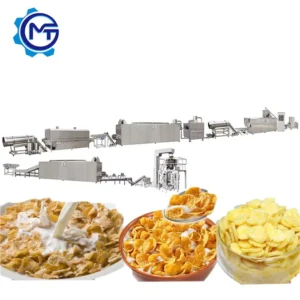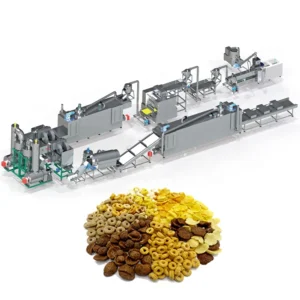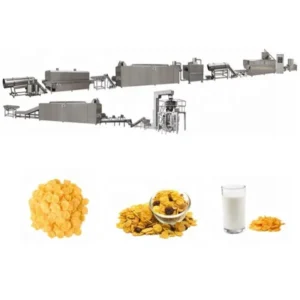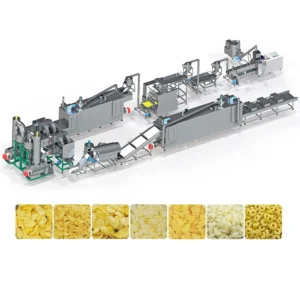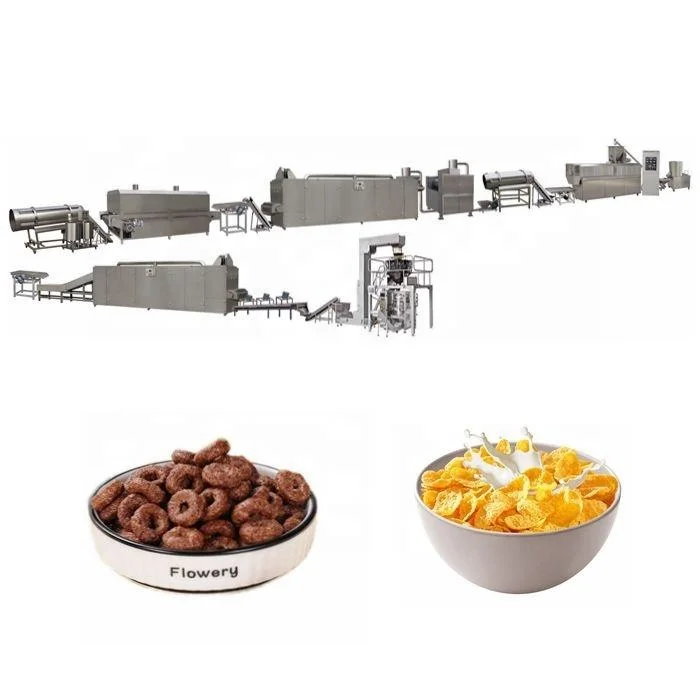
Matched Screw Configuration — every barrel zone and die opening specified against your actual cereal blend, verified in our testing workshop before the MT75 ships.
Technical Specifications
| Parameter | Value |
|---|---|
| Model | MT75 |
| Product Type | Twin Screw Extruded Corn Flakes Production Line |
| Screw Type | Twin Screw |
| Installed Power | 210 kW |
| Power Consumption | 150 kW |
| Output Capacity | 300–500 kg/hr (basis not stated in source — confirm raw material, moisture content, product format) |
| Overall Dimensions (Line) | 45 × 1.5 × 3.5 m |
| Control System | PLC Control System |
| Flaking Machinery Drive | Double motors for separate roller driving; hydraulic system for double rollers |
| Flaking Temperature Control | Infrared sensor |
| Dryer Heating Source | Gas or electric (configurable) |
| Roasting Oven | Hot air roasting with conciliation burner, two separate circulating fans, cyclone dust removal |
| Coating System | Double tumble for sugar melting, elevator, coating drum, spraying nozzle |
| Line Stations (Natural) | Mixing → Extruding → Flaking → Drying → Hot Air Roasting → Cooling → Packing |
| Line Stations (Sugar Coated) | Mixing → Extruding → Flaking → Drying → Hot Air Roasting → Sugar Spraying → Sugar Coating → Drying → Cooling → Packing |
| Basic Materials | Corn, rice, wheat, oat, barley powder |
| Final Product Shapes | Ball, tube, stick, ring, fruit loop, star, wheel, flower, heart (by adjusting mould) |
| Certification | CE, ISO |
Application Suitability
| Application | Material or Output |
|---|---|
| Natural corn flakes for breakfast cereal packs | Corn grits or corn flour at controlled moisture |
| Sugar-coated corn flakes with extended bowl life | Corn base with sugar syrup tumble coating |
| Multi-grain flake formats | Rice, wheat, oat, and barley powder blends |
| Shaped extruded cereal snacks | Corn or mixed grain dough formed through interchangeable dies |
| Fortified breakfast cereals | Grain base blended with vitamin and mineral premix |
Why Corn Flake Density Goes Wrong Before the Line Even Arrives
Screw elements copied from a generic cereal build cannot hold consistent gelatinisation across different grain blends.
I once watched a corn flakes line produce perfect sheets during the factory test using standard corn grits, only for the buyer’s real formula — loaded with coarse oat and barley — to come out hard and under-gelatinised. The entire first batch cracked during flaking and had to be scrapped. The problem was never the dryer or the roaster; it was the screw profile and barrel temperature map that had been carried over from a different product [NEED_CITE: starch gelatinisation temperature ranges for different cereal grains]. That week on-site, re-stacking the screw elements and re-tuning five heating zones brought the line back into spec, but the cost of lost material and delayed launch was already written off. When the corn flakes extrusion technology twin screw configuration is not matched to the buyer’s exact formulation, density drifts outside what the market expects in the bowl.
Starch Gelatinisation Under Controlled Shear and Moisture
Twin-screw extrusion gives process engineers independent control over shear rate, residence time, and barrel temperature across multiple zones. For corn flakes, the goal is partial gelatinisation — enough to bind the dough sheet but not so much that the flake puffs uncontrollably during roasting. The MT75 barrel is segmented into heating zones that can be tuned to the specific gelatinisation window of corn, rice, or oat-rich blends, preventing the over-expansion that makes flakes too fragile for packaging and transport.
Die Geometry and Flake Thickness Consistency
The die plate determines the cross-section of the extruded rope before it enters the flaking rolls. A die with the wrong land length produces rope that is either too dense to flatten evenly or too soft to hold its edges. The hydraulic double-roller flaking machinery on this line uses infrared temperature sensing to keep the roller gap stable, so flake thickness stays within the narrow band that roasts evenly without scorching the surface [NEED_CITE: flaking roll gap tolerance for breakfast cereal sheeting].
Reading the Specs That Matter for Cereal Extrusion
Installed power of 210 kW and running consumption around 150 kW indicate a line sized for sustained thermal and mechanical load across the extruder, dryer, and roasting oven. The twin-screw arrangement allows the operator to vary the screw element sequence — forward conveying, kneading blocks, reverse elements — without hardware changes, which is essential when switching between a pure corn formula and a multi-grain blend. PLC control locks each recipe’s barrel temperature profile, screw speed, and feeder rate so batch-to-batch variation stays within the limits the roasting oven can handle. The line stretches 45 m end to end, which means utility planning for gas supply, electrical feed, and exhaust ductwork must be confirmed well before foundation work begins.
What a Mismatched Line Costs After Installation
Running a flaker against an extruder that delivers rope at the wrong moisture content forces the drying stage to compensate, lengthening residence time and pulling throughput down to levels the buyer did not budget for. Roasters then see uneven surface bubbling because some flakes enter with higher residual moisture than others, creating a mixed texture in every bag [NEED_CITE: moisture variance effects on hot air roasting uniformity]. Wear parts — screws, die plates, flaking roller shells — consumed faster than forecasted add unplanned downtime in the first quarter, and the operator who was trained on a stable process spends weeks chasing variables that should have been fixed at the design stage.
Engineering Decisions Behind This Line
The twin-screw extrusion expertise here covers pet food, aquatic feed, snacks, and cereals, so screw configurations are pulled from an application-specific library rather than a generic template. Every barrel zone and die opening is selected against the buyer’s raw material data sheet before the MT75 enters assembly. An in-house testing workshop runs the buyer’s actual grain blend through the extruder, flaker, and roaster so the trial run report reflects real gelatinisation behaviour, not a proxy material. Throughput is balanced across the extruder, flaking machinery, dryer, and roasting oven as one system — the flaker will not sit idle waiting for the dryer, and the roaster will not choke on a backlog from the coater. Complete electrical schematics confirm voltage, frequency, and PLC language before the control cabinet is wired, preventing commissioning delays on site.
Documentation & Verification
- Line layout and capacity calculation showing station-by-station throughput for your cereal blend
- Screw and die configuration record specific to your raw material and target flake density
- Trial run report from the testing workshop on your actual grain formulation before dispatch
- Electrical schematic with voltage, frequency, and PLC screen language confirmed to your facility
- CE declaration of conformity and ISO certificate for the complete production line
- Operation and maintenance manual covering screw element re-stacking sequences and wear part replacement intervals
Installation, Commissioning & Support
- Foundation plan accounts for the full 45 m line length, with load points marked for extruder, flaker, and roaster
- Dedicated electrical circuit sized for 210 kW installed load with local voltage and frequency matched
- Extruder barrel segments and flaking rolls shipped disassembled, reassembled and aligned on site
- PLC recipe loaded with trial-run parameters, then fine-tuned against your production grain batch during commissioning
- Operator training covers screw element reconfiguration for formula changes and infrared sensor calibration on the flaker
- Wear parts list identifies screw elements, die plates, and roller shells with recommended stock quantities
What We Need to Quote the Right Line
Send us the exact grain or blend you plan to run, the moisture content you target at the extruder infeed, and the flake dimensions your packaging format demands. We also need your facility voltage and frequency, preferred PLC language, and whether your layout calls for a gas-fired or electric dryer. If you are developing a new fortified or multi-grain formula, we can schedule a trial run in the testing workshop before the MT75 is built to your configuration.
Frequently Asked Questions
Q: How is screw configuration selected for different cereal raw materials and target flake densities?
A: We map your grain blend’s starch gelatinisation curve, then choose conveying, kneading, and reverse screw elements in a sequence that delivers the right shear and residence time. Each zone is tested in our workshop with your material so the final configuration record is locked before production begins.
Q: Can I run a trial on my raw material before the line ships?
A: Yes. The testing workshop runs your actual grain formulation through the extruder, flaker, and roaster. You receive a trial run report documenting barrel temperatures, screw speed, moisture levels, and flake density so you can approve the configuration before the MT75 is disassembled for shipping.
Q: How do barrel temperature zones and moisture levels affect starch gelatinisation and flake expansion?
A: Each barrel zone is independently heated so the dough passes through a controlled gelatinisation curve. Too much heat too early causes premature puffing; too little leaves hard ungelatinised centres. Moisture at the infeed is matched to the grain blend so the dough sheets cleanly on the flaker without sticking or tearing.
Q: How is throughput balanced between the extruder, flaker, dryer, and roaster?
A: We calculate each station’s cycle time against your target output and match equipment sizing so no single unit bottlenecks the line. The flaker roller speed, dryer belt length, and roaster residence time are all specified together, not sourced from separate vendors with mismatched capacities.
Q: What voltage, frequency, and control language options are confirmed before commissioning?
A: Before the control cabinet is wired, we confirm your facility’s voltage and frequency, select the correct motor ratings, and set the PLC interface language. The electrical schematic is shared for your approval so there are no surprises when the line powers up on site.