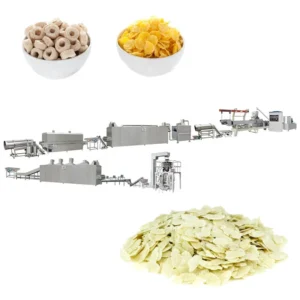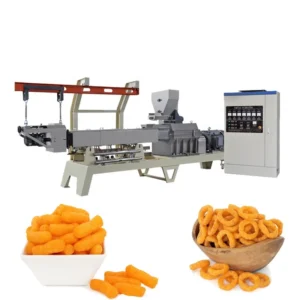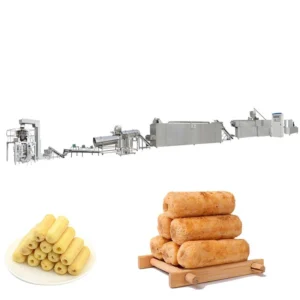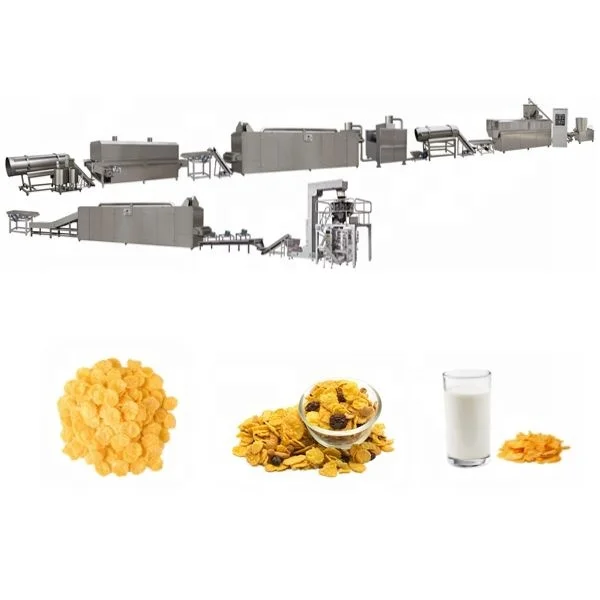
Screw Geometry Defines the Flake — twin-screw module layout and barrel zones are matched to your grain blend before the MT65 leaves the testing workshop.
Technical Specifications
| Parameter | Value |
|---|---|
| Model | MT65 |
| Product Type | Corn Flakes Production Line |
| Installed Power | 70 kW |
| Real Power Consumption | 40 kW |
| Output Capacity | 100–150 kg/h (basis not stated in source — confirm raw material / moisture content) |
| Overall Dimensions (L×W×H) | 20000 × 1200 × 2200 mm |
| Extruder Screw Type | Twin screw, co-rotating, sectional modules |
| Screw Material | 38CrMoAL alloy, nitrided |
| Feeding System | Food-grade stainless steel twin screw feeder with speed-adjusted converter |
| Drive & Control | Delta inverters on feeding, extrusion and cutting |
| Main Motor | SIEMENS (China) |
| Gearbox | Automatic lubrication |
| Cutting Mechanism | Rotary knife on die head seat, V-belt drive |
| Dryer Type | High-temperature gas-fired oven, both-side baking |
| Dryer Dimensions | 4.5 × 1.4 × 1.8 m |
| Dryer Power | 3.75 kW |
| Flake Press Power | 16.12 kW |
| Flake Press Roller | 510 × 310 × 1050 mm |
| Flake Press Dimensions | 1550 × 1300 × 2000 mm |
| Sugar Spraying Power | 28.75 kW |
| Sugar Spraying Dimensions | 4000 × 1900 × 1880 mm |
| Sugar Spraying Roller | Ø600 × 2700 mm |
| Mixer Output | 10–30 kg per load |
| Mixer Power | 4 kW |
| Mixer Tank Size | Ø600 × 500 mm |
| Mixer Dimensions | 1000 × 800 × 1200 mm |
| Screw Conveyor Power | 0.75 kW |
| Screw Conveyor Dimensions | 2700 × 500 × 2400 mm |
| Certifications | CE, ISO |
Application Suitability
| Application | Material or Output |
|---|---|
| Traditional corn flakes | Maize grits and corn flour |
| Multi-grain breakfast flakes | Rice, wheat, oat and rye blends |
| Fortified breakfast cereals | Cereal powder with soybean or nutrient premix |
| Extruded grain-based cereals | Compound grain formulations for flaked formats |
Why Nominal Output Numbers Mislead Buyers Evaluating a Corn Flakes Extrusion Production Line Manufacturer
Capacity means nothing until it is measured on your actual grain blend at your target moisture.
I watched a corn flakes line run beautifully on standard corn grits in our Jinan testing workshop. The flakes expanded evenly, colour was right, texture was crisp. Then the buyer shipped their own high-fibre wholegrain formulation from overseas, and the same screw setup produced flakes that were hard and brittle. The barrel temperature profile that worked for pure maize simply could not handle the extra fibre and different starch behaviour. We had to rework the screw module combination and adjust three heating zones before the product met spec. That is the gap between a brochure number and a working line. Every corn flakes extrusion production line manufacturer should validate output on the buyer’s actual material before the equipment leaves the factory floor [NEED_CITE: starch gelatinisation behaviour across different grain formulations].
How Screw Configuration Controls Flake Texture
The MT65 uses co-rotating twin-screw modules made from nitrided 38CrMoAL alloy, and the arrangement of those modules along the barrel determines how the grain matrix is sheared, heated and gelatinised. For corn flakes, the goal is partial gelatinisation — enough to bind the starch into a coherent pellet that will later be pressed into a flat flake, but not so much that the pellet expands prematurely at the die. We adjust the number and pitch of the conveying elements versus the kneading blocks based on your specific grain formulation and its moisture absorption rate. This is the core technical decision that separates a line producing consistent breakfast cereal from one that generates scrap on every batch change.
Barrel Temperature Profiling for Grain-Specific Behaviour
Each barrel zone on the MT65 is independently heated, and the temperature gradient from feed inlet to die face must follow the gelatinisation curve of your particular grain blend. Maize starch gelatinises at a different temperature range than oat or wheat starch, and adding soybean protein shifts that window further. When we set up the corn flakes extrusion production line manufacturer specification for a new buyer, we map the barrel profile against the formulation data sheet and then confirm it during the in-house trial run. The operator adjusts zone temperatures in real time while monitoring pellet density at the die exit [NEED_CITE: barrel zone temperature control in food extrusion processing].
What the Supporting Stations Actually Do
The flake press takes the cooked pellets from the extruder and compresses them between rollers measuring 510 × 310 × 1050 mm into the flat shape that defines corn flakes. Roller gap and pressure directly control flake thickness, which in turn determines how quickly the flake dries and how it feels in the mouth. Downstream, the gas-fired high-temperature oven with both-side baking removes residual moisture evenly across the flake surface. Uneven drying creates hard spots or causes the flake to curl and crack. The sugar spraying system, with its Ø600 × 2700 mm roller, applies coating uniformly before final cooling and sifting, so every flake carries the same flavour load rather than some being over-glazed and others bare.
The Cost of Mismatched Line Stations
If the extruder produces pellets faster than the flake press can compress them, pellets pile up, cool below pressing temperature and produce uneven flakes. If the dryer cannot remove moisture fast enough for the throughput coming from the press, flakes exit the oven with internal moisture pockets that cause sogginess within days of packing. These are not theoretical failures — they happen when a line is assembled by quoting each station at its independent maximum rather than balancing throughput across the entire sequence [NEED_CITE: throughput balancing in multi-station food processing lines].
Sourcing the Complete Line From One Equipment Supplier
Every station on this corn flakes line — from the 10–30 kg batch mixer through the twin-screw feeder, extruder, flake press, gas oven, sugar spraying drum and sifting table — is specified and supplied as a matched set, so capacity at each stage is calculated against the same material flow rate. The screw module layout and die geometry are documented in a configuration record that ties the setup to your specific grain blend. Before dispatch, we run your actual raw material through the line in our testing workshop and produce a trial report that includes pellet density, flake thickness and moisture readings. Voltage, frequency and control language are confirmed in writing before production begins, so the Delta inverters and operator interface match your facility electrical standard. CE and ISO documentation ships with every unit.
Documentation & Verification
- Line layout drawing with throughput calculation matched to your grain formulation and target output
- Screw module configuration record specifying element type, pitch and sequence for your product
- Trial run report on your raw material documenting pellet density, flake thickness and moisture
- Electrical schematic with voltage and frequency confirmation for your facility
- CE declaration of conformity and ISO certificate in the dispatch documentation package
- Operation and maintenance manual covering barrel heating zones, press roller adjustment and dryer settings
Installation, Commissioning & Support
- Foundation plan for the 20 m line footprint with utility connection points for 70 kW installed power
- Dedicated electrical circuit matching confirmed voltage and frequency, with phase rotation verified at commissioning
- Gas supply connection for the high-temperature oven sized to burner rating and local gas pressure standard
- Barrel heating zone calibration and screw speed setting during first production run with your material
- Operator training covering screw module changes, flake press roller gap adjustment and dryer temperature profiling
- Wear parts list for 38CrMoAL screw elements, die inserts and rotary cutting knives with recommended replacement intervals
What We Need From You Before Quoting
Send us your grain formulation — including the percentage of maize, rice, wheat, oat or other cereals — along with the target flake thickness and any coating specification. We also need your facility voltage and frequency, available floor space with ceiling height, and whether you will run a single recipe or require quick changeover between formulations. If you can ship a sample of your production raw material to our testing workshop, we will run it on the MT65 and return a trial report with the line proposal.
Frequently Asked Questions
Q: How is output capacity verified on my specific grain formulation?
A: We run your actual raw material through the MT65 in our testing workshop before shipment. The trial covers your exact grain blend at your target moisture level, and we document pellet density, flake thickness after pressing, and final moisture after drying in a written report. Capacity figures in our quotation are tied to that trial result, not to a generic catalogue number.
Q: How do you configure screw elements for corn flakes versus other flaked cereals?
A: Corn flakes require partial gelatinisation to form a pellet that presses flat without cracking. Oat and wheat blends need different kneading block ratios and barrel temperature profiles because their starch gelatinisation windows differ. We select the screw module sequence and die geometry based on your formulation data and confirm the setup during the in-house trial run.
Q: What voltage, frequency and control language options are confirmed before build?
A: Before production starts, we confirm your facility voltage and frequency in writing and program the Delta inverters and operator interface accordingly. Control language is set to match your operator team. This prevents the common situation where a line arrives on site and cannot be powered up until a transformer is sourced locally.
Q: Is a trial run on my raw material performed before shipment?
A: Yes, provided you send a representative sample to our testing workshop. The trial run report includes screw configuration details, barrel temperature settings, pellet characteristics at the die exit, flake dimensions after pressing and moisture content after drying. You receive the report before the line ships.
Q: How do you ensure the press, dryer and coating drum match the extruder throughput?
A: Each station is sized against the same material flow rate during line design. The flake press roller speed, oven belt speed and sugar spraying drum rotation are calculated so no station accumulates surplus product or starves the next stage. The line layout document shows this throughput balance for your review before build.