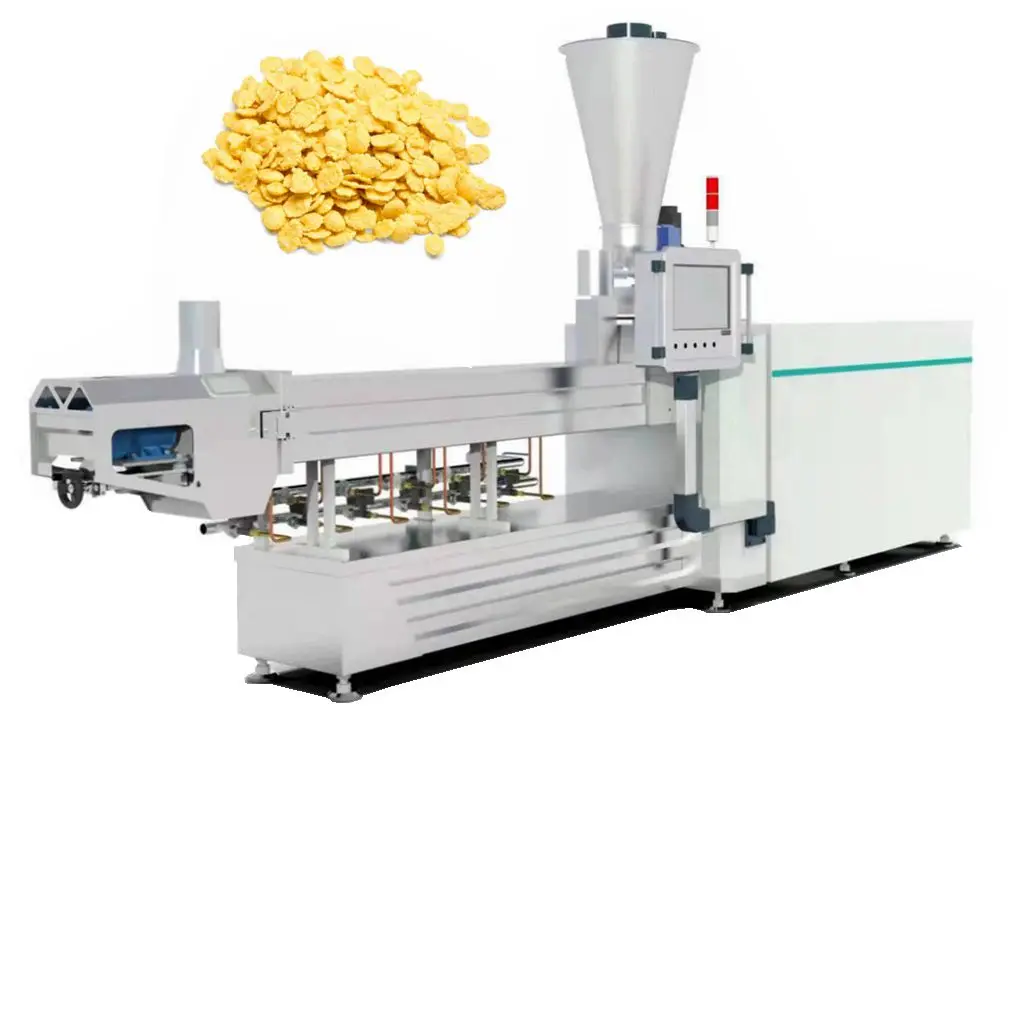
Screw and Die Configuration Specified to Your Grain — We match extruder screw profiles and die geometry to the exact corn or multi-grain blend you will run, preventing dense, under-expanded flakes that fail in the roasting oven.
Technical Specifications
| Parameter | Value |
|---|---|
| Product Type | Corn Flakes Breakfast Cereal Production Line |
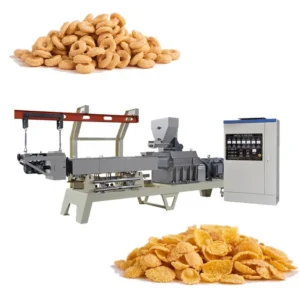
| Extruder Type | Twin Screw |
| Model Options | MT70 / MT85 / MT75 |
| Installed Power (MT70) | 160 kW |
| Installed Power (MT85) | 190 kW |
| Installed Power (MT75) | 210 kW |
| Power Consumption (MT70) | 120 kW |
| Power Consumption (MT85) | 140 kW |
| Power Consumption (MT75) | 150 kW |
| Output Capacity (MT70) | 150–200 kg/hr (basis not stated in source — confirm raw material, moisture content and flake thickness) |
| Output Capacity (MT85) | 300–400 kg/hr (basis not stated in source — confirm raw material, moisture content and flake thickness) |
| Output Capacity (MT75) | 300–500 kg/hr (basis not stated in source — confirm raw material, moisture content and flake thickness) |
| Overall Dimensions (MT70) | 41 × 1.5 × 2.2 m |
| Overall Dimensions (MT85) | 43 × 1.5 × 3.2 m |
| Overall Dimensions (MT75) | 45 × 1.5 × 3.5 m |
| Control System | PLC (flaking machine), MCC line control |
| Flaking Machine Drive | Double motors for separate roller driving, hydraulic system for double rollers |
| Flaking Temperature Control | Infrared sensor for even temperature pipe control |
| Dryer Heating Source | Gas / Electric |
| Roasting Oven | Hot air circulating with cyclone dust removal, conciliation burner |
| Coating System | Double tumble for sugar melting, elevator, coating drum, spraying nozzle |
| Lubrication | Automatic lubricating and cooling function |
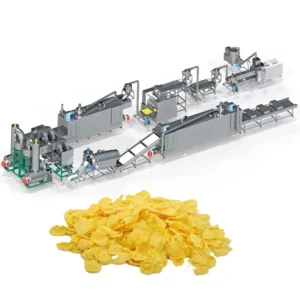
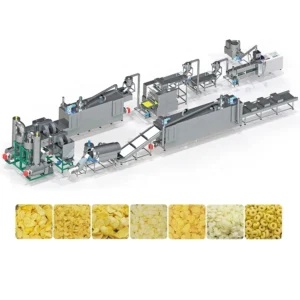
| Line Stations | Mixing → Extruding → Flaking → Drying → Hot Air Roasting → Sugar Coating (optional) → Cooling → Packing |
| Standards | CE, ISO |
Application Suitability
| Application | Material or Output |
|---|---|
| Natural corn flakes from corn grits | Degerminated corn, moisture-adjusted before extrusion |
| Multi-grain flakes | Rice, wheat, oat and barley powder blends |
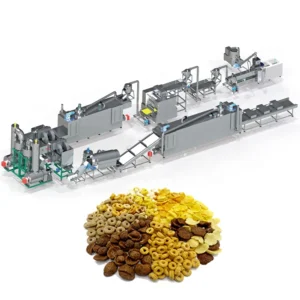
| Sugar-coated breakfast cereal | Corn flakes base with sugar syrup spray coating |
| Shaped cereal pieces | Ball, tube, ring, star, flower, heart forms via die mould change |
What Happens When Extrusion Parameters Ignore Your Raw Material
Flake texture is decided inside the barrel, not in the roasting oven.
When I commissioned a Corn Flakes line in West Africa, the customer fed locally milled white maize — coarse grind, higher fibre, lower starch availability than the standard yellow corn grits we used for factory testing. The extruder pushed material through, but the flakes came out unevenly expanded, some too dense to blister in the roasting oven, others cracking at the flaking rollers. The corn flakes extrusion line turnkey was mechanically sound; the screw configuration was wrong for that grain. That mismatch between test conditions and actual production material is the single most common reason new cereal lines underperform in their first months. [NEED_CITE: starch gelatinisation behaviour across maize varieties during extrusion]
How Screw Configuration Determines Flake Density
Inside a twin-screw extruder, the corn-based dough undergoes shear, mixing and thermal treatment simultaneously. Screw element arrangement — the sequence of conveying, kneading and reverse-pitch sections — controls residence time and the degree of starch gelatinisation achieved before the material exits the die. For high-fibre or coarse-ground corn, a longer kneading zone compensates for slower hydration. The die orifice diameter and land length then govern the pressure drop at exit, which sets the initial expansion ratio. Getting this right means the pellet that reaches the flaking rollers has the correct internal structure to flatten without fracturing and later blister evenly under hot air. This is the engineering core of any corn flakes extrusion line turnkey.
Barrel Temperature Profile and Moisture Management
Temperature zones along the barrel must follow the gelatinisation curve of the specific grain blend. Corn starch gelatinises within a relatively narrow thermal window, and multi-grain blends containing oat or barley shift that window due to differing amylose ratios. Steam injection or liquid dosing at the feed section adjusts dough moisture entering the barrel, while barrel jacket heating or cooling maintains the profile through subsequent zones. If moisture is too low, gelatinisation is incomplete and flakes remain hard and glassy. If too high, the extrudate becomes sticky, blocking the flaking rollers and producing ragged edges. The PLC-controlled system on this line allows operators to monitor and adjust zone temperatures against setpoints in real time. [NEED_CITE: thermal profiling methods in breakfast cereal extrusion]
Reading the Specification Sheet with Production in Mind
The installed power ratings — ranging from 160 kW on the MT70 to 210 kW on the MT75 — reflect the torque demand of pushing viscous cereal dough through a twin-screw barrel at production throughput. The gap between installed and consumed power indicates motor loading headroom, which matters when you switch from a light corn formulation to a heavier multi-grain blend requiring more mechanical energy input. The flaking station uses dual independent motors with hydraulic roller pressure, allowing separate speed and gap adjustment so roller wear can be compensated without replacing both rolls simultaneously. Infrared temperature monitoring at the flaking stage ensures the extrudate enters the rollers at the correct plasticity window — too cool and it cracks, too warm and it smears instead of flattening. The roasting oven uses a hot air circulation system with cyclone dust removal and a conciliation burner, which together control blister formation and final moisture without scorching flake edges.
The Cost of Ignoring Downstream Matching
When the flaker capacity is not matched to extruder output, the result is either a bottleneck that forces the extruder to idle or a surge of material the rollers cannot handle, producing inconsistent thickness. An undersized dryer means flakes enter the roasting oven too wet, extending roasting time and shifting the colour profile toward darker tones than the market expects. [NEED_CITE: line throughput balancing in breakfast cereal production] These are not theoretical concerns — they are the reason some producers run their corn flakes extrusion line turnkey at half the quoted capacity and blame the extruder when the real problem sits two stations downstream.
Why Procurement Should Start with Your Grain Sample
Every parameter on this line — screw element sequence, die geometry, barrel zones, flaking gap, drying time — can be set correctly only after the actual production material has been run through the extruder. Our in-house testing workshop accepts customer grain samples and runs them on twin-screw equipment before the production line is finalised. The trial produces a configuration record documenting screw arrangement, temperature profile and die selection specific to that material. This record travels with the machine and becomes the baseline for commissioning. The alternative — arriving at your factory with a generic screw build and hoping the local corn behaves like the test standard — is how commissioning stretches from days into weeks.
Documentation & Verification
- Screw and die configuration record matched to your grain blend
- Trial run report on your raw material before shipment
- Line layout with station-by-station throughput calculation
- Electrical schematic confirming voltage and frequency for your site
- Operation and maintenance manual with wear parts schedule
- CE declaration of conformity and ISO certificate
Installation, Commissioning & Support
- Foundation plan reflecting the MT75 overall length of 45 m and station spacing
- Dedicated power circuits sized to the 210 kW installed load of the MT75 extruder
- PLC and MCC control panels configured to your local voltage and control language
- First-run parameter setting using the trial report as baseline
- Operator training covering screw configuration changes for different grain blends
- Wear parts list with lead times for screws, dies and flaking roller surfaces
What We Need to Configure Your Line
Before we propose a line layout, we need to understand your production environment. Share the grain type and grind specification you will run, the target flake thickness and whether you require sugar coating. Confirm your facility voltage, frequency and available floor length so we can match the extruder model and station spacing to your building. If you have upstream milling or downstream packing equipment already installed, provide those specifications so we can match interface conveyors.
Frequently Asked Questions
Q: How is extruder screw configuration selected for different grain blends and target flake density?
A: We run your actual grain sample through our testing workshop on twin-screw equipment. The trial determines the kneading block sequence, conveying element pitch and die orifice size needed to achieve the gelatinisation degree and expansion ratio your target flake requires. The resulting configuration record is documented and shipped with the machine.
Q: What raw material trial runs are performed before shipment and what does the report cover?
A: The trial uses your supplied grain at your specified moisture content. The report documents screw arrangement, barrel temperature profile, die selection, extrudate expansion ratio and flaking behaviour. This becomes the commissioning baseline so product development starts before installation rather than on your factory floor.
Q: How is throughput matched between the extruder, flaker, dryer and roasting oven to prevent bottlenecks?
A: Each station is sized during the line layout phase based on the extruder output capacity and the dwell time each process requires. Flaking roller width, dryer belt area and roasting oven volume are calculated so material flows continuously without surging or starving any single station.
Q: What voltage, frequency and control language options are confirmed before production?
A: We confirm your site electrical supply — voltage, phase and frequency — and configure motors, heaters and control panels accordingly. The PLC interface language and MCC labelling are set to your operator preference before the panels leave our workshop, avoiding rewiring or reprogramming delays at commissioning.
Q: What spare wear parts are available and what is the lead time for first replacement?
A: The wear parts list covers screws, barrel liners, die inserts and flaking roller surfaces. We provide recommended first-order quantities based on your planned production hours, and parts are manufactured to the same configuration record so replacements install without requalification.