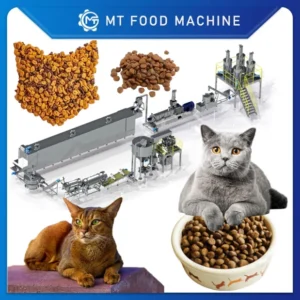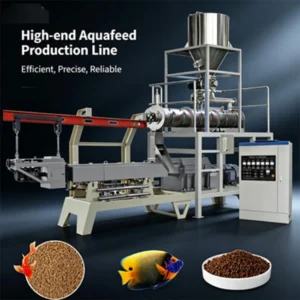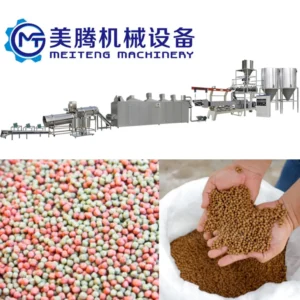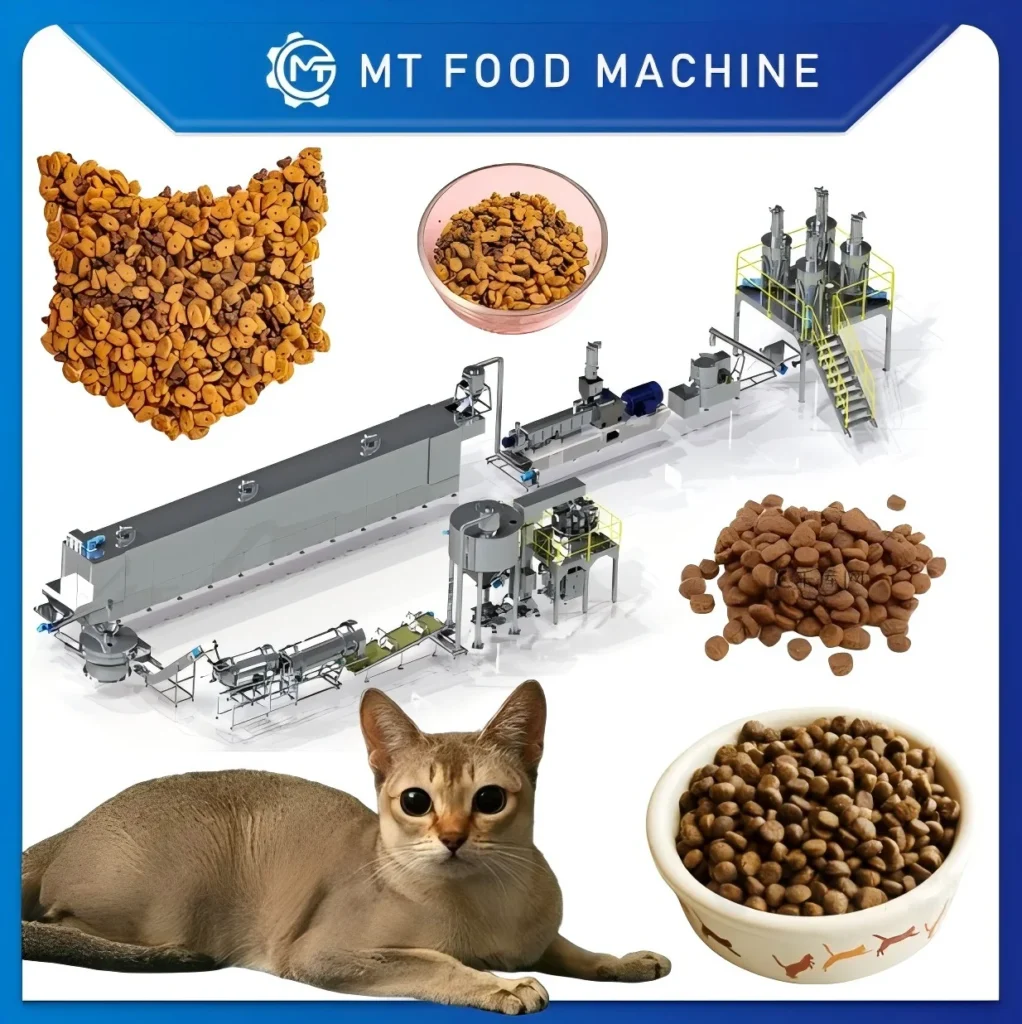
Screw Geometry Tuned to Your Formula — Each barrel section and die plate is matched to the buyer’s actual ingredient blend, not copied from a generic build, ensuring repeatable kibble density across every production run.
Technical Specifications
| Parameter | Value |
|---|---|
| Product Type | Pet Food Extrusion Line |
| Output Capacity | 100–200 kg/h (basis not stated in source — confirm raw material formulation and moisture content) |
| Extruder Type | Twin-screw |
| Control System | PLC controlled with MCC integration |
| Automation Level | Full automation across batching, extrusion, drying, coating, cooling and packing |
| Supported Formats | Dry kibble, semi-moist pet food, pet treats |
| Target Species | Multi-species (cat food focus) |
| Barrel Heating | Multi-zone independent temperature control |
| Recipe Flexibility | Configurable for multiple formulations without hardware swap |
| Energy Design | Energy-saving drive and heating layout |
| Certifications | CE, ISO |
Application Suitability
| Application | Material or Output |
|---|---|
| Dry cat kibble production | Meat meal, fish meal, cereal blends at controlled moisture |
| Semi-moist pet food runs | High-moisture formulations with humectant additives |
| Multi-species dry kibble | Variable protein-to-starch ratios across dog, cat and small pet diets |
| Pet treat extrusion | Dense dough formulations requiring low-expansion die profiles |
| Fortified nutritional kibble | Heat-sensitive vitamin and probiotic post-coating applications |
Why Nominal Capacity Numbers Mislead Pet Food Buyers
Every pet food extrusion line carries a rated output figure, yet that number rarely accounts for the buyer’s specific ingredient mix, moisture content or target kibble density.
The real throughput depends on how well the screw configuration, barrel temperature profile and die geometry match your actual formulation — not on a catalog figure measured under ideal lab conditions.
I once spent two days on a cat food line in East Africa where the extruder simply would not expand a local fish-meal blend. The screw elements had been selected for a standard corn-based recipe, and the shear profile was entirely wrong for high-protein material. Once we reconfigured the kneading blocks and adjusted the barrel zones, the line ran within its expected range. That mismatch is far more common than buyers realize, and it is the single biggest reason a quoted capacity fails to hold in production [NEED_CITE: common extrusion process mismatches in pet food manufacturing].
How Screw Element Sequencing Controls Kibble Density
The arrangement of conveying, kneading and reverse-screw elements inside the barrel determines how much mechanical energy transfers into the dough. A cat food formulation high in fish meal demands a different shear history than a poultry-meal blend, because protein denaturation and starch gelatinisation compete for thermal energy at different rates. On this cat food extrusion line specifications are built around a modular screw shaft where each element can be repositioned or swapped. That modularity means a producer can shift from a high-expansion dry kibble to a dense, slow-sinking treat format without ordering a new screw set — a practical advantage when product portfolios expand seasonally.
Barrel Temperature Zoning and Starch Gelatinisation Precision
Each barrel section on this line carries its own heating and cooling circuit, managed by the PLC. Starch gelatinisation in cat food typically initiates between specific thermal thresholds, and even a small overshoot can cause premature expansion inside the barrel rather than at the die face [NEED_CITE: starch gelatinisation temperature ranges in twin-screw extrusion]. Independent zone control lets the operator build a gradual temperature ramp that matches the residence time of a given recipe. When a semi-moist format requires lower peak temperatures to preserve humectant activity, the profile can be flattened without affecting the preconditioning stages upstream.
Reading the Specs That Actually Matter for Kibble Consistency
Twin-screw architecture is chosen here over single-screw because the intermeshing screw pair provides a self-wiping action that handles sticky, high-fat pet food blends without material buildup in the barrel. The PLC control system stores complete recipe parameters — screw speed, zone temperatures, feeder rates and moisture injection levels — so that changeovers between dry kibble and semi-moist formats are executed from a saved profile rather than from memory. Die selection is equally consequential: a multi-aperture die with a specific land length controls the expansion ratio as the superheated moisture flashes off at the die face, directly determining whether the kibble floats or sinks in the bowl. Full automation across every station — from batching through packing — eliminates the throughput bottlenecks that arise when an extruder is paired with an undersized dryer or coating drum.
The Cost of Overlooking Screw and Die Matching
When the screw configuration is copied from a generic template, the extruder may reach its nominal RPM yet produce kibble with inconsistent cell structure — some pieces over-expanded and brittle, others dense and under-cooked. A mismatched die compounds the problem: the wrong land length or aperture geometry forces the operator to compensate with barrel temperature, which shifts the gelatinisation window and alters nutritional retention. These issues do not appear during a short factory test on the manufacturer’s standard corn formula; they surface weeks after installation, once the buyer’s actual meat-meal and cereal blend enters the barrel [NEED_CITE: post-installation extrusion defects linked to generic screw configurations]. Production downtime, wasted raw material and off-spec product that must be reprocessed or discarded represent a far larger expense than the upfront cost of proper screw and die specification.
Why Source This Extrusion Line From Meiteng
Every line is configured as a single matched system rather than assembled from separate vendors, so the extruder output, dryer residence time, coating drum capacity and cooling conveyor speed are calculated together before fabrication. The in-house testing workshop allows trial runs on the buyer’s own raw material before shipment, producing a documented report on actual throughput and kibble quality. Screw configurations and die designs are specified to the target formulation, not pulled from a library of generic builds. PLC and MCC panels are built with the buyer’s facility voltage, frequency and preferred control language confirmed in advance, eliminating commissioning delays. Twin-screw process expertise spans dry kibble, semi-moist formats and treat applications, meaning the same engineering team supports product development from initial sample through stable production.
Documentation & Verification
- Screw and die configuration record matched to your ingredient formulation
- Trial run report on your raw material executed in the testing workshop before dispatch
- PLC program backup with stored recipe parameters for every agreed format
- Electrical schematic with confirmed voltage, frequency and control language
- CE declaration of conformity and ISO certificate for the complete line
- Wear parts list identifying screws, barrels and dies by part number
Installation, Commissioning & Support
- Foundation plan and utility layout provided for the PLC cabinet and MCC panel placement
- Dedicated power circuit sized to the extruder main drive and multi-zone barrel heaters
- Extruder barrel sections shipped disassembled and re-aligned on site during commissioning
- First-run parameter tuning on your raw material with recorded screw speed and temperature set points
- Operator training covering recipe changeover procedures on the PLC touch interface
- Initial spare set of high-wear screw elements and die plates supplied with the line
Preparing Your Inquiry
To move from a general inquiry to a firm line configuration, provide your target kibble format, the primary protein and starch sources in your formulation, and your expected moisture range at the extruder inlet. Confirm your facility voltage, frequency and the language your operators will use on the PLC interface. If you can ship a sample batch of raw material to the testing workshop, a trial run will validate screw geometry and die selection before the quotation is finalized.
Frequently Asked Questions
Q: How is the screw configuration selected for my cat food formulation?
A: We review your ingredient list, protein-to-starch ratio and target kibble density, then assemble a screw element sequence that delivers the correct shear and residence time. The configuration is documented and can be adjusted later if your recipe changes. A trial run on your actual material confirms the setup before the line ships.
Q: Can I test my own ingredients before the line is shipped?
A: Yes. Our in-house testing workshop runs your raw material through the configured extruder, producing kibble samples for your evaluation. The trial generates a written report covering throughput, expansion ratio, kibble density and any screw or die adjustments made during the session.
Q: How do I verify the 100–200 kg/h capacity holds on my recipe?
A: The stated range depends on your formulation’s moisture content and ingredient density. During the pre-shipment trial, we measure actual output on your material and record it in the trial report. If the result falls outside your requirement, we adjust screw speed, barrel profile or die selection until the target is met.
Q: What barrel temperature options support different kibble densities?
A: Each barrel zone has independent heating and cooling, allowing a custom temperature ramp for every recipe. High-expansion dry kibble typically needs a steep final-zone ramp, while semi-moist formats require a flatter profile to retain moisture. The PLC stores these profiles for one-touch changeover.
Q: How does the PLC support switching between dry, semi-moist and treat formats?
A: Every agreed recipe is saved as a named profile containing screw speed, zone temperatures, feeder rates and moisture settings. Operators select the target format on the touch screen, and the PLC adjusts all parameters simultaneously, reducing changeover time and preventing manual entry errors.