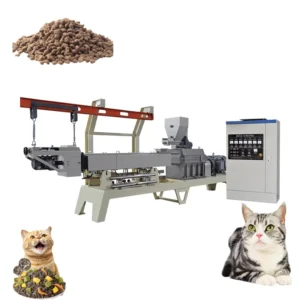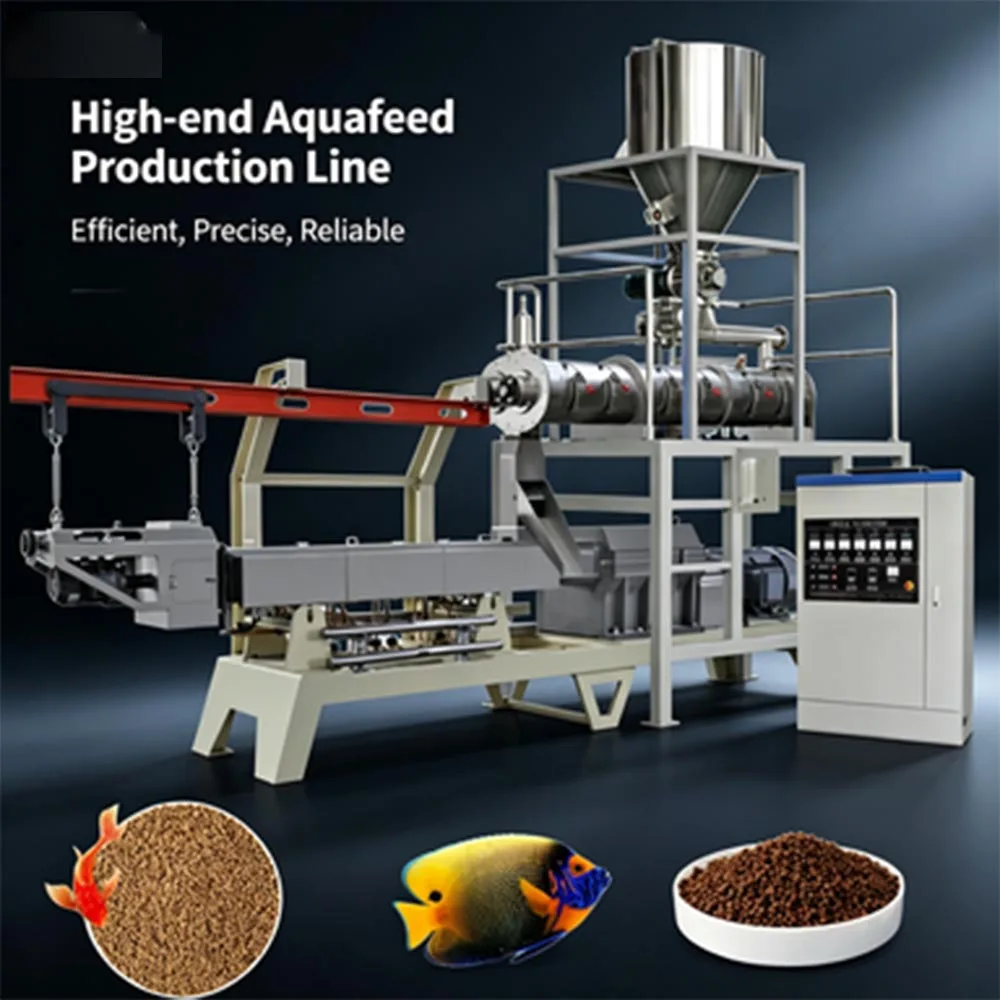
Screw and Die Configuration Matched to Raw Material — Every fish feed seasoning coating machine extrusion technology setup we ship begins with a trial run on the buyer’s actual formulation, confirming pellet buoyancy and surface finish before the line is finalized.
Technical Specifications
| Parameter | Value |
|---|---|
| Product Type | Automatic Fish Feed Seasoning and Coating Machine |
| Control System | PLC automatic control system with humanized operation interface |
| Contact Material | Food-grade 304 stainless steel |
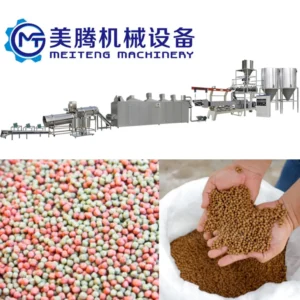
| Line Stations | Raw material mixer, extruder, dryer, seasoning coating machine, vibrating sieve, conveyor equipment |
| Transmission Structure | Optimized energy-saving transmission structure |
| Heating System | Energy-saving heating system |
| Continuous Operation | Supports long-time uninterrupted operation |
| Maintenance Design | Quick replacement of vulnerable parts |
| Processing Capacity | Large stable processing capacity (basis to be confirmed — depends on pellet size, raw material blend, and moisture content) |
Application Suitability
| Application | Material or Output |
|---|---|
| Floating aquaculture feed for catfish and tilapia | Fish meal, soybean meal, corn powder, compound additives |
| Sinking pellets for bottom-feeding species | High-protein formulations with adjusted starch ratios |
| Ornamental fish feed (koi, goldfish, tropical fish) | Specialty blends with pigment and nutrient additives |
| Medium to large scale commercial aquatic feed production | Compound formulations requiring uniform oil and flavor coating |
Why Floating Feed Sinks When the Extrusion Setup Is Wrong
Buoyancy starts at the screw and die, not at the coating drum.
I have stood beside a production line where every third batch of floating pellets sank within seconds of hitting the water. The operator blamed the dryer. The real cause was a screw configuration designed for a different starch content than what the plant was actually running. When you source a fish feed seasoning coating machine extrusion technology line, the conversation has to begin with your raw material certificate of analysis, not a brochure capacity number [NEED_CITE: raw material variability in aquaculture feed manufacturing].
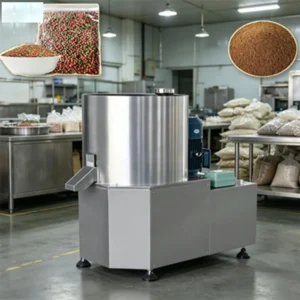
Fish Feed Flavoring Coating Oil Spraying Seasoning Machine PLC Control
How Barrel Temperature and Shear Shape Pellet Density
In aquatic feed extrusion, the degree of starch gelatinisation directly determines whether a pellet floats or sinks. The twin-screw extrusion stage applies high-temperature, high-pressure ripening that breaks down starch granules and creates a uniform internal matrix. The barrel temperature profile must be tuned so that the material reaches the correct viscosity before it hits the die.
This is where fish feed seasoning coating machine extrusion technology separates a reliable line from a problematic one. A barrel profile that runs too cool leaves ungelatinised starch in the pellet core, causing it to fracture during drying and absorb water too quickly in the pond. A profile that runs too hot degrades protein, reducing nutritional value and palatability for the target species.
Die Design and the Buoyancy Window
The die determines the final pressure drop that triggers expansion. For floating feed, a larger die opening combined with a specific screw pitch near the discharge end produces the controlled expansion needed to trap air pockets inside each pellet. Sinking feed requires the opposite approach: a tighter die and higher compression ratio to produce dense, slow-sinking pellets.
Every formulation shifts this balance. A blend heavy in fish meal behaves differently from one dominated by soybean meal because the protein-to-starch ratio changes how the material expands under pressure. This is why screw configuration and die design must be specified against the buyer’s exact formulation, not copied from a generic build [NEED_CITE: screw configuration impact on aquatic feed pellet density].
Reading the Specs That Matter
The PLC automatic control system across all line stations — mixing, extrusion, drying, seasoning, and screening — means that temperature zones, screw speed, and feed rate can be adjusted and logged as a coordinated set. When an operator changes the moisture addition at the mixer, the system can compensate dryer residence time and coating drum speed to maintain throughput consistency.
Food-grade 304 stainless steel contact surfaces resist corrosion from the salt and mineral content common in aquatic feed formulations, extending service life of barrels, screws, and coating drums. The energy-saving heating system reduces thermal loss across the barrel zones, which matters when a line runs continuously over long shifts. Quick replacement design for vulnerable parts such as die inserts and screw segments cuts changeover time when switching between floating and sinking formulations.
What Happens When Stations Are Mismatched
An extruder that outpaces the dryer forces pellets into the coating stage with residual surface moisture. Oil sprayed onto damp pellets does not adhere properly, leading to uneven coverage and nutrient leaching in the pond. I have seen a line where the coating drum was sized for a lower throughput than the extruder, creating a bottleneck that forced the entire front end to idle for minutes every cycle. That kind of mismatch does not show up in a spec sheet comparison — it appears on the first day of production [NEED_CITE: throughput matching between extruder and downstream stations].
Why This Line Holds Up Under Real Production Conditions
Complete lines from batching to packing come from a single supplier, so the extruder throughput, dryer capacity, and coating drum volume are matched to each other rather than assembled from separate vendors who each guarantee only their own station. Screw configuration and die design are specified to the buyer’s raw material and target buoyancy, not pulled from a standard catalogue.
An in-house testing workshop runs your actual raw material through the extruder and coating stages before shipment, generating a trial run report that documents pellet density, buoyancy, and surface quality. Twin-screw expertise extends across pet food, aquatic feed, and snack applications, which means the engineering team has encountered a wide range of formulation behaviors. Pre-sales consultation through on-site installation, commissioning, and ongoing maintenance support keeps the line performing after handover [NEED_CITE: pre-shipment trial runs in food extrusion equipment].
Documentation & Verification
- Line layout and capacity calculation showing throughput matching between extruder, dryer, and coating drum
- Screw and die configuration record matched to your specific aquatic feed formulation
- Trial run report on your raw material documenting pellet buoyancy and surface finish
- Electrical schematic with voltage and frequency confirmation for your local grid
- Operation and maintenance manual covering PLC parameter adjustment and vulnerable part replacement
- Wear parts list with part numbers for die inserts, screw segments, and coating nozzles
Installation, Commissioning & Support
- Foundation and floor space plan reflecting the full line footprint from mixer to vibrating sieve
- Dedicated power circuit sized to the PLC-controlled extruder and energy-saving heating system
- Station-by-station assembly sequence ensuring food-grade 304 stainless steel surfaces stay protected
- First-run parameter logging across all PLC zones to establish your baseline recipe settings
- Operator training on screw and die changeover between floating and sinking pellet formats
- Scheduled inspection intervals for coating nozzles, screw segments, and dryer heat exchangers
What We Need to Configure Your Line
Before we can specify screw configuration, die geometry, and coating drum volume, we need to know your target species, raw material formulation with moisture and protein percentages, and whether you need floating, sinking, or both pellet types. Share your workshop dimensions and local voltage and frequency so the line layout and electrical package match your facility from day one. If you have existing upstream or downstream equipment, tell us the make and throughput so we can match the interface.
Frequently Asked Questions
Q: How is screw configuration and die design matched to achieve floating vs. sinking pellet density?
A: We run your raw material through the extruder in our testing workshop and adjust screw pitch, compression ratio, and die opening until the pellet expansion and internal air structure meet your buoyancy specification. The final configuration is recorded and shipped with the machine.
Q: What barrel temperature profile and moisture range are needed for proper starch gelatinisation in aquatic feed?
A: The correct profile depends on your starch source and protein ratio. During the trial run we map temperature across barrel zones and measure gelatinisation degree, then lock those settings into the PLC so operators can reproduce the result consistently.
Q: How is seasoning and oil coating capacity matched to extruder throughput to avoid line bottlenecks?
A: The coating drum volume, spray nozzle count, and rotation speed are calculated against the extruder output rate so pellets spend enough time in the drum for even coverage without queuing or starving the downstream vibrating sieve.
Q: Can trial runs be performed on our raw material before shipment to verify buoyancy and texture?
A: Yes. Our in-house testing workshop runs your actual formulation through the full extrusion and coating sequence. You receive a trial run report documenting pellet density, floating duration, surface oil coverage, and recommended PLC parameters.