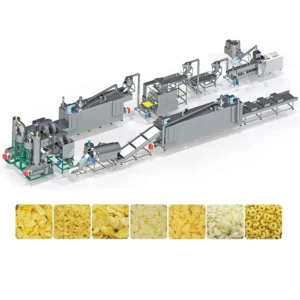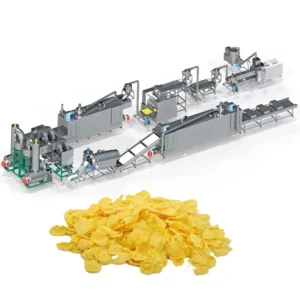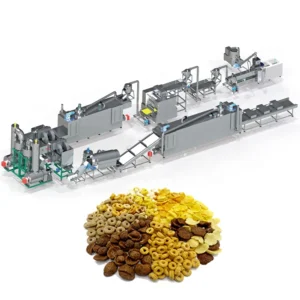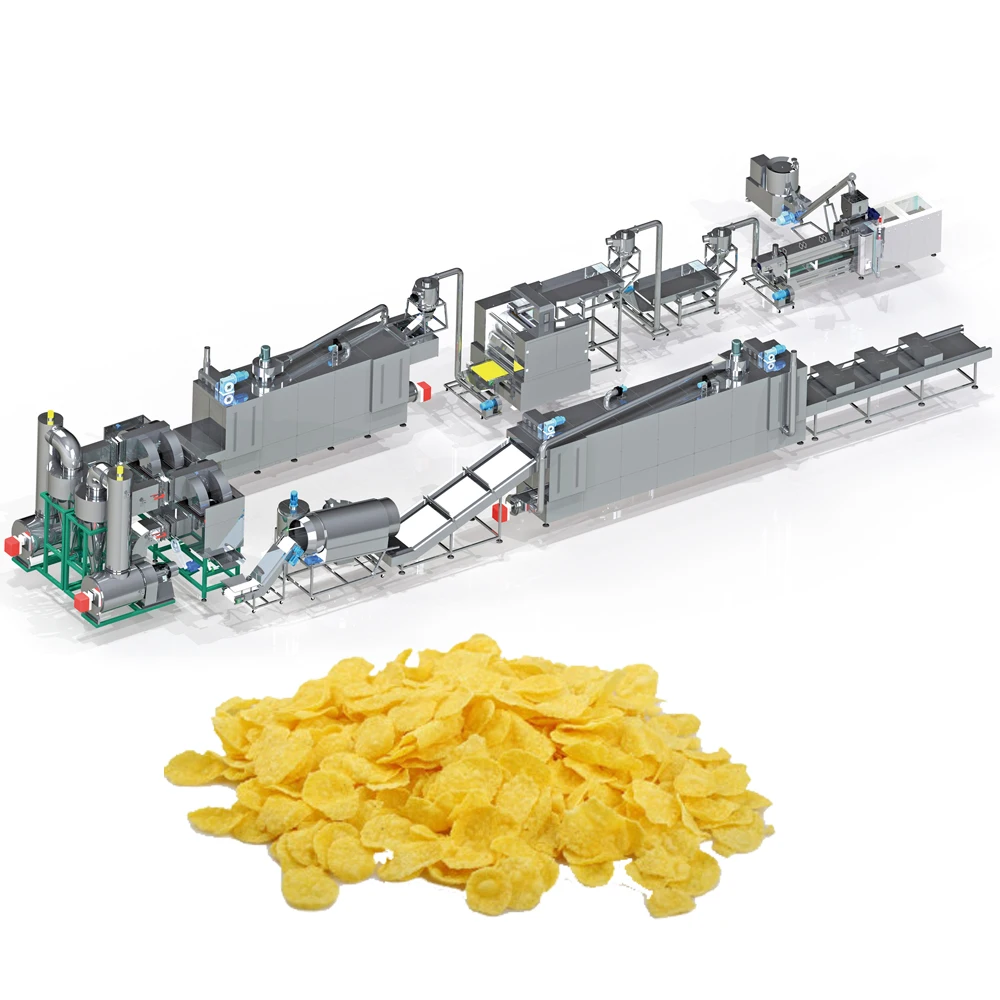
Screw configuration matched to your grain blend — Every MT75 barrel profile and die setup is validated on the buyer’s actual raw material in our testing workshop before the line ships.
Technical Specifications
| Parameter | Value |
|---|---|
| Product Type | Twin Screw Extruder Corn Flakes Production Line |
| Screw Type | Twin Screw |
| Installed Power | 210 kW |
| Power Consumption | 150 kW |
| Capacity | 300–500 kg/hr (basis not stated in source — confirm raw material and moisture) |
| Overall Dimensions | 45 × 1.5 × 3.5 m |
| Control System | PLC and MCC |
| Raw Materials | Corn, rice, wheat, oat, barley powder |
| Flaking Machinery | Hydraulic double-roller system, infrared sensor temperature control |
| Dryer Heating Source | Gas or Electric |
| Roasting Oven | Hot air with vibrating pan, conciliation burner, cyclone dust removal |
| Coating System | Double tumble sugar melting, elevator, coating drum, spraying nozzle |
| Die Configuration | Adjustable mould for multiple shapes |
| Screw Feature | Automatic lubricating and cooling function |
| Assembly State | Complete line |
| Voltage & Frequency | Customized to local voltage |
| Certification | CE, ISO |
Application Suitability
| Application | Material or Output |
|---|---|
| Natural corn flakes production | Corn grits, corn powder |
| Sugar-coated corn flakes | Corn base with sugar syrup coating |
| Multi-shape extruded breakfast cereals | Rice, wheat, oat, and barley powder blends |
| Fortified breakfast cereals | Grain blends with added nutritional premix |
| Puffed snack extrusion | Corn, rice, and multigrain formulations |
What Generic Screw Profiles Do to Your Flake Density
Corn flakes extrusion technology twin screw configurations only deliver consistent bowl-life when the screw profile is specified to the actual grain blend running through the barrel.
I have watched lines arrive at a plant with a screw setup that was perfect for standard corn grits but completely wrong for the buyer’s high-fiber multigrain recipe. The expansion collapsed inside the first dryer zone, flake density drifted outside market specification, and the roaster could not recover the surface bubbling that consumers expect [NEED_CITE: starch gelatinisation behaviour across different grain fibre levels]. The quoted capacity became irrelevant because half the output was downgraded. When corn flakes extrusion technology twin screw setups are copied from a generic build without accounting for your specific raw material behaviour, the problem does not show up until the first production run — when it is already too late to adjust without delaying launch.
Barrel Temperature Zones and Starch Gelatinisation Control
The MT75 barrel is divided into independently controlled heating zones, each contributing to a specific stage of starch gelatinisation. Moisture content and shear force must be balanced across these zones so the dough reaches the correct viscosity before it hits the die face. Our corn flakes extrusion technology twin screw approach maps each zone to the gelatinisation curve of your particular grain blend rather than applying a single universal profile.
Die Design and the Expansion Window
The adjustable mould system supports shapes from standard flakes through rings, balls, stars, and wheels. Each shape demands a different die land length and exit geometry to hold expansion within the density window your market requires. Die design is finalised only after trial runs confirm that the target shape maintains structural integrity through the flaking and roasting stages [NEED_CITE: die land length influence on extrudate expansion ratio].
How Installed Power and Screw Geometry Interact
The 210 kW installed power on the MT75 drives the twin-screw assembly through a dedicated gearing system with automatic lubricating and cooling. This power level supports the shear intensity needed for thorough mixing of multigrain formulations without overheating the dough mass. Screw geometry — including pitch, flight depth, and kneading block arrangement — is configured to control residence time and mechanical energy input, both of which directly determine whether starch is fully gelatinised or partially raw at the die exit.
The Hidden Cost of Unmatched Downstream Capacity
When the extruder output is not matched to dryer and roaster throughput, the line bottlenecks at the weakest station. A roaster that cannot keep pace forces the extruder to run below its capability, or worse, product piles up and cools unevenly before entering the hot air chamber. Uneven roasting produces flakes with inconsistent colour and texture across the same batch. Buyers who overlook station-to-station matching during line specification end up troubleshooting density variation that was never an extruder problem in the first place [NEED_CITE: throughput balancing in multi-stage cereal production lines].
Why Procurement Here Reduces Commissioning Risk
Every station from mixing through packing is supplied under one responsibility, so throughput calculations are coordinated rather than left to separate vendors to reconcile on site. Screw configuration and die design are locked in only after your raw material runs through our in-house testing workshop, producing a trial run report you review before shipment. Electrical schematics and voltage specifications are confirmed against your facility’s supply before production begins, eliminating the commissioning delays that occur when frequency or control language does not match local standards. The PLC and MCC control architecture is documented with circuit-level detail, and line layout drawings account for utility connections at each station.
Documentation & Verification
- Screw and die configuration record matched to your grain blend and target flake density
- Trial run report on your raw material produced in our testing workshop before dispatch
- Electrical schematic with voltage and frequency confirmed to your facility specification
- Line layout drawing with capacity calculation showing matched throughput at every station
- CE declaration of conformity and ISO certificate for customs and regulatory clearance
- Operation and maintenance manual with wear parts list specific to your screw configuration
Installation, Commissioning & Support
- Foundation plan accounts for the 45 m line length and vibrating roaster pan load distribution
- Power supply specification confirms 210 kW extruder circuit and separate dryer heating source feed
- Line arrives in sectional assembly state with station-by-station installation sequencing
- First-run parameter setting covers barrel temperature profile and hydraulic flaking roller pressure
- Operator training addresses PLC interface navigation, die changeover, and screw maintenance intervals
- Wear parts list identifies screw segments and die inserts specific to your configuration for reorder planning
Preparing Your Line Specification
Share your grain formulation including any fiber or nutritional premix additions, your target flake density and bowl-life expectation, and your daily output requirement. We also need your facility voltage and frequency, preferred control language, and available floor space with ceiling height to finalise the line layout and utility routing.
Frequently Asked Questions
Q: How is screw configuration and die design matched to my grain blend and target flake density?
A: We run your actual raw material through the twin-screw extruder in our testing workshop, adjusting screw element arrangement, barrel temperature zones, and die geometry until expansion and density meet your specification. The validated configuration is then documented and locked in for your production line build.
Q: What barrel temperature profile and moisture range are needed for proper starch gelatinisation?
A: The profile depends on your specific grain blend and fiber content. During the trial run, we map each barrel zone temperature against moisture addition to find the gelatinisation window that produces consistent dough viscosity and clean die exit. This profile is recorded and transferred to your PLC at commissioning.
Q: Can I run a trial on my raw material before shipment to verify expansion and texture?
A: Yes. Our in-house testing workshop is equipped for full trial runs using your supplied raw material. You receive a trial run report showing expansion ratio, flake density, and texture assessment before the screw and die configuration is finalised for your line production.
Q: How do you ensure the dryer and roaster capacity matches extruder output without bottlenecking?
A: Line layout and capacity calculation are performed as one exercise covering every station. Dryer belt area, roaster chamber volume, and airflow are sized so that no single station limits the throughput achieved at the extruder under your confirmed raw material conditions.