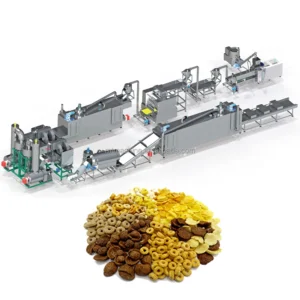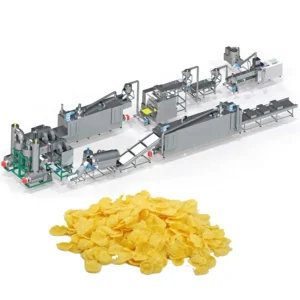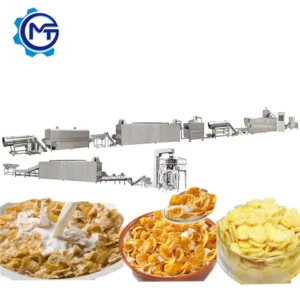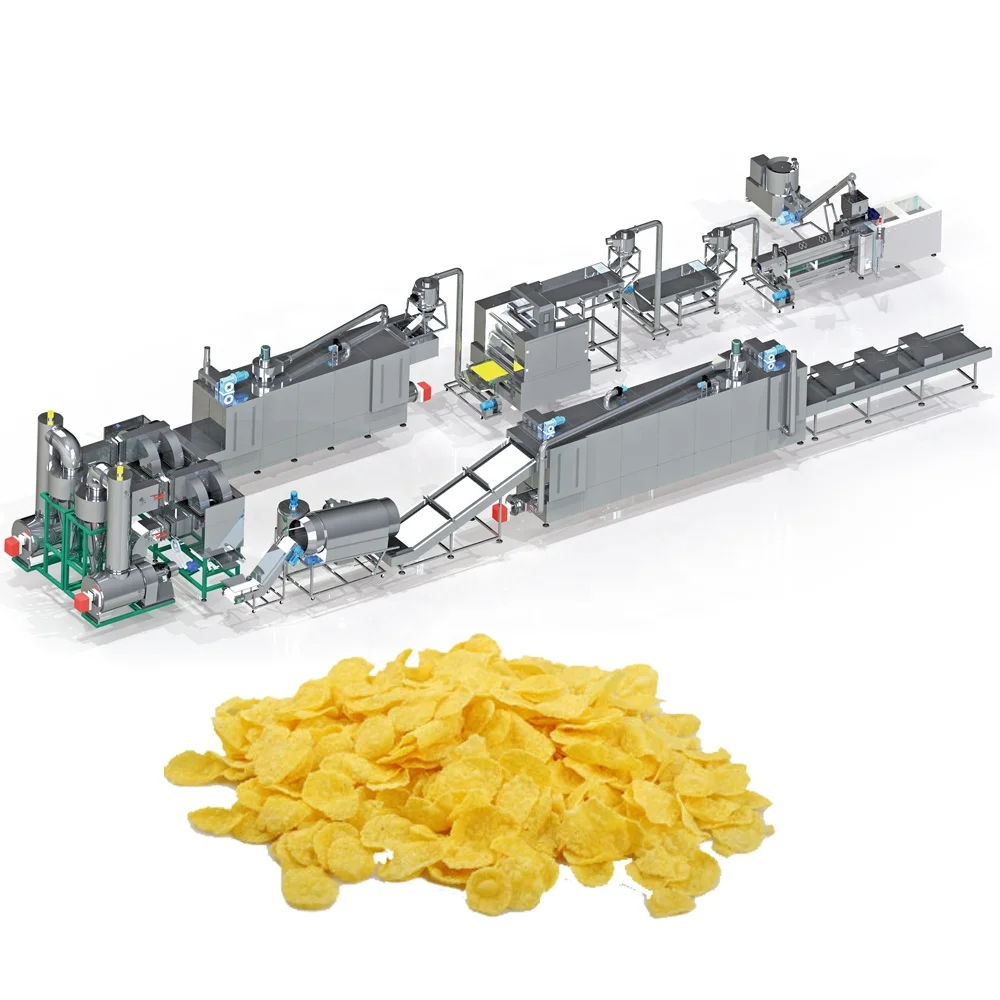
Matched Screw Geometry — Every barrel section and die land on the MT75 is selected against your specific corn flour blend and target flake density, not copied from a generic build.
Technical Specifications
| Parameter | Value |
|---|---|
| Model | MT75 |
| Product Type | Twin Screw Corn Flakes Extrusion Line |
| Screw Type | Twin screw |
| Installed Power | 210 kW |
| Power Consumption | 150 kW |
| Output Capacity | 300–500 kg/h (basis not stated in source — confirm raw material, moisture content, and flake thickness) |
| Voltage | 380V / 220V (frequency configurable to 50/60 Hz) |
| Control System | PLC and MCC control |
| Overall Dimensions (L×W×H) | 45 × 1.5 × 3.5 m |
| Line Stations | Mixing → Extruding → Flaking → Drying → Hot Air Roasting → Sugar Spraying & Coating → Drying → Cooling → Packing |
| Flaking Machinery | Hydraulic double-roller system, dual-motor independent drive, infrared sensor temperature control |
| Dryer Heating Source | Gas / Electric |
| Hot Air Roasting Oven | Vibrating pan, reconciliation burner, dual circulating fans, cyclone dust removal |
| Coating System | Double tumble sugar melting, elevator, coating drum, spraying nozzle |
| Extruder Features | Automatic lubrication, cooling function |
| Material | Stainless steel (food-grade contact surfaces) |
| Raw Materials | Corn flour, rice, wheat, oat, barley powder |
| Final Products | Natural corn flakes, sugar-coated corn flakes, various shapes via die adjustment |
| Standards | CE, ISO |
| Warranty | 1 year (core components) |
Application Suitability
| Application | Material or Output |
|---|---|
| Natural corn flake breakfast cereal production | Corn flour, corn grits at controlled moisture |
| Sugar-coated and honey-coated corn flakes | Corn flour base with sugar or honey slurry coating |
| Multi-grain flaked cereals | Wheat, oat, rice, and barley powder blends |
| Puffed snack shapes on the same extrusion platform | Ball, tube, stick, ring, fruit loop, star, wheel, flower, heart via die change |
Why "Rated Capacity" Means Nothing Without Your Raw Material on a Corn Flakes Extrusion Line Turnkey Production
A number on a quote sheet tells you what the machine does on the supplier’s test flour — not on yours.
I spent years in after-sales parts warehouses across the Yangtze Delta manufacturing belt before moving into export sales, and the most common call I fielded was from buyers whose corn flakes extrusion line turnkey production could not hold the quoted output once their actual formulation hit the barrel. The line runs fine on standard corn flour during the factory trial, then the buyer ships in a high-fibre whole-grain premix and the flakes come out hard, flat, and dense. The extruder was never the problem — the screw configuration was [NEED_CITE: screw element selection for high-fibre cereal formulations].
Shear Profile and Starch Gelatinisation in the Barrel
The MT75 twin-screw extruder uses a modular screw arrangement where each element — conveying, kneading, reverse — is positioned to control the shear and residence time your corn flour requires. Starch gelatinisation in corn flour demands a precise combination of moisture, temperature, and mechanical work; too little shear and the starch granules pass through partially intact, producing flakes that fracture rather than crisp. The barrel temperature profile is managed zone by zone, so the gelatinisation front advances steadily along the screw length rather than spiking in one section.
Die Geometry and Flake Expansion Control
Die design determines how the extrudate expands as it exits the barrel and pressure drops to atmospheric. For corn flakes, the die land length and orifice diameter must match the dough viscosity at the die face — a viscosity that shifts with every change in corn variety, particle size, and moisture content [NEED_CITE: die land design for cereal extrudate expansion]. A die specified for low-amylose corn flour will produce ragged, over-expanded pellets when fed high-amylose material, and those pellets flatten unevenly through the flaking rollers.
What the Flaking and Roasting Stations Actually Do to Your Flake
The hydraulic double-roller flaking machinery compresses each pellet to the target thickness while infrared sensors monitor roller surface temperature in real time. Independent dual-motor drive means each roller can be adjusted separately to compensate for wear or thermal expansion. Downstream, the hot air roasting oven uses a reconciliation burner combustion chamber with two circulating fans and a cyclone dust removal device — this arrangement controls the surface blistering that gives corn flakes their characteristic appearance and crispness without scorching the interior.
Reading the Specs That Matter for Corn Flake Texture
The 210 kW installed power and 150 kW operating consumption of the MT75 reflect the work required to plasticise and gelatinise cereal starches at continuous throughput. Twin-screw extrusion is chosen over single-screw here because the intermeshing screw flights provide positive conveying and self-wiping action — critical when processing sticky, high-moisture cereal doughs that would adhere to a single-screw barrel. The PLC control system coordinates extruder speed, barrel zone temperatures, flaking roller gap, and roasting oven burner output so that a recipe change on the touchscreen propagates through every station simultaneously. This coordination is what maintains batch-to-batch consistency when you switch between a natural corn flake run and a sugar-coated variant.
The Hidden Cost of a Generic Line Configuration
When stations are sourced from separate vendors and bolted together without throughput calculation, the flaking rollers sit idle waiting for the extruder, or the roasting oven burns product because the dryer upstream cannot keep pace. These imbalances do not show up during a brief factory demo on standard flour. They emerge weeks into production when your actual raw material exposes every mismatch [NEED_CITE: throughput balancing across cereal extrusion line stations]. I have walked into plants where the coating drum was sized for double the extruder output, so half the drum sat empty and sugar distribution was uneven across the batch.
Why This Line Is Configured Differently
Every station from the batching mixer through the packing conveyor is supplied under one responsibility, so throughput calculations are matched before metal is cut. The screw configuration and die design are specified to the buyer’s raw material and target flake density — not pulled from a catalogue page. An in-house machine testing workshop runs trial production on your actual corn flour or multi-grain premix before shipment, generating a trial run report that documents the screw arrangement, barrel temperatures, and flake density achieved. The MT75 platform supports both natural and sugar-coated corn flakes as well as multi-grain variants using wheat, oat, rice, or barley, with die changes producing shapes beyond traditional flakes on the same extrusion base.
Documentation & Verification
- Line layout and capacity calculation showing throughput matched across every station
- Screw and die configuration record specific to your corn flour formulation
- Trial run report on your raw material from the in-house testing workshop
- Electrical schematic with voltage and frequency confirmed for your market
- CE declaration of conformity and ISO certificate for export compliance
- Operation and maintenance manual with wear parts list and replacement intervals
Installation, Commissioning & Support
- Foundation and utility planning for the 45 m line footprint and 150 kW operating load
- Voltage and frequency verification against local supply before the PLC is programmed
- Extruder barrel alignment and flaking roller gap calibration during on-site commissioning
- Hot air roasting oven burner tuning and cyclone dust extraction testing at your facility
- Operator training on PLC recipe management and screw element replacement procedures
- Spare wear parts package including screw elements, die inserts, and flaking roller sleeves
Before You Request a Quote
To configure a corn flakes extrusion line turnkey production that actually holds capacity on your floor, share your corn flour specification sheet including particle size distribution and starch composition, your target flake thickness and density range, and your local voltage and frequency standard. If you are running a multi-grain blend, list every component and its proportion. Let us know whether you need a trial run on your raw material in our testing workshop before you commit to shipment.
Frequently Asked Questions
Q: How is the quoted output capacity verified for our specific corn flour?
A: Output figures are based on a defined raw material, moisture content, and flake thickness. We run your actual corn flour or multi-grain premix in our testing workshop and document the achievable throughput in a trial run report before you approve production. This report records the screw configuration, barrel temperatures, and resulting flake density.
Q: How do you match screw configuration and die design to our formulation?
A: We review your raw material data sheet — starch type, particle size, fibre content, and fat level — then select screw elements and die geometry that deliver the gelatinisation and expansion your target flake requires. The configuration is recorded and shipped with the machine so your team has the baseline for future adjustments.
Q: Can we run a trial on our raw material before shipment?
A: Yes. Our in-house testing workshop runs your actual corn flour or premix through the MT75 extruder and downstream stations. You receive a trial run report covering screw arrangement, barrel temperature profile, flake thickness, density measurements, and any adjustments made during the trial to reach your specification.
Q: How is throughput balanced between the extruder, flaker, and roasting oven?
A: Each station is sized against the extruder output at your confirmed raw material and moisture level. The line layout document shows calculated throughput at every transfer point — extruder discharge, flaking roller feed, dryer capacity, and roasting oven residence time — so no station becomes a bottleneck during continuous production.
Q: What voltage, frequency, and PLC language options are confirmed before production?
A: Before the electrical panel is wired, we confirm your site voltage, frequency, and preferred PLC interface language. This is documented in the electrical schematic and the specification confirmation sheet you sign off on. The hot air roasting oven burner and all motor drives are set to match your local supply standard.