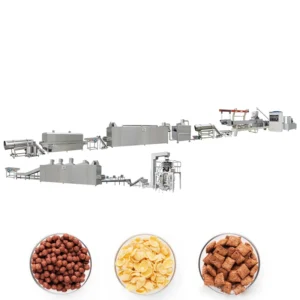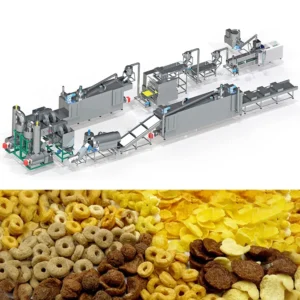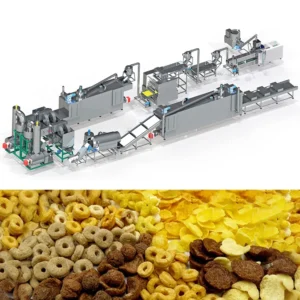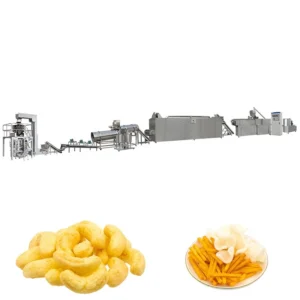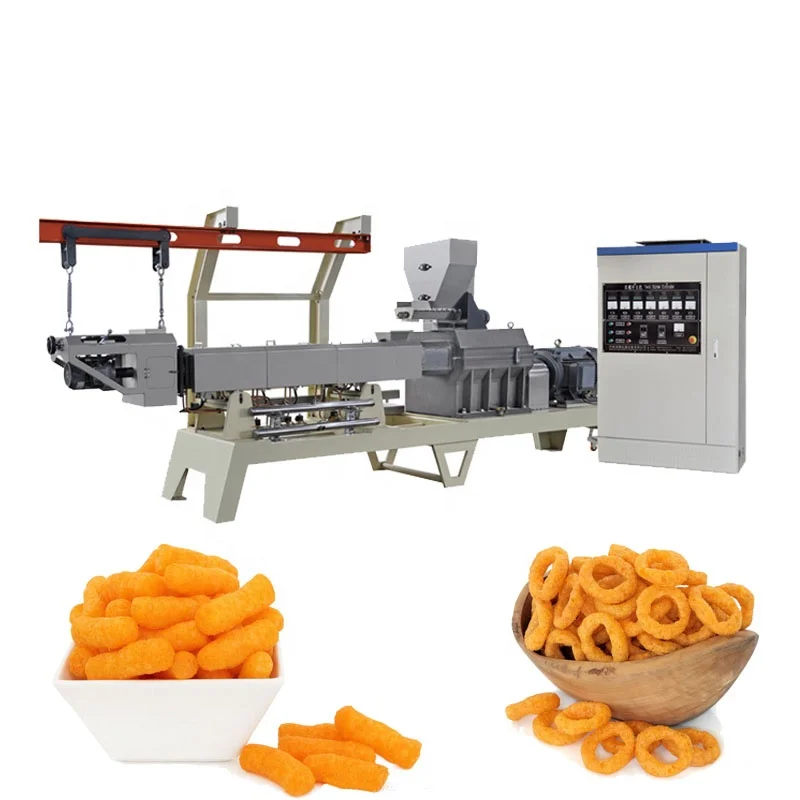
Precise extrusion parameters — Every corn flakes extruder screw configuration die design is specified to your exact flour blend and moisture profile, not pulled from a generic build sheet.
Technical Specifications
| Parameter | Value |
|---|---|
| Product Type | Corn Flakes Extruder Production Line |
| Models Available | MT70, MT85, MT75 |
| Screw Type | Twin Screw |
| Installed Power (MT70 / MT85 / MT75) | 160 kW / 190 kW / 210 kW |
| Power Consumption (MT70 / MT85 / MT75) | 120 kW / 140 kW / 150 kW |
| Output Capacity (MT70) | 150–200 kg/h (basis not stated in source — confirm raw material and moisture content) |
| Output Capacity (MT85) | 300–400 kg/h (basis not stated in source — confirm raw material and moisture content) |
| Output Capacity (MT75) | 300–500 kg/h (basis not stated in source — confirm raw material and moisture content) |
| Overall Dimensions (MT70 / MT85 / MT75) | 41×1.5×2.2 m / 43×1.5×3.2 m / 45×1.5×3.5 m |
| Control System | PLC control for flaking machinery; MCC available per corporate profile |
| Extruder Working Principle | Feeding, extruding, cutting, heating, gearing, and controlling systems |
| Flaking Station Features | Hydraulic double-roller system, separate dual motors, infrared sensor temperature control |
| Hot Air Roasting Oven | Vibrating pan, high-temperature spraying tubes, reconciliation burner, dual circulating fans, cyclone dust removal |
| Coating System | Double tumble sugar melting, elevator, coating drum, spraying nozzle |
| Dryer Heating Source | Gas or Electric |
| Die Configuration | Adjustable mould for ball, tube, stick, ring, fruit loop, star, wheel, flower, and heart shapes |
| Raw Materials | Corn, rice, wheat, oat, barley powder |
| Assembly State | Complete turnkey line with layout customization |
| Voltage & Frequency | Customized to local supply (basis not stated in source — confirm with buyer requirements) |
| Standards | CE, ISO |
Application Suitability
| Application | Material or Output |
|---|---|
| Natural corn flakes for breakfast cereal market | Corn, wheat, oat, and barley powder blends |
| Sugar-coated corn flakes production | Corn and rice bases with sugar spraying and coating stations |
| Multi-shape extruded breakfast cereals | Ball, tube, stick, ring, fruit loop, star, wheel, flower, heart shapes via die change |
| Inflated puff crispy rice | Rice powder and rice grits |
| Instant porridge production | Corn, oat, and multi-grain blends |
Why Generic Corn Flakes Extruder Screw Configuration Die Design Fails at Commissioning
A screw profile chosen for standard corn flour will collapse when your blend includes rice, oat, or barley at meaningful ratios.
I once set up a corn flakes line in Southeast Asia where the buyer substituted thirty percent of the corn flour with brown rice flour. The extrusion parameters were locked in for pure corn, so starch gelatinisation was incomplete. The flakes came out dense, sank in milk, and shattered during the sugar coating drum. The entire trial batch was scrapped before we re-profiled the screw elements and adjusted barrel zone temperatures. This happens more often than equipment suppliers admit [NEED_CITE: frequency of formulation mismatch in cereal extrusion projects]. The corn flakes extruder screw configuration die design must be matched to your specific grain blend before the machine leaves the factory.
Barrel Zone Management for Starch Gelatinisation
Corn flakes demand a precise gelatinisation window. The twin-screw extruder manages this through independently controlled barrel heating zones. Moisture content entering the barrel, combined with shear from the screw elements and zone-by-zone temperature, determines whether starch granules fully swell without rupturing. Under-gelatinised dough produces hard, glassy flakes. Over-gelatinised dough sticks to the flaking rollers and tears during sheeting.
Die Geometry and Its Effect on Flake Density
The die land length and orifice diameter control back-pressure inside the barrel, which directly influences expansion ratio at the die face. For corn flakes destined for flaking and roasting, the extrudate must exit with enough structure to hold a sheet but not so much puff that the rollers crush it into powder. The corn flakes extruder screw configuration die design is adjusted so that the pellet emerging from the die has the right density and moisture profile for the downstream flaking station to compress it into a thin, even sheet.
Reading the Power and Dimension Data
The installed power across the MT70, MT85, and MT75 models ranges from 160 kW to 210 kW, with operating consumption noticeably lower. This gap reflects the motor headroom needed for start-up torque and variations in raw material viscosity — denser grain blends with higher fibre content demand more instantaneous torque. The line dimensions, stretching over 41 metres for the MT70 and up to 45 metres for the MT75, reflect the number of stations involved: mixing, extruding, flaking, drying, hot air roasting, cooling, and packing. Buyers planning factory floor layout need to account for the full footprint plus operator walkways and raw material staging [NEED_CITE: typical floor space allocation for cereal extrusion lines]. The PLC-controlled flaking station uses a hydraulic double-roller system with infrared sensor temperature monitoring to keep roller surface heat even across the sheet width, preventing edge cracking during compression.
The Hidden Cost of Skipping Raw Material Trials
When an extruder ships without a trial run on the buyer’s actual grain blend, the first real test happens on the factory floor during installation. If the flakes come out too dense, too fragile, or wrong in colour, re-configuring the screw elements and die requires shipping new parts internationally and scheduling another engineer visit. Downtime accumulates. Market launch dates slip. Retail buyers lose confidence. Every parameter — barrel temperature, screw pitch, die orifice, moisture addition rate — interacts with the specific starch and fibre profile of your raw material [NEED_CITE: impact of raw material variability on extrusion consistency]. A trial run in the supplier’s testing workshop before shipment eliminates this risk entirely.
Why This Extrusion Platform Fits Breakfast Cereal Projects
The line is supplied as a complete system from batching through extrusion to packing, meaning throughput at every station is calculated to match rather than assembled from separate vendors who optimise independently. The screw configuration and die design are specified to your raw material formulation and target flake density, not copied from a catalogue. An in-house testing workshop allows trial runs on your actual grain blend before the equipment ships, confirming texture and expansion. The hot air roasting oven uses a vibrating pan with high-temperature spraying tubes and dual circulating fans for even roast colour and crunch development across the full bed width. The same extruder platform handles natural flakes, sugar-coated variants, and multi-shape cereal formats by swapping the die, giving producers flexibility without a second capital line.
Documentation & Verification
- Screw and die configuration record documenting the profile matched to your grain blend
- Trial run report on your raw material from the in-house testing workshop before shipment
- Line layout drawing with capacity calculation showing station-to-station throughput balance
- Electrical schematic confirming voltage, frequency, and control language before production
- Operation and maintenance manual with wear parts list for screw elements and dies
- Packing photographs and customs documentation support for international shipment
Installation, Commissioning & Support
- Foundation planning for line footprint up to 45 metres with utility drop points mapped
- Electrical hookup matching the customised voltage and frequency confirmed at order stage
- PLC and MCC control system commissioning with operator language set to local requirements
- Flaking roller pressure and infrared sensor calibration during first production run
- Twin-screw element inspection schedule and replacement intervals documented in the manual
- Die and screw wear parts stocked and available for first replacement before commissioning ends
What to Share When Requesting a Line Proposal
To configure the extrusion parameters and line layout accurately, we need your target product format (natural flakes, sugar-coated, or multi-shape cereal), your raw material formulation with exact grain ratios and expected moisture content, and your daily output target. Please also confirm your factory voltage and frequency, preferred control language, and available floor space with ceiling height. If your formulation includes non-standard grains or specialty additives, sending a raw material sample for a testing workshop trial run is the fastest path to a confirmed configuration.
Frequently Asked Questions
Q: How is screw configuration and die design selected for my specific raw material and target flake density?
A: The screw element profile, barrel zone temperatures, and die geometry are chosen based on your grain blend’s starch content, fibre level, and target flake density. A trial run on your raw material in the testing workshop confirms the configuration before the machine ships, so adjustments are made at the factory rather than during installation at your site.
Q: What barrel temperature profile and moisture range are needed for proper starch gelatinisation?
A: Gelatinisation depends on the interplay between barrel zone temperatures, screw shear, and moisture addition rate. For corn-dominant blends, moisture typically enters in the low-to-mid teens by weight, with barrel zones progressively heated to control starch swelling. The exact profile is established during the raw material trial run and documented in your configuration record.
Q: How do you verify that extruder output matches the flaking and roasting station capacity without bottlenecking?
A: Every station in the line — mixing, extruding, flaking, drying, roasting, cooling — is sized so that throughput is balanced. The line layout and capacity calculation document shows the matched rates across all stations, preventing situations where the extruder produces faster than the flaking rollers can sheet or the roasting oven can finish.
Q: Can the same extruder platform produce both corn flakes and multi-shape cereal formats by changing the die?
A: Yes. The adjustable die system supports ball, tube, stick, ring, fruit loop, star, wheel, flower, and heart shapes. Switching between flat corn flakes and shaped cereals involves changing the die plate and, if needed, adjusting screw configuration elements. This allows one extruder to serve multiple product lines without a separate machine purchase.
Q: Is a trial run on my raw material available before shipment to confirm product texture and expansion?
A: Yes. The in-house testing workshop conducts trial runs using your actual raw material blend before the equipment ships. The trial run report documents extrusion parameters, flake density, texture, and expansion results, giving you verified product data before the line arrives at your factory.