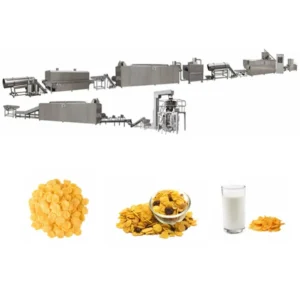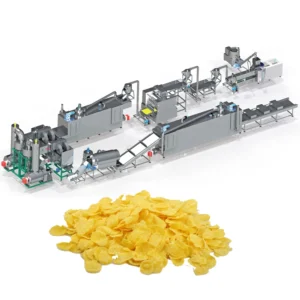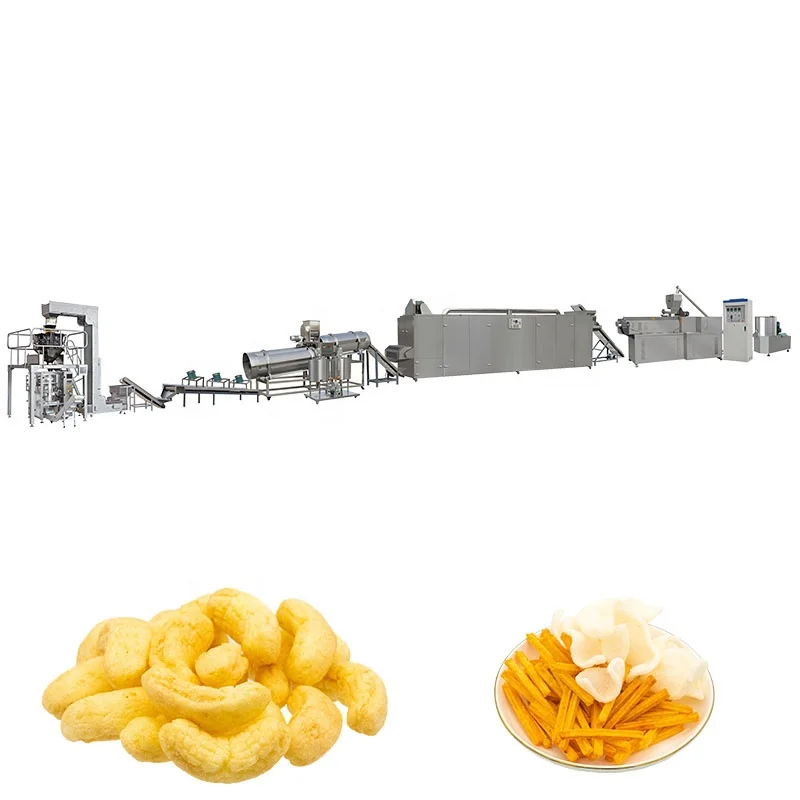
Screw Configuration Matched to Your Grain Blend — Every MT-75 barrel zone and screw element is selected after a trial run on your actual corn, rice, or multi-grain formulation, so gelatinisation and expansion behave the same on your factory floor as they did in our testing workshop.
Technical Specifications
| Parameter | Value |
|---|---|
| Model | MT-75 Twin Screw Extruder |
| Product Type | Twin Screw Corn Flake Extrusion Line |
| Screw Type | Twin-screw |
| Output Capacity | 200–300 kg/hr (basis not stated in source — confirm raw material / moisture / flake thickness) |
| Control System | PLC control system |
| Voltage | 220V / 380V (confirm frequency for destination market) |
| Heating Source (Dryer / Roaster) | Gas or Electric |
| Extruder Working Sections | Feeding, extruding, cutting, heating, gearing, controlling |
| Flaking Machinery Drive | Double motors for separate roller driving; hydraulic system |
| Flaking Temperature Control | Infrared sensor |
| Hot Air Roasting Oven | Vibrating pan, dual circulating fans, cyclone dust removal |
| Coating System | Double tumble sugar melting, elevator, coating drum, spraying nozzle |
| Core Components | Gearbox |
| Warranty | 1 Year (including core components) |
| Machinery Test Report | Provided |
| Video Outgoing-Inspection | Provided |
| Standards | CE, ISO |
Application Suitability
| Application | Material or Output |
|---|---|
| Natural corn flakes | Corn grits, rice, wheat, oat, barley through extrusion, flaking, roasting |
| Sugar-coated corn flakes | Same grain base with sugar spraying, coating, and secondary drying |
| Fortified breakfast cereals | Multi-grain blends with added vitamin and mineral premixes |
| Snack cereal formats | Extruded grain pellets processed into flaked or toasted snacks |
Why Nominal Throughput Rarely Survives Contact with Real Grain
Corn flakes extrusion line technology only delivers rated output when screw geometry and barrel temperatures are tuned to your specific grain blend and moisture content.
I once watched a breakfast cereal line stall because the corn grits arriving at the extruder were coarser than the grind used during factory testing. The extruder choked, flake density climbed, and the roasting oven sat idle waiting for material. The nameplate capacity was technically correct — for a different particle size [NEED_CITE: particle size influence on twin-screw extrusion throughput]. That is why every parameter in corn flakes extrusion line technology must be anchored to your actual raw material, not a catalog benchmark.
Barrel Zone Profiling and Starch Gelatinisation
A twin-screw extruder processes grain through distinct thermal stages. The feed zone must hydrate the grits without premature gelatinisation, while the compression and metering zones raise temperature and shear to complete starch conversion. On the MT-75, each barrel zone is independently heated and monitored through the PLC, so operators can adjust the profile when switching from corn to a higher-fibre oat blend. Consistent gelatinisation is what gives the final flake its bowl-life crispness rather than turning soggy within minutes of hitting milk.
Die Geometry and Flake Blister Formation
The die plate determines pellet shape, moisture release rate, and the surface blister pattern that consumers associate with quality corn flakes. A die with too-large openings produces thick pellets that crack during flaking; undersized holes restrict throughput and raise back-pressure unpredictably. Corn flakes extrusion line technology depends on matching die land length and orifice diameter to the dough viscosity at the metering zone exit [NEED_CITE: die design principles for breakfast cereal extrusion]. The MT-75 screw and die record is documented per order, so re-orders or formulation changes have a known baseline.
Reading the Specs That Actually Matter
The PLC control system is the nerve centre of the MT-75, governing screw speed, barrel temperatures, and feeder rates from a single interface. For buyers comparing machines, the control architecture determines whether an operator can replicate yesterday’s run after a weekend shutdown. The infrared-sensor-controlled flaking rollers maintain a set surface temperature across both rolls, preventing one side of the flake from sticking while the other releases cleanly. In the hot air roasting oven, dual circulating fans and a cyclone dust removal device work together to manage surface blistering without scorching fines that would otherwise accumulate and require manual cleaning.
The Hidden Cost of Skipping the Raw Material Trial
When an extruder ships with a generic screw configuration, the first weeks on-site become an expensive experiment. Operators adjust moisture, feed rate, and barrel heat in search of acceptable flake density, burning raw material and lost production time with every iteration. If the dryer and roaster were sized to a theoretical output that the extruder cannot sustain on your grain, the bottleneck compounds [NEED_CITE: line throughput balancing in cereal processing]. Downstream stations idle, energy costs per kilogram rise, and the line never reaches the financial model that justified the investment.
Why This Line Is Built Around Your Material
The in-house testing workshop runs your grain formulation through the MT-75 before the line ships, generating a trial run report with documented screw, die, and barrel settings. Throughput matching across extruder, flaker, dryer, and roaster is calculated from those trial results, not from a generic capacity table. Screw elements use wear-resistant processing to extend service intervals in abrasive corn and multi-grain applications. The flaking station pairs hydraulic roller pressure with independent double-motor drives for uniform flake thickness. Documentation covers every validated parameter so your production team has a reproducible starting point on day one.
Documentation & Verification
- Screw and die configuration record matched to your grain formulation and target flake thickness
- Trial run report on your raw material documenting barrel temperatures, screw speed, and moisture settings
- Line layout with throughput calculation linking extruder output to flaker, dryer, and roaster capacity
- Electrical schematic confirming voltage, frequency, and PLC language for your facility
- Factory test record and video outgoing-inspection before crate sealing
Installation, Commissioning & Support
- Foundation plan reflecting the MT-75 line footprint and vibrating roaster pan dynamic load requirements
- Dedicated circuit sizing for 220V/380V extruder drive and electric or gas dryer ignition systems
- PLC parameter upload and barrel zone calibration using your trial-run baseline during commissioning
- Operator training on screw speed and moisture adjustments for grain blend changeovers
- Wear parts list covering screws, dies, and flaking roller surfaces with recommended replacement intervals
What to Prepare Before Requesting a Quote
To size the MT-75 correctly, share your primary grain types and typical particle size distribution, target hourly output at a defined moisture level, and available workshop dimensions including ceiling clearance for the elevator and coating drum. Specify your local voltage and frequency along with the preferred PLC display language. If you plan to run both natural and sugar-coated variants, confirm the approximate production split so the coating and secondary drying stations are scaled accordingly.
Frequently Asked Questions
Q: How are screw configuration and barrel temperatures matched to a specific grain blend?
A: Your raw material is run in our testing workshop where we test different screw element arrangements and barrel zone temperatures until flake density, expansion, and surface texture meet your specification. The winning configuration is recorded and replicated on the production extruder before shipment.
Q: How is flake density controlled through die design and extrusion parameters?
A: Die orifice diameter and land length set the pellet shape and moisture content at the exit. Combined with screw speed and barrel heat, these factors determine how much the pellet expands before the flaking rolls compress it into the target thickness and density.
Q: What does a pre-shipment trial run validate?
A: The trial confirms actual throughput on your grain, documents barrel temperature profiles and screw speed settings, measures flake thickness and density after flaking, and verifies that dryer and roaster settings produce the required surface blister and final moisture.
Q: How is throughput balanced between the extruder, flaker, dryer, and roaster?
A: Each station is sized based on the trial-run output rather than a generic rating. The flaker roller width and speed, dryer belt length, and roaster pan area are all calculated to handle the extruder’s validated capacity without creating upstream or downstream bottlenecks.