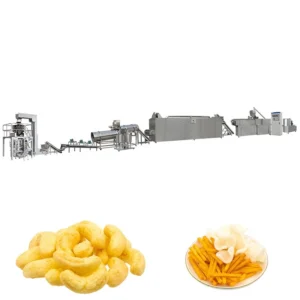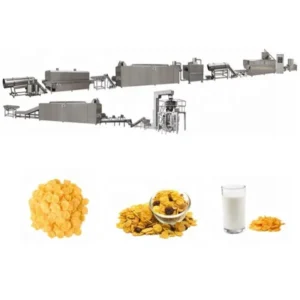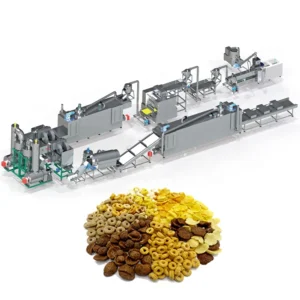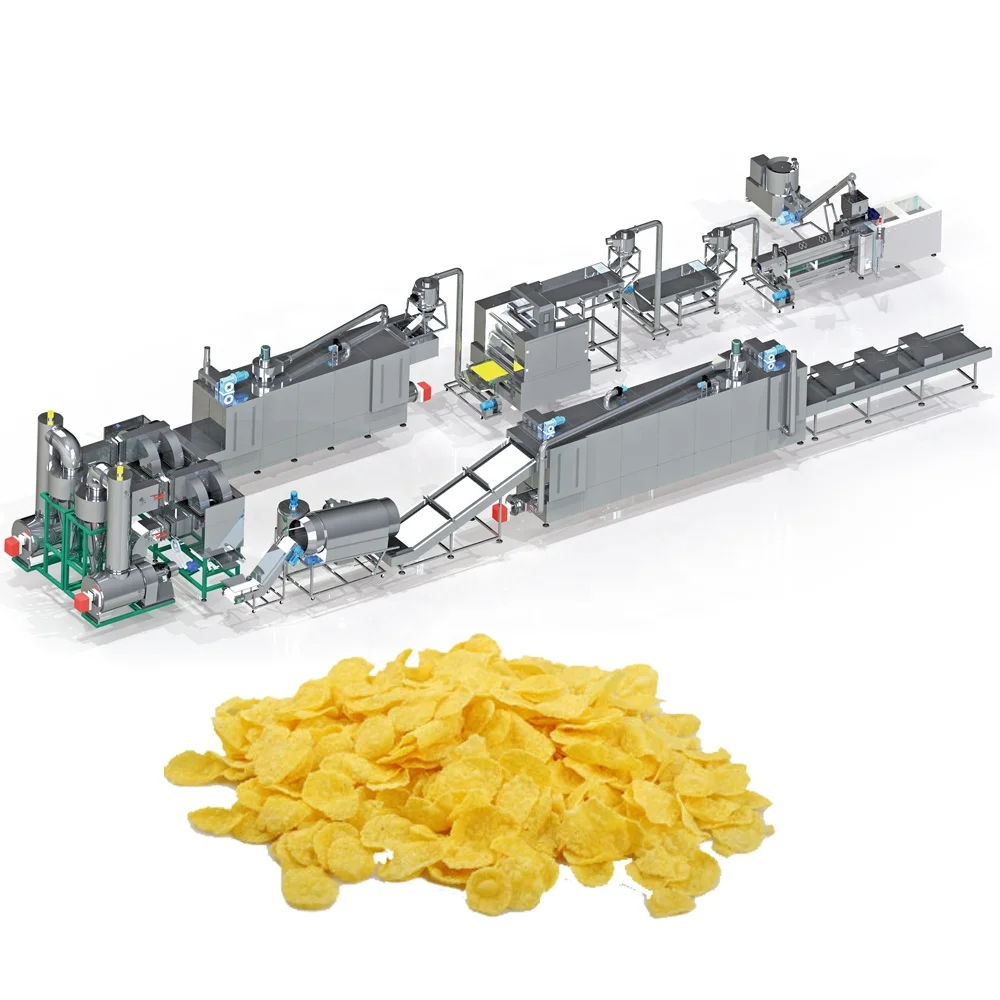
Matched Extrusion Parameters — screw configuration and barrel temperature profile validated against your specific grain formulation before shipment
Technical Specifications
| Parameter | Value |
|---|---|
| Product Type | Corn Flakes Processing Line |
| Model | MT75 |
| Extruder Type | Twin Screw |
| Installed Power | 210 kW |
| Power Consumption | 150 kW |
| Capacity | 300–500 kg/h (basis to be confirmed) |
| Voltage | 380V / 220V |
| Overall Dimensions | 45 × 1.5 × 3.5 m |
| Control System | PLC |
| Line Stations | Mixing, Extruding, Flaking, Drying, Hot Air Roasting, Sugar Spraying, Coating, Cooling, Packing |
| Raw Materials | Corn flour, rice, wheat, oat, barley powder |
| Material | Stainless Steel (food-grade contact parts) |
| Warranty | 1 Year (core components) |
| Certification | CE, ISO |
Application Suitability
| Application | Material or Output |
|---|---|
| Natural corn flakes | Degerminated corn grits |
| Sugar-coated breakfast flakes | Corn, rice, or wheat blends |
| Multigrain cereal flakes | Oat and barley powder formulations |
| Shaped cereal pieces | Ball, tube, ring, star, and loop formats via die change |
Why Generic Screw Builds Fail on Real Grain Batches
A copied screw configuration cannot compensate for variable starch behaviour across different corn sources.
I once watched a line run perfectly on a standard corn flour during the factory test, then produce shattered flakes the moment the buyer loaded their local degerminated grits. The fat content was higher, and the gelatinisation window shifted. Without adjusting the barrel temperature curve and screw element spacing, the extrudate left the die too dry and brittle to survive the flaking rollers. That is the gap between a nominal capacity figure and a line that actually holds output on your raw material. [NEED_CITE: starch gelatinisation behaviour across grain varieties]
Barrel Temperature Zones and Shear Control
The twin-screw extruder in this line uses multiple independently heated barrel zones. Each zone can be set to a different target, allowing the starch to hydrate and gelatinise progressively rather than shocking the material with a single heat spike. Correct zone profiling is what gives the extrudate enough internal moisture uniformity to produce consistent surface blistering during the roasting stage.
Die Geometry and Flake Expansion
The die plate determines the cross-section of the extruded rope before it hits the flaking rollers. For traditional flat flakes, a narrow slit die is standard. When the target shifts to shaped cereal pieces — rings, stars, or fruit loops — the die face changes entirely, and the screw configuration must be retuned to deliver the right expansion ratio at the new die geometry. This is where corn flakes extrusion technology screw configuration decisions directly determine whether the final product matches market expectations.
Moisture Injection and Residence Time
Water or steam injection points along the barrel let the operator fine-tune dough moisture mid-process. Combined with screw speed adjustments, this controls residence time inside the barrel. A longer residence time at lower shear suits high-oat formulations that gelatinise slowly; a shorter, higher-shear pass works better for pure corn grits. Getting this wrong means either under-cooked centres that collapse after flaking or over-worked dough that emerges gummy. [NEED_CITE: twin-screw residence time and shear rate principles]
Matching Downstream Throughput
The flaking machine uses a hydraulic system with double motors driving separate rollers, and the roasting oven relies on two circulating fans with a cyclone dust removal device. If the extruder is set to push 500 kg/h but the flaking roller gap and roasting oven belt speed are not matched to that volume, flakes pile up, cool unevenly, or pass through the oven too fast to develop the required crunch. Every station must hold the same throughput the extruder delivers.
The Cost of Skipping a Pre-Shipment Trial
When a buyer accepts shipment without a trial run on their own raw material, the first weeks of production become an expensive experiment. Screw elements get swapped, barrel zones get reprogrammed, and flaking roller pressure gets adjusted by trial and error — all while producing off-spec product that cannot be sold. In some cases, the wrong screw configuration causes excessive wear on the barrel liner, shortening the interval before the first costly replacement set is needed. [NEED_CITE: extruder wear from incorrect screw and barrel pairing]
Why This Line Is Configured Around Your Material
The screw configuration and die design are specified to your raw material formulation and target flake density, not pulled from a generic build library. The in-house testing workshop runs your actual grain blend before the line ships, documenting screw speed, barrel temperatures, and moisture levels that produce acceptable blistering and crunch. The PLC control system stores these validated parameters so operators can recall them batch after batch. Downstream stations — flaking, drying, roasting — are capacity-matched to the extruder output so no single station bottlenecks the line. Electrical schematics confirm voltage, frequency, and control language for your facility before production begins.
Documentation & Verification
- Screw and die configuration record matched to your grain blend and target flake density
- Trial run report on your raw material showing barrel temperature profile and moisture data
- Line layout with throughput calculation across every station from mixer to packer
- Electrical schematic with confirmed voltage, frequency, and PLC interface language
- CE declaration of conformity and ISO certificate for the complete processing line
- Operation and maintenance manual with wear parts list for screws, dies, and rollers
Installation, Commissioning & Support
- 45 m line footprint requires level concrete floor with anchor points at extruder and flaking stations
- 210 kW installed load needs a dedicated circuit with correct breaker rating for 380V or 220V supply
- PLC cabinet pre-wired and labelled; on-site wiring limited to inter-station connections and utilities
- First production run supervised to validate screw speed, barrel zones, and flaking roller gap settings
- Operator training covers recipe recall, moisture adjustment, and die changeover for different cereal shapes
- Wear parts list identifies screw elements, die plates, and flaking roller surfaces with reorder codes
What to Prepare Before Requesting a Quotation
Share your raw material specification — corn grits source, fat and moisture content, particle size distribution — along with the target flake thickness and whether sugar coating is required. Confirm your facility voltage and frequency, the available floor space and ceiling height, and the preferred PLC interface language. If you are replacing an existing line, note which upstream and downstream equipment will remain in use so the new stations can be matched.
Frequently Asked Questions
Q: How do screw configuration and barrel temperature profile affect flake density and surface blistering?
A: The screw element sequence controls shear intensity and residence time, which determine how completely the starch gelatinises. Barrel zone temperatures then set the moisture level of the extrudate as it exits the die. Together, these parameters decide whether the flake roasts into a light, blistered crisp or a dense, hard chip. Configuration must match your specific grain formulation.
Q: What extrusion moisture level is needed for different grain blends?
A: Pure corn grits typically need a different moisture target at the die face than oat-heavy or wheat-blend formulations. Higher-fat materials require careful moisture control because fat interferes with starch expansion. The trial run in the testing workshop establishes the correct moisture setpoint for your blend before the line ships.
Q: How is extruder throughput matched to flaking and roasting capacity?
A: The flaking roller speed and gap, the dryer belt speed, and the roasting oven fan output are all calculated to handle the extruder’s validated output rate. If any station is undersized, flakes accumulate or pass through too quickly, resulting in uneven drying and inconsistent texture across the batch.
Q: Can trial runs be performed on my actual raw material before shipment?
A: Yes. The in-house testing workshop runs your grain blend through the extruder, flaking machine, and roasting oven. The trial run report documents the screw speed, barrel temperature profile, moisture injection rate, and resulting flake density, blistering, and crunch — giving you validated parameters before the line arrives at your facility.