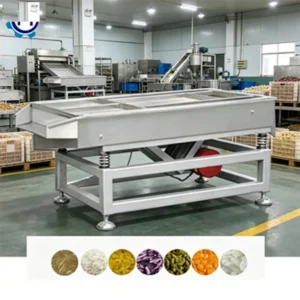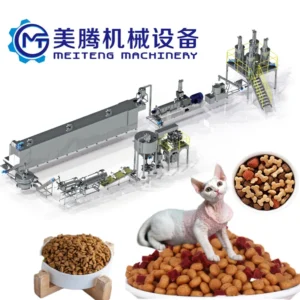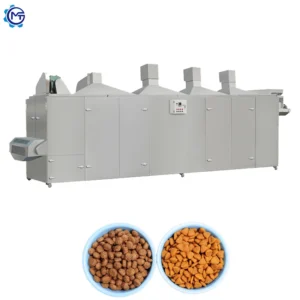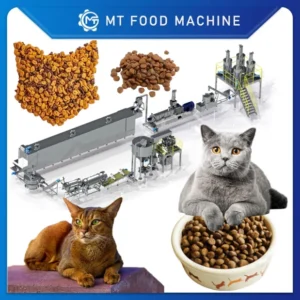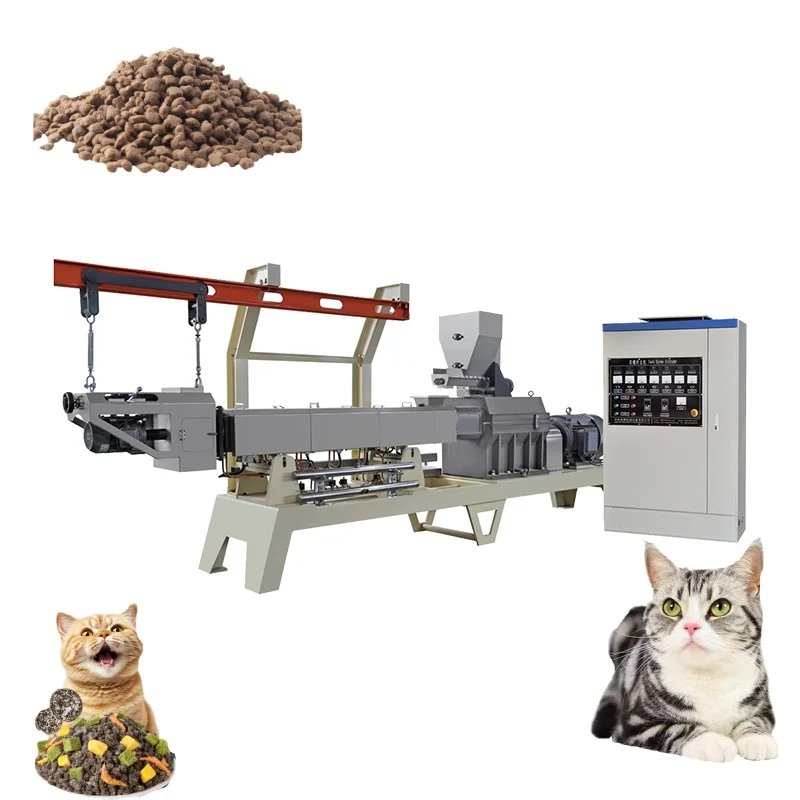
Screw-Configured Extrusion — twin-screw geometry and die sizing mapped to your raw material formulation before any metal is cut, validated on actual samples in the testing workshop.
Technical Specifications
| Parameter | Value |
|---|---|
| Product Type | Pet Food Extrusion Production Line |
| Output Capacity | Up to 3 tons per hour (basis not stated in source — confirm raw material type, moisture content, and kibble size) |
| Versatile Applications | Dog, cat, and fish feed production |
| Warranty | 1-year comprehensive warranty |
| Process Visualization | Fish feed process drawing included |
| Control System | Available with PLC or MCC control (confirm configuration) |
| Voltage & Frequency | Configurable to target market standards (confirm requirements) |
| Screw Type | Single or twin screw (confirm selection) |
| Certification | CE and ISO certification available (verify for this specific line) |
Application Suitability
| Application | Material or Output |
|---|---|
| Dry dog kibble production | Corn, wheat, rice, meat meal, and bone meal blends |
| Cat food extrusion | High-protein formulations with fish meal and poultry by-product |
| Floating aquatic feed | Starch-rich formulations requiring controlled expansion |
| Sinking fish feed | Dense formulations with minimal expansion ratio |
| Specialty pet treats | Core-filled or textured formats using modified screw setups |
What "3 Tons per Hour" Actually Means on Your Floor
A capacity figure without raw material context is a guess, not a guarantee.
I have watched lines ship out with a rated throughput that falls apart the moment the buyer switches from our test flour to their local grain supply. The starch content, particle size, and moisture level of your actual recipe change how material behaves inside the barrel — shift one variable and the expansion ratio drifts, the kibble density moves outside spec, and the dryer can no longer keep pace. This is why I refuse to quote a throughput number without first running your recipe through the testing workshop. [NEED_CITE: raw material variability in extrusion throughput]
How Screw Geometry Dictates Kibble Density
The length-to-diameter ratio and element arrangement inside the barrel control residence time and shear intensity. A high-shear configuration breaks down starch granules aggressively, producing a lighter, more expanded kibble suited to dog food. A gentler profile preserves more structure, yielding the denser pellet that aquaculture markets demand for sinking feed. When we match the twin screw pet food extruder specifications to your target product, we are really choosing how much mechanical energy the material absorbs before it exits the die.
Barrel Temperature Zones and Starch Gelatinisation
Each barrel section carries its own heating and cooling circuit, letting the process engineer build a temperature gradient that matches the recipe. Early zones hydrate the starch without premature gelatinisation; middle zones apply the heat spike needed for full conversion; final zones stabilise the melt before the die. If a zone runs too hot, the material scorches and the kibble takes on a bitter note that dogs reject. Too cool, and the starch remains partially raw, compromising digestibility and shelf life. [NEED_CITE: starch gelatinisation temperature ranges in food extrusion]
Reading the Spec Sheet Against Your Actual Recipe
Output capacity figures only hold when the raw material matches the test conditions. A line rated at high throughput on pure corn grits may slow considerably on a blend heavy in meat meal, because protein and fat change the melt viscosity and the screw must work harder. The control system choice — PLC versus MCC — determines whether you can store recipe profiles and recall them at the touch of a screen, or whether operators manually adjust each zone every time the formulation changes. Voltage and frequency must align with the destination country’s grid; a motor wound for the wrong supply will overheat within the first production shift. Screw type selection — single versus twin — affects how well the extruder handles fibrous or high-fat formulations that tend to slip in a single-screw flight.
The Hidden Cost of a Generic Screw Build
A screw configuration lifted from a catalogue rather than matched to your recipe produces kibble that looks right on the surface but fails the bite test. The expansion may be uneven, leaving some pieces too hard for small breeds and others too soft to survive the coating drum. Downstream, the dryer burns extra fuel chasing moisture targets that a correctly configured extruder would have met at the die. Operators compensate with constant adjustments, driving up scrap and wearing the screw elements prematurely. [NEED_CITE: extrusion screw wear patterns under off-spec operation]
Why Process Engineers Source from This Workshop
Every screw and die combination is documented against the buyer’s raw material, not pulled from a generic library. The in-house testing workshop runs your actual recipe before the line ships, generating a trial report that captures the temperature profile, screw speed, and moisture settings that produced acceptable kibble. Line layout calculations match throughput across mixing, extrusion, drying, coating, and packing so no single station bottlenecks the rest. Electrical schematics confirm voltage, frequency, and control language before production begins, eliminating the commissioning delays that arise when a panel arrives wired for the wrong grid. Twin-screw expertise spans pet food, aquatic feed, and snack applications, so the same engineering team that configures a dog kibble line can reconfigure it for floating fish pellets when market demand shifts.
Documentation & Verification
- Screw and die configuration record matched to your raw material formula
- Trial run report generated on your actual ingredients before dispatch
- Electrical schematic confirming target voltage, frequency, and panel language
- Line layout with capacity calculation showing throughput balance at every station
- CE declaration of conformity and ISO certificate for the complete line
Installation, Commissioning & Support
- Foundation plan sized to the extruder’s footprint and dynamic vibration load
- Dedicated electrical circuit matching confirmed voltage and frequency at the main panel
- Barrel sections and screw shafts assembled on-site with alignment verified by dial indicator
- First-run parameter logging across all heating zones to establish baseline recipe profile
- Operator training covering screw speed, moisture injection, and die changeover procedures
- Wear parts list specifying screw elements, die plates, and cutter bearings with reorder intervals
Before You Send an Inquiry
Provide your raw material formulation — including protein percentage, fat content, and moisture level — along with the target kibble size and density range your market expects. Specify your facility’s available voltage and frequency, the control language your operators read, and whether you need the line to integrate with existing mixing or packing equipment. If you want a trial run on your own ingredients before committing, state that in the first message so we schedule testing workshop time alongside the quotation.
Frequently Asked Questions
Q: How is the screw configuration selected for my raw material and target kibble density?
A: We start with your ingredient list, protein-to-starch ratio, and the density your market requires. The process engineer then selects screw element types, pitch, and arrangement to deliver the right shear and residence time, and validates the setup on your actual material in the testing workshop before the extruder ships.
Q: What extrusion parameters control expansion ratio and final kibble texture?
A: Screw speed, barrel temperature profile, moisture injection rate, and die geometry together determine how much the material expands as it exits. Adjusting any one variable shifts the expansion ratio, so the trial run captures the full parameter set needed to hold your target texture consistently.
Q: Can I run a trial on my own raw material before committing to the full line?
A: Yes. The testing workshop accepts your ingredient shipment and runs the configured extruder on your recipe, producing a trial report with kibble samples, recorded parameters, and measured density values so you can evaluate the product before the line is built.
Q: How do barrel temperature zones affect starch gelatinisation in pet food extrusion?
A: Each zone heats or cools independently, creating a gradient that hydrates starch early, gelatinises it at peak temperature, then stabilises the melt before the die. Correct profiling prevents scorching in high-sugar recipes and ensures full conversion for digestibility.
Q: What documentation proves the extruder is configured for my product specifically?
A: You receive a screw and die configuration record listing every element and its position, a trial run report on your material with measured outputs, and electrical schematics confirming voltage and control language — not a generic manual but a production-specific file package.