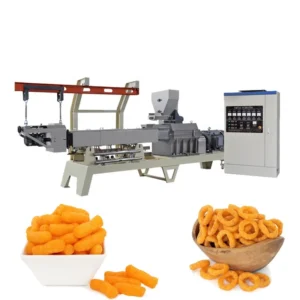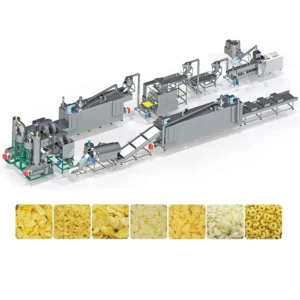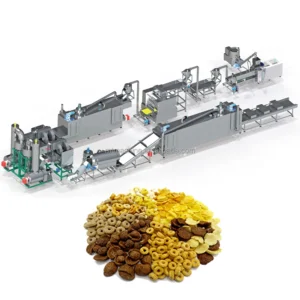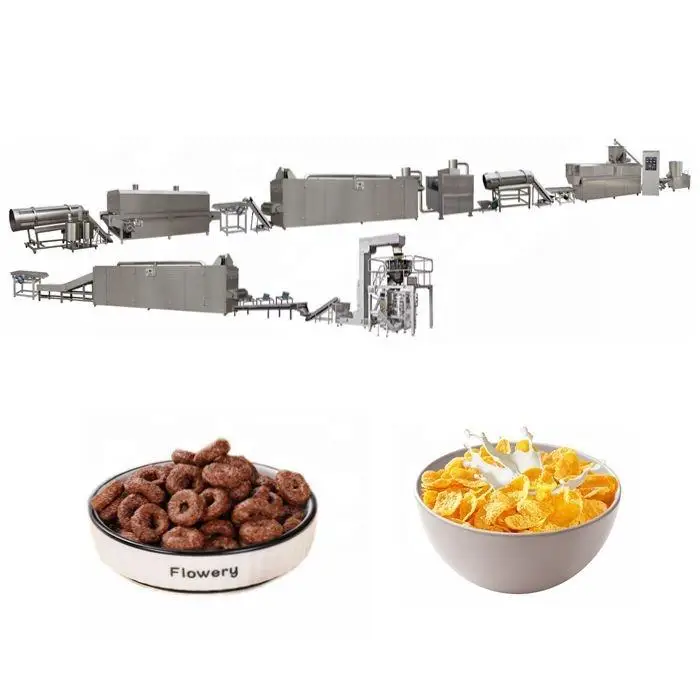
Screw Geometry as Process Variable — Every MT75 configuration we ship records the exact screw element sequence and die land length matched to the buyer’s cereal formulation, not a generic build copied from a catalogue line.
Technical Specifications
| Parameter | Value |
|---|---|
| Model | MT75 |
| Product Type | Corn Flakes Production Line |
| Screw Type | Twin Screw |
| Installed Power | 210 kW |
| Power Consumption | 150 kW |
| Output Capacity | 300–500 kg/h (basis not stated in source — confirm raw material, moisture content, and product format) |
| Overall Line Dimensions | 45 × 1.5 × 3.5 m |
| Control System | PLC |
| Dryer Heating Source | Gas or Electric (configurable) |
| Flaking System | Hydraulic double-roller, double motor separate drive, infrared temperature sensor |
| Roasting Oven | Conciliation burner, dual circulating fans, cyclone dust removal |
| Coating System | Double tumble sugar melter, elevator, coating drum, spray nozzle |
| Final Product Formats | Corn flakes, sugar-coated flakes, ball, tube, stick, ring, fruit loop, star, wheel, flower, heart |
| Compatible Raw Materials | Corn, rice, wheat, oat, barley powder |
| Certifications | CE, ISO |
Application Suitability
| Application | Material or Output |
|---|---|
| Natural corn flake breakfast cereal | Corn grits or corn flour base, roasted without sugar coating |
| Sugar-coated corn flake cereal | Corn or multi-grain base with sugar or honey spray coating |
| Multi-grain extruded cereal shapes | Rice, wheat, oat, or barley blends in ring, ball, star, or loop format |
| Fortified breakfast cereal production | Cereal base with added vitamin and mineral premix in flake or pellet format |
Why Screw Configuration Matters More Than Quoted Output
A 500 kg/h rating means nothing if the screw elements are set for corn grits but your formulation uses an oat-heavy blend.
We see it repeatedly on corn flakes extrusion production line technology projects: the line arrives, the buyer loads their actual premix, and the extrudate either over-expands and shatters in the flaking rolls or stays dense and refuses to blister in the roasting oven. The throughput number on the quotation was based on a reference material that never matched the buyer’s recipe. Starch gelatinisation temperature shifts with every grain ratio change, and barrel zones that work for pure corn will under-cook a wheat-oat blend or scorch a high-rice formulation. [NEED_CITE: starch gelatinisation temperature variance across cereal grains]
Barrel Temperature Profile and Starch Gelatinisation
The twin-screw extruder in this line operates across multiple independently heated barrel zones. Each zone can be set to a different temperature target through the PLC, allowing the operator to build a gradual thermal profile that brings the starch paste through gelatinisation without flash moisture loss. Corn starch typically gelatinises between 62 and 72 degrees Celsius, but the actual peak depends on moisture content and the presence of lipid or fibre from whole-grain corn or blended cereals. The corn flakes extrusion production line technology relies on holding the melt at the correct viscosity long enough for complete hydration before the material reaches the die face.
Die Geometry and Expansion Ratio Control
The die plate at the extruder discharge determines the cross-section of the extrudate rope before it enters the flaking rolls. A smaller die orifice with a longer land length generates higher back-pressure, which suppresses expansion and yields a denser pellet that flakes into a thicker, crunchier sheet. Larger orifices with shorter lands allow more expansion at the die exit, producing a lighter sheet that may shatter under roller pressure. Interchangeable die inserts let a single extrusion platform produce flake feedstock as well as direct-expanded shapes like rings, stars, and loops by swapping the die plate and adjusting screw speed accordingly. [NEED_CITE: die land length influence on extrudate density in cereal processing]
Interpreting the Line Specifications for Your Process
The 210 kW installed power across the MT75 line reflects the combined draw of the twin-screw main drive, feeder motors, flaking roll hydraulics, dryer burners or electric heaters, and roasting oven fans. Actual power consumption sits around 150 kW during steady-state operation, with peaks during start-up and product changeover. The hydraulic double-roller flaking unit uses separate motors for each roller, which prevents speed mismatch that can tear the cereal sheet or produce uneven thickness. Infrared temperature sensing on the flaking rolls catches thermal drift before it affects sheet consistency. The roasting oven’s conciliation burner paired with two circulating fans and a cyclone dust collector gives operators control over surface blistering without scorching the flake interior — a balance that defines bowl-life and crunch retention in milk.
What Happens When Extruder and Dryer Capacity Are Mismatched
An extruder running at full output feeds wet, soft flakes into a dryer that cannot remove moisture fast enough. The flakes mat together on the belt, stick to the mesh, and arrive at the roasting oven with uneven moisture content. The roasting stage then over-dries some pieces while leaving others underdone, creating a mixed batch that fails bowl-life testing. This bottleneck is invisible on the quotation if each station was sourced from a different vendor with no throughput reconciliation. [NEED_CITE: throughput matching across extrusion drying and roasting stages]
Why the Trial Run Cannot Be Skipped
Every grain blend behaves differently under shear and heat. A formulation that includes oat bran will absorb moisture at a different rate than pure corn grits, changing the residence time needed inside the barrel. Our in-house testing workshop runs the buyer’s actual raw material through the configured screw and die set before the line ships. The trial run report documents barrel temperatures, screw speed, moisture addition rate, and the resulting flake density and blister pattern after roasting. This is the same data the operator will use on day one of production, eliminating the weeks of trial-and-error that otherwise follow installation.
What We Build Into Every Corn Flake Line
Screw configurations are specified against the buyer’s declared raw material blend and target flake density, not pulled from a default build sheet. The flaking, drying, and roasting stations are sized to match the extruder’s actual throughput on that material, preventing the downstream bottlenecks that strand production lines at half capacity. PLC control language and electrical schematics are confirmed to the buyer’s local voltage, frequency, and operator language before fabrication begins. CE and ISO documentation ships with every line, and spare screw elements, die inserts, and flaking roll surfaces are listed with part numbers so replacements can be ordered before the first wear cycle ends. [NEED_CITE: CE machinery directive compliance for food extrusion equipment]
Documentation & Verification
- Screw element sequence and die configuration record tied to your cereal formulation
- Trial run report on your supplied raw material with flake density and blister data
- Electrical schematic with voltage, frequency, and PLC language confirmed pre-build
- Line layout with station throughput reconciliation across extrusion through packing
- CE declaration of conformity and ISO certificate for customs and regulatory filing
- Wear parts list with part numbers for screws, dies, and flaking roll surfaces
Installation, Commissioning & Support
- Foundation plan accounts for the 45 m line length and roasting oven vibration isolation
- Electrical room must supply 210 kW at the confirmed voltage and frequency with dedicated breaker circuits
- PLC interface loaded with the agreed operator language before the control cabinet leaves the factory
- Commissioning includes first production run on your raw material with barrel zone and roller pressure tuning
- Operator training covers screw changeover, die swap for alternate shapes, and roasting oven burner adjustment
- Spare screw elements and die inserts shipped with the line to cover the initial wear interval
What We Need to Configure Your Line
Send us your target cereal formulation — the grain types, ratios, and any added fibre, protein, or vitamin premix — along with the flake thickness and bowl-life specification your market expects. Confirm the electrical supply at your facility, including voltage, phase, and frequency, and the language your operators will use on the PLC screen. If you have existing upstream milling or downstream packing equipment, share the interface dimensions and throughput so we can match the line endpoints.
Frequently Asked Questions
Q: How is screw configuration selected for different cereal bases like corn versus wheat or oat?
A: Each grain has a distinct starch gelatinisation range and fibre content that affects melt viscosity inside the barrel. We select screw element types — conveying, kneading, and reverse elements — and their sequence to match the shear and residence time your specific blend requires. The configuration is documented before build and validated during the trial run on your supplied raw material.
Q: What barrel temperature and moisture level are needed for proper starch gelatinisation in corn flake extrusion?
A: Corn starch gelatinises between roughly 62 and 72 degrees Celsius, but the effective target shifts with moisture content and grain blend composition. Barrel zones are set in a graduated profile through the PLC, and water or steam injection rate is tuned during the trial run to achieve full gelatinisation without flash drying at the die face.
Q: How is flake density controlled across the extrusion, flaking, and roasting stages?
A: Density starts at the die — orifice size and land length set the extrudate expansion ratio. The hydraulic flaking rolls then compress the rope to the target sheet thickness, with infrared sensors monitoring roll temperature. The roasting oven’s conciliation burner and circulating fans develop the final blister pattern and moisture reduction that locks in crunch and bowl-life.
Q: Can the same twin-screw extruder produce both corn flakes and other cereal shapes?
A: Yes. By swapping the die plate and adjusting screw speed and barrel profile, the extruder can produce direct-expanded rings, balls, stars, loops, and other shapes without additional hardware. The flaking rolls are bypassed for these formats, and the product moves directly to drying and coating stages.