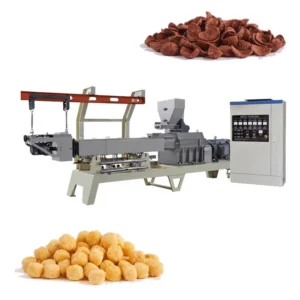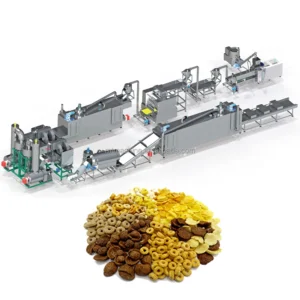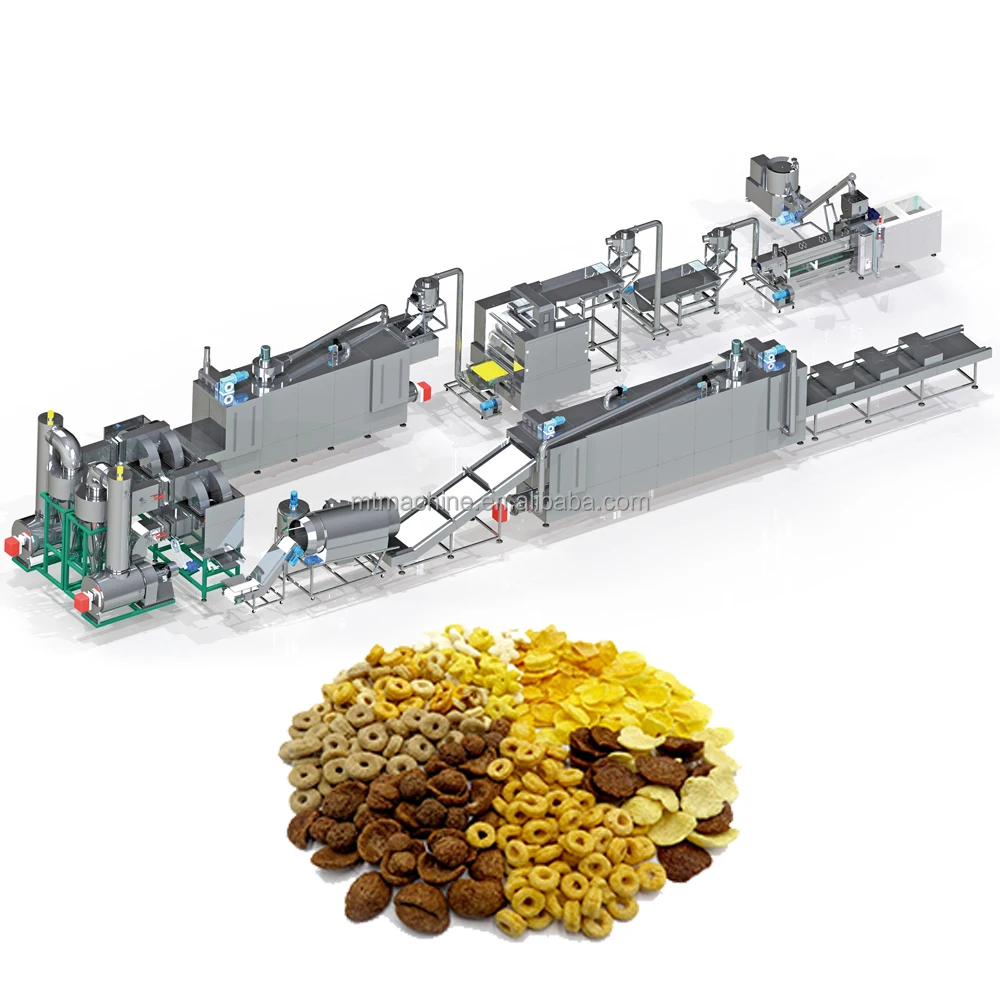
Screw geometry matched to grain recipe — Our twin-screw configuration and barrel temperature profile are developed around your specific corn, oat, or wheat blend, not copied from a generic cereal build, ensuring starch gelatinisation reaches the level your flake density demands.
Technical Specifications
| Parameter | Value |
|---|---|
| Model | MT-75 |
| Product Type | Twin Screw Corn Flakes Extrusion Production Line |
| Screw Type | Twin screw |
| Output Capacity | 200–300 kg/h (basis not stated in source — confirm raw material, moisture content and flake format) |
| Rated Power | 3 kW (source value — verify against full line catalog; may refer to single station) |
| Voltage & Frequency | 220V / 380V (frequency to be confirmed per destination market) |
| Control System | PLC control system (flaking machinery station) |
| Line Stations | Mixing → Extruding → Flaking → Drying → Hot Air Roasting → Cooling → Packing |
| Sugar Coating Variant | Adds Sugar Spraying → Sugar Coating → Secondary Drying after roasting |
| Extruder Screw Feature | Automatic lubricating and cooling; wear-resistant screw treatment |
| Flaking Machinery | Hydraulic double-roller system; dual independent motors; infrared temperature sensor |
| Dryer Heating Source | Gas or Electric |
| Hot Air Roasting Oven | Vibrating pan, dual circulating fans, cyclone dust removal |
| Coating System | Double tumble sugar melter, elevator, coating drum, spray nozzle |
| Assembly State | Complete line with supporting equipment |
| Warranty | 1 Year (Gearbox included as core component) |
Application Suitability
| Application | Material or Output |
|---|---|
| Traditional corn flakes | Corn grits, maize flour |
| Multi-grain breakfast flakes | Wheat, rice, oat, barley blends |
| Sugar-coated cereal flakes | Corn or grain base with sucrose or syrup glaze |
| Fortified breakfast cereal | Grain base with added vitamin and mineral premix |
| Puffed snack variants | Line reconfiguration using alternate die and cutting setup |
What "200–300 kg/h" Really Means on Your Grain Blend
Capacity numbers are only honest when the raw material and moisture content sit right next to them.
I have watched a corn flakes extrusion production line run flawlessly on pure corn grits in the factory, then choke within the first hour when the buyer switched to a high-fibre oat-wheat mix on site. The starch gelatinisation window shifted, shear inside the barrel dropped, and the flakes came out dense and hard — two weeks of re-tuning the screw elements and barrel zones before the line approached its nameplate throughput again [NEED_CITE: starch gelatinisation temperature variance across cereal grains]. A corn flakes extrusion production line turnkey quote that omits the grain recipe is a guess, not an engineering commitment.
How Barrel Temperature Profile Controls Flake Crispness
A corn flakes extrusion production line turnkey project lives or dies by the thermal history the dough receives inside the barrel. Each heating zone must be set so that starch granules absorb water and swell without rupturing prematurely; too early and the dough loses elasticity before the die, too late and the pellet exits under-cooked, producing a flake that stays chewy after roasting. The MT-75 barrel sections allow independent temperature control, letting the process engineer build a gradient that matches the gelatinisation onset of the specific grain or blend being fed.
Screw Element Sequencing for Fibre-Rich Formulations
When oat bran or wheat germ enters the recipe, the standard conveying and kneading block arrangement often fails to generate sufficient mechanical shear. Replacing two neutral kneading discs with reverse-angle elements increases residence time and shear rate, compensating for the lubricating effect of bran particles [NEED_CITE: effect of dietary fibre on twin-screw extrusion torque]. The MT-75 screw shaft accepts modular elements, so the configuration can be re-sequenced when the buyer introduces a new SKU without replacing the entire screw assembly.
Reading the Spec Sheet Beyond Nominal Numbers
The listed 3 kW rated power likely reflects a single station rather than the aggregate line draw; buyers planning transformer capacity and cable runs must request a full utility schedule before finalising the electrical room layout. Voltage options span 220 V and 380 V, but the frequency — 50 Hz or 60 Hz — determines motor speed and therefore screw RPM, which in turn affects shear and output. The hydraulic flaking station uses infrared temperature feedback to maintain roller surface conditions, preventing dough sticking or uneven sheet thickness that would propagate through to the roasting oven. Dual circulating fans inside the hot air roasting oven create cross-flow across the vibrating pan, giving each flake a comparable thermal exposure and consistent surface blistering.
The Hidden Cost of Skipping a Trial Run
A buyer who accepts shipment without witnessing a test on their own grain blend inherits every variable the factory defaulted to. Screw wear accelerates when the actual abrasive mineral content in locally sourced corn exceeds the reference material, and die land length optimised for one pellet geometry may restrict flow on another, forcing the operator to raise barrel pressure and risk motor overload [NEED_CITE: abrasive wear rates in food extrusion screws]. These issues surface during commissioning — when travel, accommodation and downtime costs multiply.
Why This Line Is Engineered Differently
Screw and die geometry are specified against the buyer’s grain formulation and target flake density, not pulled from a catalogue default. The in-house testing workshop runs the buyer’s actual raw material before the line ships, so the barrel temperature curve and screw sequence are documented, not guessed. Every station — mixer throughput, extruder output, flaking roller speed, dryer belt load, roasting oven residence time — is calculated as a single system to prevent bottlenecks. Electrical schematics confirm voltage, frequency and PLC language before metal is cut. Wear parts lists and screw element drawings travel with the shipment, so the first replacement order can be placed without emergency measurements.
Documentation & Verification
- Line layout and throughput calculation matching extruder output to flaking mill and roasting oven capacity
- Screw element sequence and die land record tailored to buyer’s grain recipe
- Trial run report on customer-supplied raw material from the in-house testing workshop
- Electrical schematic confirming voltage, frequency and PLC interface language
- CE declaration of conformity and ISO certificate with factory test record
Installation, Commissioning & Support
- Foundation pad and utility trench plan reflecting the full line footprint and hydraulic flaking station load
- Dedicated circuit schedule for 380 V three-phase supply with isolator sizing per station motor
- Modular extruder barrel sections allow on-site assembly without overhead crane beyond standard workshop capacity
- First-run parameter log capturing barrel zone temperatures, screw RPM and hydraulic roller pressure for the buyer’s grain
- Operator training covering screw element changeover, infrared sensor calibration and roasting oven fan balance
- Wear parts list identifying screw flights, die inserts and flaking roller surfaces with reorder part numbers
What to Include in Your Inquiry
Send the exact grain formulation — including percentage of corn, oat, wheat or barley and any vitamin premix — along with target flake thickness and moisture at packing. Confirm your facility voltage, frequency and preferred PLC language. If you plan to run both natural and sugar-coated variants, note the expected ratio so the coating drum and secondary dryer can be sized from the start.
Frequently Asked Questions
Q: How is the 200–300 kg/h capacity verified against my specific grain blend?
A: We run your actual raw material in our testing workshop, recording barrel temperatures, screw RPM and flake density. The resulting trial report documents the achievable throughput at your moisture content and recipe, replacing the generic nameplate figure with a recipe-specific value.
Q: What screw configuration is recommended for high-fibre oat or wheat blends?
A: High-fibre recipes typically require reverse-angle kneading elements to maintain shear. We sequence the screw elements based on your formulation’s fibre percentage and fat content, then validate the arrangement during the pre-shipment trial run.
Q: How do you prevent the dryer or roasting oven from bottlenecking extruder output?
A: Each station’s capacity is calculated from the extruder’s confirmed throughput at your recipe. Belt speed, oven residence time and fan volume are matched so the wettest flake entering the dryer exits within moisture spec before reaching the roasting stage.
Q: What voltage and PLC language options are confirmed before production?
A: We request your site voltage, frequency and preferred PLC interface language at the proposal stage. The electrical schematic and control panel legend are reviewed and signed off before the line enters assembly, avoiding rewiring or reprogramming during commissioning.