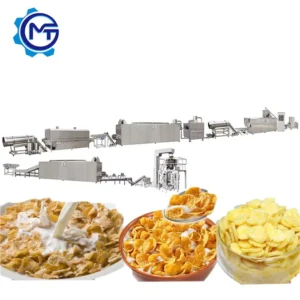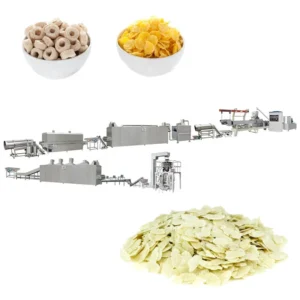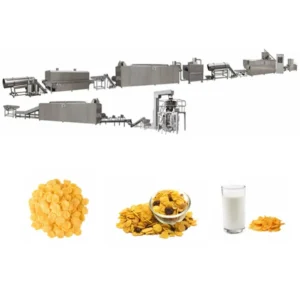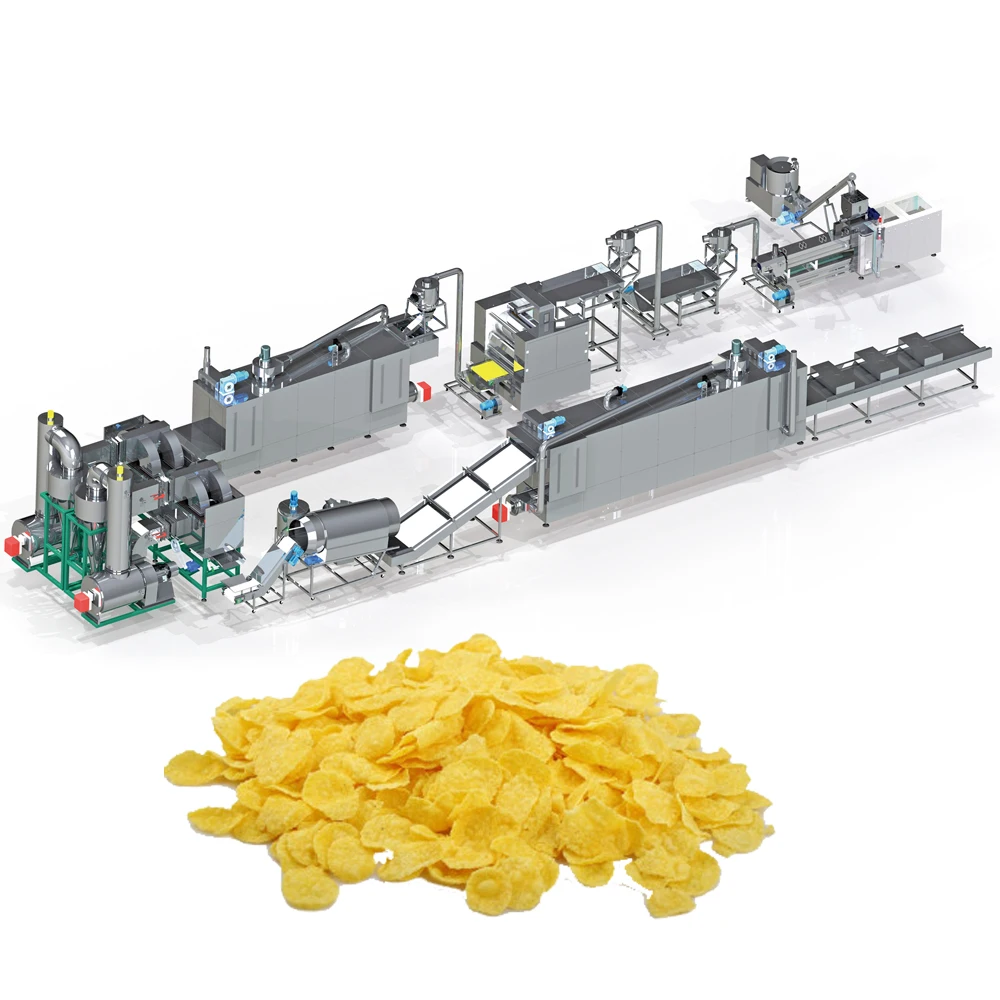
Integrated Extrusion Technology — Every screw element and barrel zone on the MT70 corn flakes extrusion line is configured around your specific grain formulation to control starch gelatinisation and final flake texture.
Technical Specifications
| Parameter | Value |
|---|---|
| Product Type | Corn Flakes Production Line |
| Model Options | MT70 / MT85 / MT75 |
| Installed Power | MT70: 160 kW / MT85: 190 kW / MT75: 210 kW |
| Power Consumption | MT70: 120 kW / MT85: 140 kW / MT75: 150 kW |
| Output Capacity | MT70: 150–200 kg/h (basis to be confirmed) / MT85: 300–400 kg/h (basis to be confirmed) / MT75: 300–500 kg/h (basis to be confirmed) |
| Overall Dimensions (L×W×H) | MT70: 41 × 1.5 × 2.2 m / MT85: 43 × 1.5 × 3.2 m / MT75: 45 × 1.5 × 3.5 m |
| Extruder Type | Twin Screw with automatic lubricating and cooling |
| Control System | PLC control (flaking machinery); MCC and PLC (line level) |
| Flaking Drive | Hydraulic double-roller system with separate dual motors |
| Flaking Temperature Control | Infrared sensor monitoring with temperature pipe |
| Dryer Heating Source | Gas or Electric (configurable) |
| Hot Air Roasting Oven | Conciliation burner, dual circulating fans, cyclone dust removal |
| Coating System | Double tumble sugar melting, elevator, coating drum, spraying nozzle |
| Certifications | CE, ISO |
Application Suitability
| Application | Material or Output |
|---|---|
| Natural corn flakes production | Corn powder with controlled moisture content |
| Sugar-coated corn flakes | Corn, rice, or wheat powder with sugar coating stage |
| Shaped cereal formats (rings, stars, fruit loops, balls, tubes) | Corn, rice, wheat, oat, or barley powder with die change |
| Multi-grain breakfast cereals | Blended oat, barley, and wheat formulations |
| Fortified breakfast cereal lines | Grain powder blends with added nutritional premix |
Why Starch Gelatinisation Dictates Your Line Design
The extruder screw profile and barrel temperature zones must match your exact grain blend — generic configurations produce inconsistent flake density and poor bowl life.
When a breakfast cereal producer installs a corn flakes extrusion production line built on generic screw settings, the first sign of trouble appears at the roasting oven. Flakes that have not achieved uniform starch gelatinisation inside the barrel emerge with variable moisture, leading to uneven blistering and a texture that either shatters or goes stale within days on the shelf. I have walked into facilities where operators spent weeks adjusting dryer temperatures to compensate for problems that actually originated upstream in the extruder barrel [NEED_CITE: twin-screw extrusion parameters for cereal grain processing]. The corn flakes extrusion production line specifications you evaluate should always show screw element arrangement matched to your raw material, not a default build.
Barrel Temperature Profile and Starch Conversion
The twin-screw extruder on the MT70 series processes corn, rice, wheat, oat, and barley powders through a controlled feeding system, extruding system, and cutting system with integrated heating zones. Starch gelatinisation requires precise thermal and mechanical energy input — the barrel temperature profile must bring the dough mass through distinct phases of hydration, shear, and expansion. For corn flakes extrusion production line specifications, the screw configuration determines residence time and shear intensity, which directly govern the degree of starch conversion achieved before the dough exits the die.
Flaking Roller Pressure and Flake Geometry
After extrusion, the cooked dough pellets pass through the PLC-controlled flaking machinery where the hydraulic double-roller system compresses them into thin flakes. The infrared sensor monitors roller temperature continuously, preventing surface sticking and ensuring consistent thickness across the full roller width. Separate dual motors driving each roller independently allow differential speed adjustment, which influences flake surface texture. Uniform flake geometry at this stage is critical — thickness variation of even fractions of a millimetre translates to inconsistent roasting behaviour downstream, producing a mix of over-browned and under-toasted flakes in the same batch [NEED_CITE: flaking roller pressure impact on cereal flake uniformity].
Reading the Spec Sheet for Your Raw Material
The installed power ratings across the MT series — 160 kW for the MT70, 190 kW for the MT85, and 210 kW for the MT75 — reflect the mechanical and thermal energy required to process increasing volumes of grain dough through the extruder barrel. Higher power does not automatically mean higher efficiency; it means the machine is built to handle greater mass flow rates and the associated torque load on the screw shafts. The automatic lubricating and cooling function on the screws reduces wear during extended production runs, which matters when processing abrasive grains like corn at elevated temperatures. For buyers evaluating corn flakes extrusion production line specifications, the power consumption figures (120 kW, 140 kW, and 150 kW respectively) give a more realistic picture of operating cost than installed power alone. The dryer heating source is configurable between gas and electric — this choice affects both running cost and the temperature precision achievable in the pre-drying stage before roasting.
When Generic Screw Configurations Cause Downstream Failures
A corn flakes line assembled from standalone machines without throughput matching creates bottlenecks that no amount of operator adjustment can fix. If the extruder output exceeds the flaking machinery capacity, cooked dough pellets queue up, cool down, and lose the plasticity needed for clean flaking. If the hot air roasting oven lacks sufficient dwell time for the volume arriving from the dryer, flakes exit under-toasted with excess residual moisture, leading to sogginess in the bowl and shortened shelf life. These are not theoretical problems — they appear within the first production week and are often misdiagnosed as raw material issues [NEED_CITE: production line throughput mismatch in food extrusion]. The consequence is product that fails to meet the density and crispness specifications your market expects, with retail buyers rejecting shipments.
Why Sourcing the Full Line from One Engineering Team Matters
The MT70, MT85, and MT75 corn flakes lines are configured as integrated systems where extruder output, dryer capacity, flaking rate, and roasting oven throughput are calculated together before production begins. The screw configuration and die design are specified to your raw material formulation and target flake density rather than copied from a standard build. An in-house testing workshop allows trial runs on your actual corn, rice, or multi-grain blend before the line ships, so product development begins with verified parameters rather than guesswork. Pre-sales engineering covers line layout customised to your factory footprint, with voltage, frequency, and PLC control language confirmed to match your local utility supply and operator requirements. The hot air roasting oven features a vibrating pan with high-temperature spraying tubes, a conciliation burner, dual circulating fans, and a cyclone dust removal device — all specified to deliver the surface blistering and moisture reduction your flake specification demands.
Documentation & Verification
- Screw and die configuration record matched to your grain formulation and target flake density
- Trial run report on your actual raw material conducted in the testing workshop before shipment
- Electrical schematic with voltage, frequency, and PLC control language confirmed for your facility
- Line layout drawing with throughput calculation across extruder, dryer, flaker, roaster, and coater
- Operation and maintenance manual with wear parts list for screws, dies, and roller surfaces
Installation, Commissioning & Support
- Foundation and floor space planned around the MT70 line footprint of 41 × 1.5 × 2.2 m or larger model dimensions
- Power supply verified against confirmed voltage and the MT70 rated consumption of 120 kW before energisation
- Hydraulic flaking system commissioned with roller pressure and infrared temperature sensor calibrated to your flake thickness target
- Hot air roasting oven burner and dual circulating fans balanced for your specific dwell time and blistering requirement
- Operator training covers PLC interface navigation, screw wear inspection, and die changeover procedures
- Wear parts inventory including replacement screw elements and die plates specified for your production schedule
What We Need to Configure Your Line
To prepare a line configuration and layout proposal, we need your target product format — natural flakes, sugar-coated flakes, or shaped cereal pieces — along with the specific grain or grain blend you will process. Please share your daily output target, available factory floor dimensions, and local voltage and frequency supply. If you have existing upstream mixing or downstream packing equipment, let us know so the line throughput can be matched to those stations.
Frequently Asked Questions
Q: How is the output capacity of the MT70 corn flakes line verified before purchase?
A: Output capacity depends on your specific raw material type and moisture content, so we conduct trial runs in our in-house testing workshop using your actual grain formulation. The trial run report documents achievable throughput under realistic conditions rather than quoting a nominal figure that may not hold on your material.
Q: How do you select the screw configuration for my cereal formulation?
A: We review your raw material composition, target flake density, and desired bowl-life characteristics, then specify screw element arrangement and die geometry accordingly. The configuration record is documented and provided to you, so settings can be replicated or adjusted as your product range evolves.
Q: How is throughput balanced between the extruder, flaker, and roasting oven?
A: Each station is sized as part of an integrated calculation rather than selected independently. Extruder output, dryer capacity, flaking roller throughput, and roasting oven dwell time are matched so no single station becomes a bottleneck during continuous production at your target rate.
Q: What electrical and control specifications are confirmed before production starts?
A: We confirm your site voltage, frequency, and required PLC control language before finalising the electrical schematic. This prevents the situation where a drying oven or roasting oven cannot power up on arrival because of a voltage mismatch with local supply infrastructure.
Q: Can I test my raw material on the line before it ships?
A: Yes, our testing workshop runs your actual grain formulation through the extruder and downstream stations before dispatch. This verifies screw configuration, flake geometry, and roasting behaviour so you begin production with proven parameters rather than starting product development after installation.