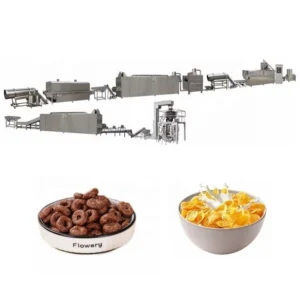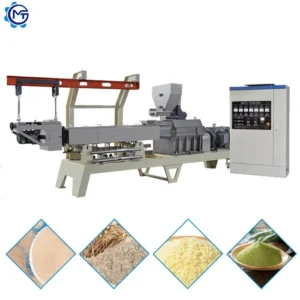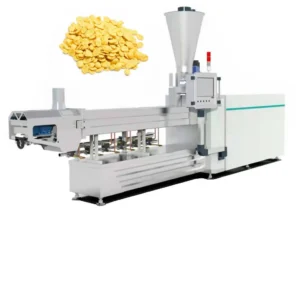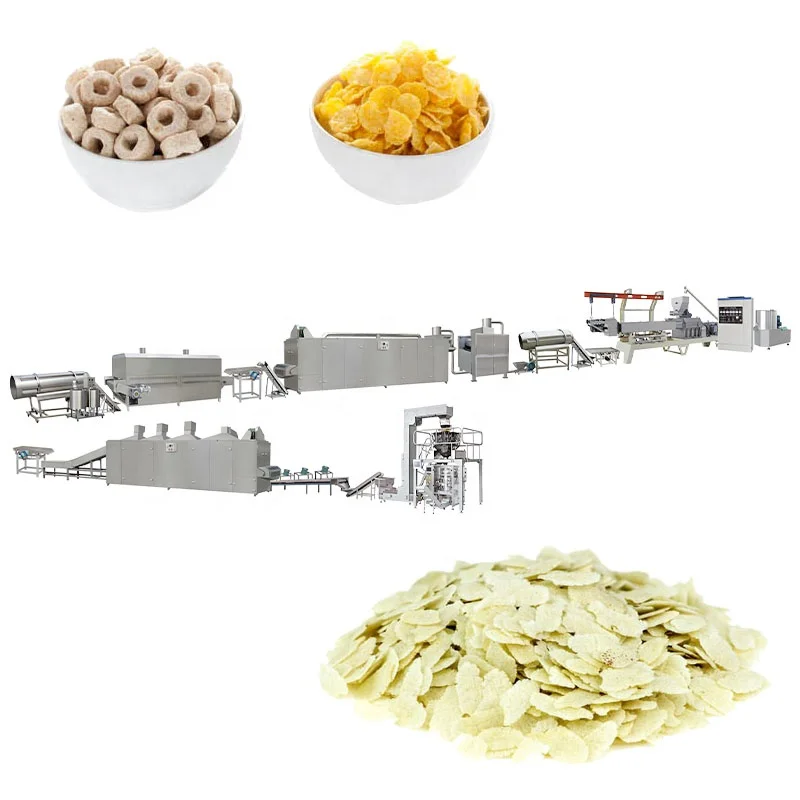
Screw Geometry Dictates Texture — MT70, MT85, and MT75 extruders are configured with screw profiles and die designs matched to your specific grain blend and target flake density, not a generic default.
Technical Specifications
| Parameter | Value |
|---|---|
| Product Type | Corn Flake Production Line / Breakfast Cereal Extruder |
| Models Available | MT70 / MT85 / MT75 |
| MT70 Installed Power | 160 kW |
| MT70 Power Consumption | 120 kW |
| MT70 Capacity | 150–200 kg/hr (basis not stated in source — confirm raw material, moisture content, and flake thickness) |
| MT70 Dimensions (L×W×H) | 41 × 1.5 × 2.2 m |
| MT85 Installed Power | 190 kW |
| MT85 Power Consumption | 140 kW |
| MT85 Capacity | 300–400 kg/hr (basis not stated in source — confirm raw material, moisture content, and flake thickness) |
| MT85 Dimensions (L×W×H) | 43 × 1.5 × 3.2 m |
| MT75 Installed Power | 210 kW |
| MT75 Power Consumption | 150 kW |
| MT75 Capacity | 300–500 kg/hr (basis not stated in source — confirm raw material, moisture content, and flake thickness) |
| MT75 Dimensions (L×W×H) | 45 × 1.5 × 3.5 m |
| Extruder Type | Twin Screw |
| Flaking Machine Type | Double-roller flaking machinery |
| Flaking Machine Capacity | 200–300 kg/hr (basis not stated in source — confirm flake thickness target) |
| Flaking Machine Control | PLC control system |
| Flaking Machine Drive | Double motors for separate roller driving; hydraulic system |
| Dryer Heating Source | Gas / Electric |
| Coating System | Double tumble for sugar melting, elevator, coating drum, spraying nozzle |
| Control System | PLC and MCC |
| Assembly State | Complete turnkey line |
Application Suitability
| Application | Material or Output |
|---|---|
| Natural corn flake production | Corn grits, corn flour |
| Sugar-coated breakfast cereals | Corn, rice, wheat, oat, barley powder with sugar coating |
| Multi-shape cereal formats | Rings, balls, sticks, stars, fruit loops, wheels via die changes |
| Fortified breakfast cereals | Grain blends with added nutritional premix |
| Mixed grain cereal processing | Blends of rice, wheat, oat, and barley powders |
Why "300 kg/hr" Means Nothing Without the Recipe
Extrusion output is inseparable from the raw material feeding it.
I was on-site in Jakarta last year commissioning a corn flake line rated at 200 kg/hr. Trial runs on pure corn flour ran smoothly, but the moment the client switched to their proprietary multigrain blend, expansion collapsed and the flakes came out dense and hard. The nameplate capacity did not change — the actual throughput of acceptable product dropped to near zero until I reconfigured the barrel temperature zones and swapped screw elements to match the starch gelatinisation behaviour of the new formulation. This is why breakfast cereal extruder screw configuration must be specified against your actual recipe, not a benchmark material. [NEED_CITE: starch gelatinisation temperature differences across corn, wheat, rice, and oat]
Barrel Temperature Zones and Starch Behaviour
Each barrel section on these twin-screw extruders operates under independent heating control. For corn flakes extrusion technology, the feeding zone maintains lower temperatures to prevent premature gelatinisation, while the compression and metering zones progressively raise heat to drive starch conversion. The exact profile shifts depending on whether you are running pure corn, a corn-rice blend, or an oat-heavy formulation — each grain has a distinct gelatinisation window and moisture absorption rate.
Shear, Moisture, and Expansion Control
The screw configuration determines how much mechanical shear is applied to the dough as it moves through the barrel. Higher shear generates internal heat and affects the degree of starch breakdown, which directly influences how the extrudate expands at the die face. Moisture content at the barrel inlet works alongside this — too little moisture limits gelatinisation, while excess moisture suppresses expansion and produces a dense, poorly textured flake after pressing and roasting. Getting the corn flakes extrusion technology parameters right requires iterative adjustment against the specific grain blend. [NEED_CITE: moisture content effect on extrudate expansion in twin screw extrusion]
Reading the Specification Sheet Against Your Product Target
Installed power ranges from 160 kW on the MT70 to 210 kW on the MT75, reflecting the different screw diameters and throughput ranges. The flaking station uses a PLC-controlled hydraulic double-roller system with infrared temperature sensing to maintain uniform roller surface temperature, which matters because uneven roller heat produces flakes with variable thickness and inconsistent roasting behaviour downstream. The hot air roasting oven employs dual circulating fans and a cyclone dust removal device to control surface blistering — the characteristic bubbles on a corn flake that deliver crispness. If any one of these stations is undersized relative to the extruder output, the entire line bottlenecks.
The Cost of Ignoring Station-to-Station Throughput
An extruder running at full output means little if the flaking machine cannot press the extrudate fast enough, or if the dryer cannot reduce moisture to the level the roaster requires. I have seen lines where the extruder was correctly specified but the dryer was one size too small, forcing the operator to slow the entire line and run the extruder below its working capacity. The result is higher per-unit energy cost and a production rate that never reaches the quoted figure. Line throughput matching across every station — mixing, extruding, flaking, drying, roasting, coating, and cooling — is the parameter that determines actual output. [NEED_CITE: line balancing in continuous food extrusion processing]
Why This Approach to Line Design Works
Screw configuration and die design are specified against the buyer’s raw material formulation and target flake density, not copied from a standard template. An in-house testing workshop runs trial production on the customer’s actual grain blend before shipment, so expansion behaviour, flake texture, and density are validated in advance. Every station from batching through packing is supplied as a coordinated system, meaning throughput calculations are matched rather than assembled from independent vendor quotes. Electrical schematics confirm voltage, frequency, and control language before production begins, eliminating commissioning delays caused by mismatched power supplies or unreadable HMI interfaces. The CE-certified equipment has been exported to producers across varied regulatory environments since 2014.
Documentation & Verification
- Line layout with throughput calculations matched to your grain blend and target flake density
- Screw and die configuration record specific to your raw material formulation
- Trial run report from in-house testing workshop on your actual grain blend before dispatch
- Electrical schematic with confirmed voltage, frequency, and control language
- Factory test record covering all stations from mixer through packing conveyor
- Operation and maintenance manual with wear parts replacement schedule
Installation, Commissioning & Support
- Foundation and utility planning based on the 41–45 m line footprint and 160–210 kW installed power requirement
- Voltage and frequency verification against local supply before electrical panel energisation
- Screw element and die assembly on-site with configuration verified against trial run records
- PLC and MCC commissioning with control language set to operator preference
- Wear parts list covering screws, dies, and flaking roller surfaces with replacement intervals
- Hot air roaster burner calibration and airflow balancing for consistent surface blistering
What to Include in Your Inquiry
To receive a meaningful line proposal rather than a generic catalogue quote, share your target grain formulation including any minor ingredients, the flake thickness and density your market expects, and the daily output you need to meet. Specify your facility voltage and frequency, available floor space and ceiling height, and whether existing upstream mixing or downstream packing equipment will be retained. If you are working with a new or reformulated recipe, request a trial run on your raw material in the testing workshop before committing to production.
Frequently Asked Questions
Q: How is screw configuration and die design determined for my specific grain blend and target flake density?
A: The screw element arrangement — conveying, kneading, and reverse-screw sections — is selected based on your grain blend’s starch composition and the expansion behaviour required at the die. Die aperture shape and size are matched to the target extrudate cross-section before flaking. This configuration is documented and validated through a trial run on your raw material before the machine ships.
Q: What barrel temperature profile and moisture levels are used during production?
A: Barrel zones are set according to the gelatinisation characteristics of your specific grain formulation. Corn, rice, wheat, oat, and barley each require different temperature progressions and inlet moisture levels. The exact profile used during your trial run is recorded and provided as a starting parameter sheet for your production team.
Q: How is throughput matched between the extruder, flaker, dryer, and roaster?
A: Each station is sized based on the extruder’s output at your confirmed recipe, with allowance for moisture loss at the dryer and residence time at the roaster. The line layout document shows the calculated throughput at every station so you can verify there are no bottlenecks before the equipment is built.
Q: What parameters change when switching from natural corn flakes to sugar-coated formats?
A: Sugar coating adds a tumble-coating drum and sugar melting system downstream of the roaster. The extruder and flaker settings may remain unchanged, but the dryer output moisture target shifts slightly to ensure proper sugar adhesion. Coating drum speed and syrup spray rate are adjusted to achieve the target sugar load.
Q: How do corn, rice, wheat, oat, and barley differ in extrusion behaviour?
A: Each grain has a distinct starch gelatinisation temperature, protein content, and fibre level that affect dough viscosity inside the barrel. Rice tends to expand more readily than oat, which requires higher shear to achieve similar texture. These differences drive the screw configuration, barrel temperature profile, and moisture settings selected for your formulation.