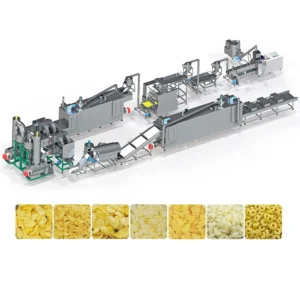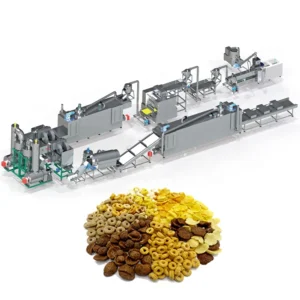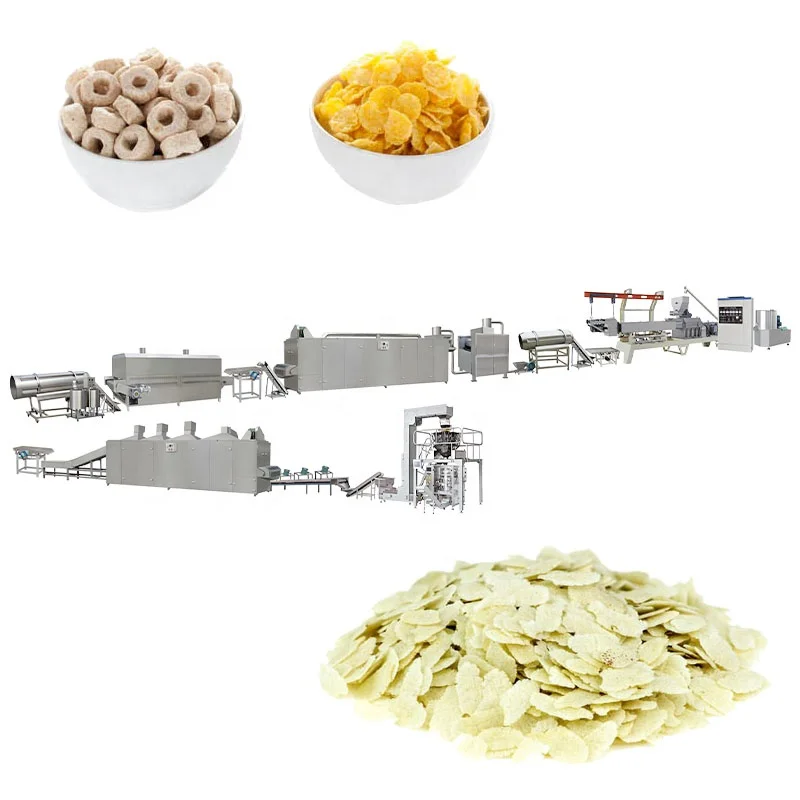
Screw configuration matched to raw material — Every corn flake extrusion line we ship runs on a screw profile and die geometry tested against the buyer’s actual grain blend, not a generic setup pulled from a catalog.
Technical Specifications
| Parameter | Value |
|---|---|
| Product Type | Corn Flake Extrusion Production Line |
| Extruder Type | Twin Screw |
| Models Available | MT70, MT85, MT75 |
| MT70 Installed Power | 160 kW |
| MT70 Power Consumption | 120 kW |
| MT70 Capacity | 150–200 kg/h (basis not stated in source — confirm raw material / moisture content) |
| MT70 Overall Dimensions | 41 × 1.5 × 2.2 m |
| MT85 Installed Power | 190 kW |
| MT85 Power Consumption | 140 kW |
| MT85 Capacity | 300–400 kg/h (basis not stated in source — confirm raw material / moisture content) |
| MT85 Overall Dimensions | 43 × 1.5 × 3.2 m |
| MT75 Installed Power | 210 kW |
| MT75 Power Consumption | 150 kW |
| MT75 Capacity | 300–500 kg/h (basis not stated in source — confirm raw material / moisture content) |
| MT75 Overall Dimensions | 45 × 1.5 × 3.5 m |
| Raw Materials | Corn, rice, wheat, oat, barley powder |
| Control System | PLC control with automatic lubricating and cooling |
| Flaking Drive | Double motors with hydraulic system for independent roller driving |
| Flaking Temperature Control | Infrared sensor for even pipe temperature regulation |
| Dryer Heating Source | Gas or Electric |
| Roasting Oven | Hot air with conciliation burner, dual circulating fans, cyclone dust removal |
| Coating System | Double tumble sugar melting, elevator, coating drum, spraying nozzle |
| Screw Feature | Wear-resistant manufacturing technology |
| Final Product Shapes | Ball, tube, stick, ring, fruit loop, star, wheel, flower, heart |
| Standards | CE, ISO |
Application Suitability
| Application | Material or Output |
|---|---|
| Natural corn flake production | Corn grits, whole corn meal |
| Sugar-coated breakfast cereal | Corn, rice, wheat blends with sugar glaze |
| Multi-grain flake cereal | Oat, barley, rice, wheat powder combinations |
| Shaped cereal pieces | Rings, stars, balls, fruit loops via interchangeable die plates |
| Fortified breakfast cereal | Grain blends with added vitamin and mineral premix |
Why Generic Screw Profiles Sink a Corn Flake Line
A corn flake extrusion line screw configuration die design built without your raw material data produces flakes that either shatter during coating or stay too dense for the bowl.
I learned this the hard way. Years back I specified a line for a Middle East customer using a screw setup we had run successfully on coarse corn grits. Their local supplier provided finely milled corn flour that hydrated faster and packed tighter in the barrel. The extruder choked, gelatinisation was uneven, and what came out the die looked nothing like flakes. Capacity dropped to barely half the nameplate figure. The customer was ready to cancel the order. Since that project, I will not sign off on a shipment until the buyer’s exact raw material has run through our testing workshop. The corn flakes extrusion line screw configuration die design must be validated against what actually goes into the hopper [NEED_CITE: starch gelatinisation behaviour across different corn particle size distributions].
How Barrel Temperature Zones Shape Flake Texture
Corn starch gelatinises within a narrow temperature window, and a twin-screw extruder with multiple independently controlled barrel zones lets the process engineer hold each section precisely where it needs to be. Too cool in the melting zone and the starch granules survive intact, leaving hard white cores that never soften in milk. Too hot and the melt fractures at the die face, producing ragged edges that break apart on the flaking rollers. The screw element sequence — conveying, kneading, reverse-conveying — determines how much shear energy supplements the barrel heaters, and that balance is what the corn flakes extrusion line screw configuration die design must capture before metal is cut.
Die Geometry and the Density Problem
The die plate is where the extrudate takes its initial shape, and every hole diameter and land length influences how much the dough expands as it exits into ambient pressure. A shorter land gives more puff, which sounds good until you realise that over-expanded pellets collapse under the flaking rollers into thin, brittle discs with almost no bowl life. A longer land restrains expansion and produces a denser pellet that flakes into a thick, hard piece the consumer’s teeth will not for* different land lengths on the buyer’s formulation and measuring the resulting flake density and bowl life [NEED_CITE: relationship between die land length and pellet expansion ratio in cereal extrusion]. The corn flakes extrusion line screw configuration die design is not a one-time choice; it is a set of parameters locked in after physical trials.
Reading the Spec Sheet Like a Process Engineer
The installed power figures across the MT70, MT85, and MT75 reflect the motor capacity available to drive the screw shafts under load. Higher installed power does not automatically mean higher throughput — it means the extruder can maintain screw speed when processing viscous, high-protein or high-fibre formulations that resist conveyance. Power consumption values show what the machine actually draws during steady-state operation, and the gap between installed and consumed power is the headroom you have for formulation changes. The hydraulic flaking unit with independent double-motor drive lets you set roller speed and gap separately for each roller, which matters when you are chasing a specific flake thickness between 0.3 and 1.0 mm. The infrared sensor on the flaking machinery keeps the roller surface temperature uniform across its width, preventing edge flakes from setting differently than centre flakes. PLC control means every barrel zone temperature, screw speed, and feeder rate is stored as a recipe, so the operator reproduces the same corn flakes extrusion line screw configuration die design parameters batch after batch without manual guesswork.
The Cost of Skipping the Trial Run
When a line ships without a test on the buyer’s raw material, the first production run becomes the trial — inside the customer’s own factory, on their schedule, with their reputation on the line. Extruder throughput drops because the screw profile does not match the feed stock’s rheology. The dryer cannot keep up because the moisture content leaving the extruder is higher than the layout calculation assumed. The coating drum overflows because pellet volume is different from what the generic build anticipated. Every downstream station becomes a bottleneck because the upstream assumptions were wrong [NEED_CITE: throughput mismatch consequences in multi-station cereal processing lines]. Fixing these problems after installation means new screw elements, modified die plates, and recalibrated dryer curves — all at the buyer’s expense and delay.
Why Buyers Source This Line Here
The line runs as one integrated system from batching through packing, with throughput calculated so that no station starves or floods the next. Screw elements and die inserts are selected specifically for the buyer’s grain type and target flake density, not copied from a reference project with different raw materials. Every configuration is documented in a screw and die record that travels with the machine. The in-house testing workshop runs the buyer’s actual raw material before the line ships, producing a trial run report that confirms capacity, flake density, and product appearance. Electrical schematics are prepared with the destination voltage, frequency, and control language confirmed before the control cabinet is wired, preventing commissioning delays on site.
Documentation & Verification
- Line layout drawing with station-by-station capacity calculation for your grain formulation
- Screw and die configuration record matched to your raw material trial results
- Electrical schematic with confirmed voltage, frequency, and PLC language
- Trial run report on your supplied corn or multi-grain material before dispatch
- CE declaration of conformity for the complete extrusion and flaking assembly
- Operation manual covering recipe storage, roller gap adjustment, and safety interlocks
Installation, Commissioning & Support
- Foundation plan based on the chosen model footprint, up to 45 m line length
- Dedicated power circuit sized for the MT75 peak draw of 210 kW installed
- Flaking unit arrives assembled; roller alignment verified during on-site commissioning
- PLC recipes loaded and barrel zones tuned during first production run with your operators
- Wear parts list covering screw elements, die inserts, and flaking roller surfaces
- Maintenance schedule for hydraulic fluid checks, automatic lubrication system, and cooling circuit
What to Prepare Before Requesting a Quote
To configure the right corn flakes extrusion line screw configuration die design for your project, share your primary grain type and particle size distribution, target flake thickness and density, daily output requirement, and whether you plan to run sugar-coated or natural variants. Include your facility voltage and frequency, available floor space with ceiling height, and preferred PLC interface language. If you can send a sample of your raw material, we will run it through the testing workshop and return a trial report with the recommended screw profile before any purchase commitment.
Frequently Asked Questions
Q: How is screw configuration selected for different cereal blends and target flake density?
A: We build the screw element sequence — conveying, kneading, and reverse sections — around your specific grain blend’s starch content, particle size, and hydration rate. Each configuration is tested in our workshop on your supplied raw material. The resulting flake density, expansion ratio, and surface texture are measured, and the screw profile is adjusted until the output matches your product specification before the line ships.
Q: What barrel temperature profile and moisture level produce optimal starch gelatinisation for corn flakes?
A: The profile depends on your corn variety and grind size, but generally the feed zone stays low to prevent premature gelatinisation while the compression and metering zones climb into the range where corn starch fully gelatinises. Moisture content at the barrel typically sits between 25 and 30 percent. We dial in the exact zones during the trial run and record the recipe in the PLC for repeatability.
Q: How does the flaking roller gap and temperature control affect final flake thickness and crispness?
A: The hydraulic double-roller unit with independent motor drive allows precise gap setting that determines flake thickness. The infrared sensor maintains even roller surface temperature, which controls how quickly the pellet surface sets during compression. Cooler rollers produce softer flakes that may stick; hotter rollers can case-harden the surface. Both parameters are tuned during commissioning to hit your target crispness and bowl life.
Q: Can a trial run be performed on our raw material before the line ships?
A: Yes. Send us a representative sample of your corn, rice, wheat, or multi-grain blend, and we will run it through the extruder in our testing workshop using the proposed screw and die configuration. You receive a trial run report documenting throughput, flake density, product appearance, and recommended process parameters so you know exactly what to expect at installation.
Q: How are extruder throughput, dryer capacity, and coating drum volume balanced to avoid line bottlenecks?
A: During the layout and capacity calculation phase, we match each station’s throughput to the extruder’s confirmed output on your raw material. The dryer length, air temperature, and belt speed are sized for the moisture load leaving the flaking unit. The coating drum volume and sugar spraying rate are calculated for the pellet volume per hour. This prevents any single station from limiting the entire line.