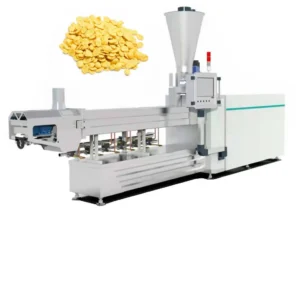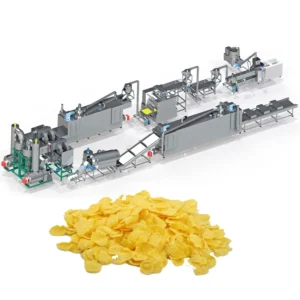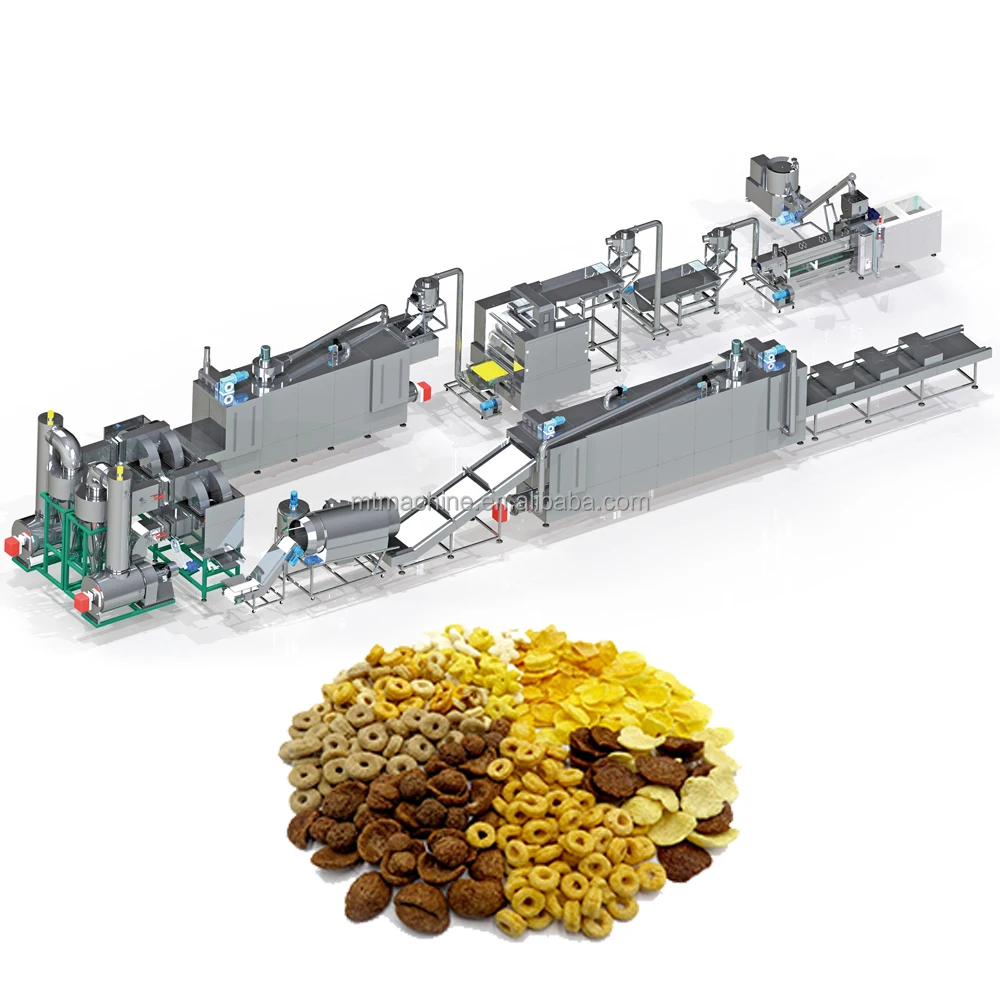
Screw Configurations Matched to Recipe — MT-75 twin-screw geometry and die profile are specified against the buyer’s actual grain blend, not borrowed from a generic cereal build.
Technical Specifications
| Parameter | Value |
|---|---|
| Model | MT-75 |
| Product Type | Corn Flakes Breakfast Cereal Extrusion Production Line |
| Screw Type | Twin Screw |
| Output Capacity | 200–300 kg/h (basis not stated in source — confirm raw material, moisture content and recipe formulation) |
| Rated Power | 3 kW (rated or peak not specified — verify against full line power requirement) |
| Voltage | 220V / 380V (frequency to be confirmed) |
| Flaking Machine Dimensions | 1330 × 440 × 960 mm (verify whether this refers to flaking unit only or full line footprint) |
| Net Weight | 50 kg (verify whether this refers to single station or full line) |
| Control System | PLC (flaking machine); line-level PLC and MCC available on request |
| Flaking Roller Drive | Dual independent motors with hydraulic pressure system |
| Flaking Temperature Control | Infrared sensor for even roller temperature |
| Dryer Heating Source | Gas or Electric |
| Roasting Oven | Hot air with conciliation burner, dual circulating fans, cyclone dust removal |
| Coating System | Double tumble sugar melter, elevator, coating drum, spraying nozzle |
| Lubrication | Automatic system with cooling function |
| Assembly State | Complete line, modular stations |
| Warranty | 1 Year (including gearbox) |
| Standards | CE, ISO |
Application Suitability
| Application | Material or Output |
|---|---|
| Natural corn flakes | Corn grits, rice, wheat, oat or barley base |
| Sugar-coated breakfast flakes | Corn or multi-grain pellets with syrup coating |
| Fortified cereal flakes | Grain blends with added vitamin and mineral premix |
| Snack pellet variants | Alternative die and line configuration adjustments |
Why "300 kg/h" Means Nothing Without the Recipe
Capacity on corn grits is not capacity on your oat-and-barley blend.
A corn flakes extrusion production line quoted at a single throughput figure rarely tells you what happens when the recipe changes. I once spent two weeks on-site reworking screw elements and die geometry after a producer switched from standard corn flour to a high-fibre whole-grain mix. The flakes came out dense and brittle because the starch gelatinisation window shifted entirely. The extruder barrel temperature profile that worked perfectly on corn could not develop the same expansion on oat-heavy material, and the downstream flaking rollers crushed rather than flattened the pellets. [NEED_CITE: starch gelatinisation behaviour across different cereal grains]
When buyers compare lines only on the nameplate output, they miss the variable that matters most: whether the screw configuration and die design have been matched to their specific raw material formulation and target flake density.
Barrel Temperature Profile and Starch Gelatinisation
The extrusion stage is where the corn flakes extrusion production line earns its keep. Twin-screw geometry controls residence time, shear rate and moisture distribution inside the barrel. Each barrel zone can be set to a different temperature, allowing the operator to build a gradient that drives progressive starch gelatinisation from the feed inlet to the die face. Get the profile wrong and the extrudate exits either undercooked — producing hard, glassy flakes that shatter during flaking — or over-expanded, giving low-density flakes with poor bowl-life.
Die Geometry and Flake Thickness Control
The die orifice diameter and land length determine the extrudate strand cross-section before it reaches the flaking rollers. A larger die opening produces thicker pellets that require more hydraulic pressure to flatten, influencing the final flake thickness and surface blister pattern during roasting. Die design is not a fixed choice: it shifts depending on whether the target is a thin, crisp natural flake or a thicker, crunchier sugar-coated variant. The MT-75 die plate is specified after the buyer confirms the target flake dimensions and the raw material behaviour observed during trial runs.
Reading the Specification Sheet Beyond the Headline Numbers
The rated power of 3 kW refers to a specific station and should not be confused with the total connected load across mixing, extrusion, flaking, drying and roasting. Buyers planning electrical infrastructure need the full line power calculation before ordering switchgear. Similarly, the flaking machine footprint of 1330 × 440 × 960 mm covers only that station; the complete corn flakes extrusion production line requires considerably more floor length when drying, roasting, cooling and packing conveyors are laid out in sequence. Voltage is available at 220V or 380V, but frequency and phase must be locked down early — a 50 Hz motor rewound for 60 Hz markets changes dryer fan speed and roasting oven airflow in ways that affect product surface colour and moisture uniformity. [NEED_CITE: voltage and frequency standards by export market]
The Cost of Ignoring Downstream Matching
An extruder that outpaces its dryer creates a bottleneck: wet flakes pile up on the conveyor, stick together, and enter the roasting oven with uneven moisture content. The result is a batch where some flakes are scorched while others remain doughy inside. I have seen producers add a second dryer after installation because the original line was spec’d from separate catalogues rather than engineered as one system. The capital cost of the extra dryer and the lost production weeks could have been avoided if throughput across every station had been calculated together from the start. [NEED_CITE: throughput mismatch consequences in cereal processing lines]
Why Engineers Source the Full Line Here
The MT-75 line is configured under one supplier from batching through packing, so the extruder output, flaking roller speed, dryer belt length and roasting oven residence time are all calculated against the same target throughput rather than assembled from independent vendor catalogues. Screw configuration and die design are documented against the buyer’s raw material formulation, not copied from a previous project. Before the line ships, the buyer’s actual grain blend runs through the in-house testing workshop so expansion ratio, flake density and bowl-life can be verified while adjustments are still inexpensive. Electrical schematics are issued with voltage, frequency and control language confirmed for the destination facility. Post-installation support covers operator training, wear parts supply and ongoing process troubleshooting.
Documentation & Verification
- Line layout drawing showing station-by-station throughput match for your target output
- Screw element layout and die specification recorded against your grain formulation
- Trial run report from in-house testing on your supplied raw material
- Electrical schematic confirming voltage, frequency and PLC language for your facility
- CE declaration of conformity covering the complete extrusion assembly
- Factory acceptance test record with video inspection before dispatch
Installation, Commissioning & Support
- Foundation plan provided for the full line footprint including flaking, drying and roasting stations
- Dedicated circuit sizing confirmed against total connected load across all MT-75 stations
- Modular station delivery allows phased installation in facilities with limited access
- PLC parameter sets loaded during commissioning with operator training on recipe changeover
- Wear parts list supplied at handover covering screws, die plates and flaking roller shells
- Scheduled maintenance intervals defined for gearbox oil, automatic lubrication reservoir and fan bearings
Before You Request a Quote
To size the corn flakes extrusion production line accurately, share your base grain or grain blend, target flake thickness, and whether you plan to run natural, sugar-coated or both variants. Confirm the available voltage and frequency at your facility, the control language your operators require, and the daily output target so the line can be throughput-matched from mixing to packing. If your recipe includes high-fibre or non-standard ingredients, flag this early so a pre-shipment trial can be arranged.
Frequently Asked Questions
Q: How is extruder output verified on my specific raw material?
A: Output capacity depends on the grain blend, moisture content and recipe formulation. We run your actual raw material through the in-house testing workshop before shipment and document the achievable throughput, expansion ratio and flake density. The quoted capacity is then confirmed against those trial results rather than a generic benchmark.
Q: How are screw configuration and die design chosen for my flake target?
A: Screw element arrangement and die orifice size are selected based on your grain type, target flake thickness and desired bowl-life. The configuration is recorded in the project documentation so replacements and future recipe adjustments can be made without repeating the development cycle from scratch.
Q: How do you prevent bottlenecks between extruder, flaker and dryer?
A: Every station on the corn flakes extrusion production line is throughput-matched during the layout phase. Belt speed, roller gap, dryer length and roasting oven residence time are all calculated from the same extruder output figure, so no single station limits the rest.
Q: What electrical details are confirmed before the line ships?
A: Voltage, frequency, phase and PLC interface language are confirmed during the specification stage. Electrical schematics are issued showing circuit sizing for each station so your facility team can prepare switchgear and cabling before the equipment arrives.
Q: Can I test my recipe before committing to the full line?
A: Yes. You can send your raw material to the testing workshop for a trial run on the extruder and flaking station. The trial produces a report covering expansion, flake density and roasting behaviour, allowing configuration changes before production begins.