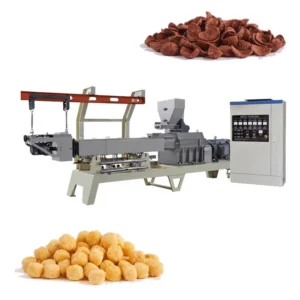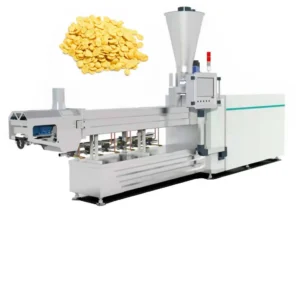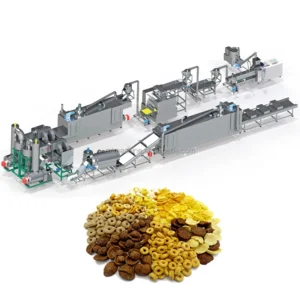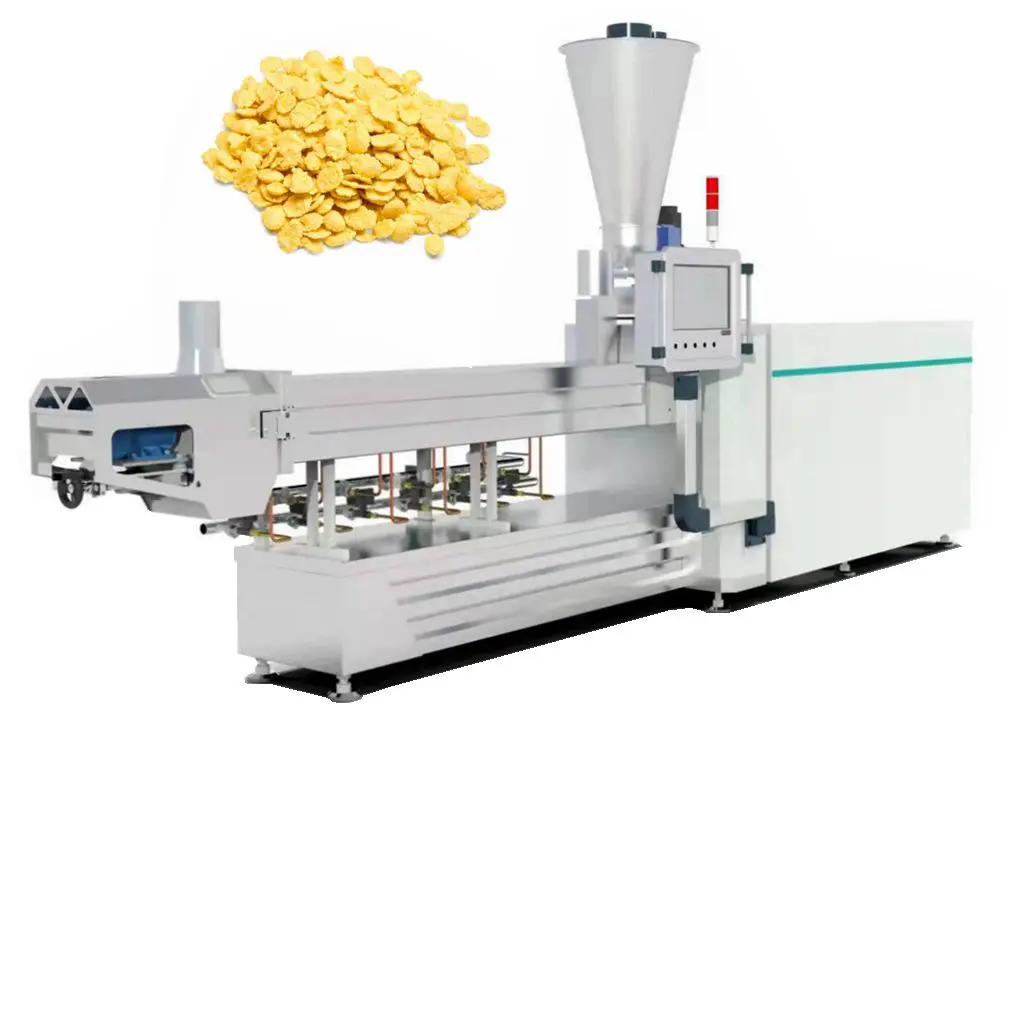
Screw configuration matched to your grain — every MT-series line ships with a screw and die record built around your specific corn variety and target flake density, not a copied generic layout.
Technical Specifications
| Parameter | Value |
|---|---|
| Product Type | Breakfast Cereal Corn Flakes Production Line |
| Models Available | MT70, MT85, MT75 |
| Extruder Type | Twin Screw |
| Installed Power | 160 kW (MT70) / 190 kW (MT85) / 210 kW (MT75) |
| Power Consumption | 120 kW (MT70) / 140 kW (MT85) / 150 kW (MT75) |
| Output Capacity | 150–200 kg/h (MT70, basis not stated in source — confirm raw material / moisture) |
| Output Capacity | 300–400 kg/h (MT85, basis not stated in source — confirm raw material / moisture) |
| Output Capacity | 300–500 kg/h (MT75, basis not stated in source — confirm raw material / moisture) |
| Overall Dimensions | 41 × 1.5 × 2.2 m (MT70) / 43 × 1.5 × 3.2 m (MT85) / 45 × 1.5 × 3.5 m (MT75) |
| Control System | PLC and MCC line control |
| Screw Material | Special wear-resistant alloy |
| Lubrication | Automatic system with cooling function |
| Flaking Rollers | Hydraulic double-motor drive with infrared temperature monitoring |
| Dryer Heating Source | Gas or Electric (configurable) |
| Roasting Oven | Hot air with conciliation burner, dual circulating fans, cyclone dust removal |
| Coating System | Double tumble sugar melting, elevator, coating drum, spraying nozzle |
| Basic Raw Materials | Corn, rice, wheat, oat, barley powder |
| Assembly State | Complete line from batching to packing |
| Standards | CE, ISO |
Application Suitability
| Application | Material or Output |
|---|---|
| Natural corn flakes (unsweetened) | Corn grits or corn flour at controlled moisture |
| Sugar-coated / glazed corn flakes | Corn base with sugar syrup coating stage |
| Multi-shape breakfast cereals | Rice, wheat, oat, or barley powder with die changeover for ball, tube, ring, star, flower, heart shapes |
| Fortified cereal production | Grain blends with added nutrient premix requiring controlled gelatinisation |
| Puffed snack variants | Shared extruder and dryer stations with adjusted screw speed and die geometry |
What "300 kg/h" Really Means on Your Corn Source
A capacity number without a raw material basis is a guess, not a guarantee.
I once watched a customer lose three weeks because the trial ran on standard corn grits while their actual flour was脱胚 (degermed) and far finer. The flakes blistered during pressing and shattered in the oven. Screw speed, barrel temperature zones, and moisture targets all had to be torn up and rebuilt from scratch. When you review breakfast cereal corn flakes extrusion line specifications, the first question should always be: on whose corn, at what grind size, and at what moisture? [NEED_CITE: starch gelatinisation behaviour across corn varieties]
How Barrel Temperature Zones Shape the Flake
The twin-screw extruder uses multiple independently heated barrel zones to control the degree of starch gelatinisation as the dough moves from feed to die. Too little heat and the corn dough arrives at the flaking roller under-gelatinised, producing a dense flake with poor bowl-life. Too much and the dough over-expands before it even reaches the press, creating internal voids that collapse during roasting. Getting the breakfast cereal corn flakes extrusion line specifications right means matching each zone’s set-point to your flour’s particle size and fat content.
Why Die Geometry Decides Expansion Ratio
The die opening diameter and land length determine how much the extrudate expands as it exits into ambient pressure. A short land with a wide bore yields a low-density rope suited to puffed cereal formats, while a longer land with a narrower bore constrains expansion and delivers the compact pellet needed for subsequent flaking. On the MT series, die inserts are selected after reviewing your target flake thickness and the hydraulic roller gap setting. [NEED_CITE: die land length and expansion ratio relationship in food extrusion]
Reading the Numbers That Actually Matter
Installed power across the three models spans 160 kW to 210 kW, but power consumption under load settles between 120 kW and 150 kW, reflecting the real draw during steady-state extrusion. The automatic lubricating system with cooling keeps the gearbox within safe temperature limits during continuous shifts. Hydraulic double-motor flaking rollers allow independent speed adjustment on each roller surface, which matters when you are chasing uniform flake thickness below one millimetre. The infrared sensor on the flaking station monitors roller surface temperature in real time, catching uneven heating before it causes thickness drift across the roller width.
The Hidden Cost of a Generic Screw Build
A screw configuration copied from a different product — say, pet food kibble — will push corn dough through the barrel with the wrong shear profile. The result is inconsistent gelatinisation: some particles are fully cooked while others pass through almost raw. Downstream, the flaking roller cracks the under-cooked sections and the roasting oven cannot recover the texture. You end up with a high rejection rate and a line that never reaches its nameplate output. [NEED_CITE: screw shear profile effects on starch conversion]
Why Procurement Should Start With Your Flour Sample
Every Meiteng line is configured around documented process parameters rather than catalogue defaults. The in-house testing workshop runs your actual raw material before the line ships, producing a trial report that locks in screw speed, barrel temperatures, and die selection. PLC and MCC controls are programmed to your local voltage and frequency, with HMI language confirmed before the panel is wired. The roasting oven’s conciliation burner and dual circulating fans are balanced to the line’s throughput so that no station bottlenecks another. Documentation — from screw configuration records to electrical schematics — travels with the machine so your maintenance team has a baseline from day one.
Documentation & Verification
- Line layout showing matched throughput across extruder, dryer, flaking, and roasting stations
- Screw and die configuration record tied to your corn variety and target flake density
- Trial run report on your raw material verifying output and flake quality before shipment
- Electrical schematic with confirmed voltage, frequency, and PLC/HMI language
- CE declaration of conformity and ISO certificate for customs and regulatory clearance
- Wear parts list with screw elements, die inserts, and roller surfaces identified by part number
Installation, Commissioning & Support
- Foundation plan accounts for the 41–45 m line length and vibration isolation at the flaking station
- Dedicated electrical circuit sized to the 120–150 kW running load with correct breaker rating
- Extruder gearbox filled and automatic lubrication system verified before first motor start
- Barrel temperature zones calibrated against your trial-run set-points during on-site commissioning
- Operator training covers die changeover procedure for multi-shape cereal formats
- First replacement schedule for screw elements and die inserts provided at handover
What We Need From Your Side
Share your corn source, grind size, and typical moisture content so we can replicate your conditions in the testing workshop. Confirm your factory floor length and ceiling height to validate the 41–45 m line layout. Provide local voltage, frequency, and preferred PLC language so the control panel is wired correctly before crating.
Frequently Asked Questions
Q: How is output capacity verified against my specific corn flour and moisture level?
A: We run your actual raw material in the in-house testing workshop before the line ships. The trial locks in screw speed, barrel temperatures, and moisture targets, and a report documents the achieved throughput and flake density against your specification.
Q: How are screw and die settings chosen for natural versus sugar-coated flakes?
A: Natural flakes require a higher degree of gelatinisation and a denser pellet, so we use a longer die land and tighter barrel temperature profile. Sugar-coated variants allow slightly more expansion; the screw configuration is adjusted to deliver a rope that survives the coating drum without breaking.
Q: What electrical and control details are confirmed before production starts?
A: We verify your site voltage, frequency, phase, and preferred PLC/HMI language. The electrical schematic is reviewed and approved before the control panel is wired, preventing commissioning delays caused by mismatched supply or untranslated interfaces.
Q: How do you prevent one station from bottlenecking the rest of the line?
A: The line layout includes a throughput calculation that matches extruder output to dryer residence time, flaking roller speed, and roasting oven capacity. Each station is sized so the slowest link still meets the agreed production target on your raw material.