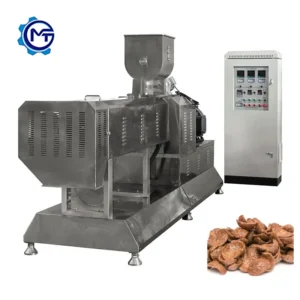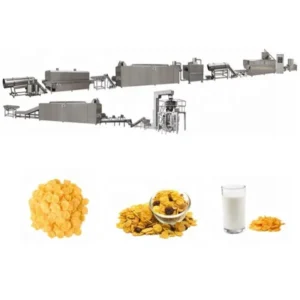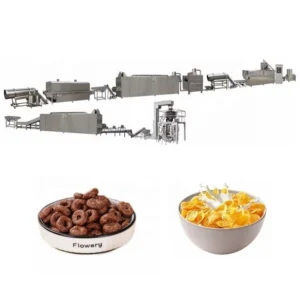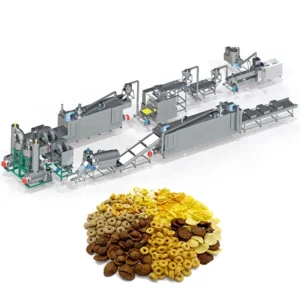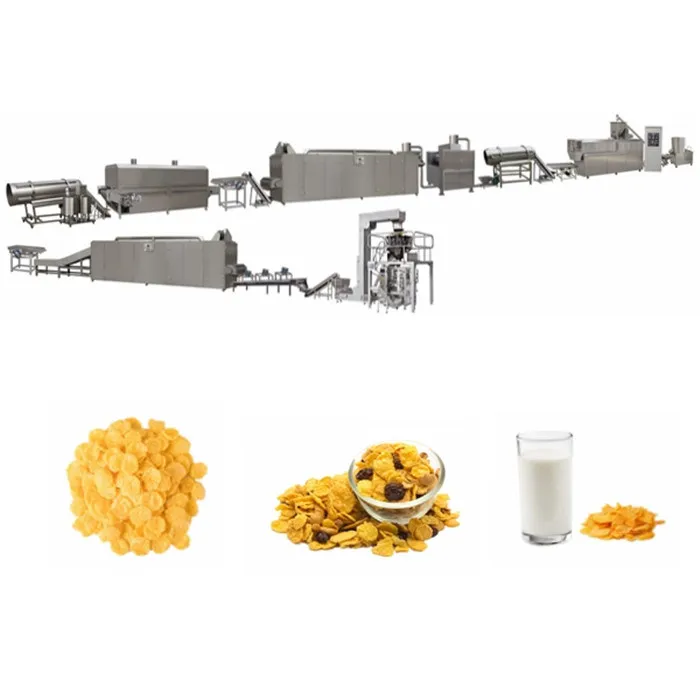
Matched screw and die geometry — Trial runs on your specific corn variety in our testing workshop validate gelatinisation and flake density before the MT75 ships.
Technical Specifications
| Parameter | Value |
|---|---|
| Model | MT75 |
| Product Type | Corn Flakes Extrusion Production Line |
| Screw Type | Twin Screw |
| Installed Power | 210 kW |
| Power Consumption | 150 kW |
| Output Capacity | 300-500 kg/h (basis not stated in source — confirm raw material / moisture content) |
| Overall Dimensions | 45 x 1.5 x 3.5 m |
| Control System | PLC (flaking machinery); MCC available for line |
| Heating Source (Dryer) | Gas / Electric |
| Line Stations | Mixing, Extruding, Flaking, Drying, Hot Air Roasting, Sugar Coating (optional), Cooling, Packing |
| Flaking Machinery | Hydraulic system for double rollers; Double motors for separate roller driving; Infrared sensor temperature control |
| Hot Air Roasting Oven | Conciliation burner; Two separate circulating fans; Cyclone dust removal device; Vibrating pan with high temperature spraying tubes |
| Coating System | Double tumble for sugar melting, elevator, coating drum, spraying nozzle |
| Extruder Working Principle | Feeding system, extruding system, cutting system, heating system, gearing system, controlling system |
| Extruder Advantage | Automatic lubricating and cooling function; Screw made by special wear-resistant technology |
| Standards | CE; ISO |
Application Suitability
| Application | Material or Output |
|---|---|
| Natural Corn Flakes | Corn grits, corn flour |
| Sugar-Coated Corn Flakes | Corn base with sugar syrup coating |
| Multigrain Breakfast Cereals | Blends of rice, wheat, oat, and barley powder |
| Shaped Cereal Pellets | Ball, tube, stick, ring, fruit loop, star, wheel, flower, heart shapes via extruder mould adjustment |
Why Generic Screw Profiles Ruin Corn Flake Density
Starch gelatinisation requires a screw configuration and barrel temperature curve mapped to your exact corn variety and moisture level.
When a line arrives with a generic screw build, the extruder might run, but the output often fails to meet market expectations. I have seen corn flakes emerge too dense to crisp properly during roasting, or so brittle that they shatter in the packaging drum. The corn flakes extrusion line extrusion technology demands precision; without matching the screw elements to the raw material’s behaviour under heat and shear, the entire production target is compromised [NEED_CITE: starch gelatinisation kinetics in twin-screw extrusion].
Mapping the Barrel Temperature Profile
The journey from raw corn grits to a flake-ready pellet hinges on how heat and shear are applied across the barrel zones. In the MT75, the heating system works in tandem with the twin-screw configuration to manage moisture migration and starch breakdown. If the feed zone is too hot, the material bridges; if the metering zone lacks sufficient shear, the gelatinisation degree stays too low for proper flaking later.
Controlling Expansion and Moisture
Managing the moisture content right up to the die face dictates whether the pellet will flatten into a dense flake or puff into a hollow shell. The corn flakes extrusion line extrusion technology relies on the die design to create the necessary backpressure. By adjusting the die geometry and the cutting system speed, operators can control the pellet size and density, ensuring the material is primed for the hydraulic flaking rollers downstream [NEED_CITE: die geometry effects on extrudate density].
Reading the Extruder Specifications
The 210 kW installed power on the MT75 provides the torque necessary to handle high-viscosity doughs typical of corn and multigrain blends. The twin-screw design allows for a wider range of moisture content in the mix compared to single-screw alternatives, which is crucial when switching between corn varieties or adding oat and barley powder. Furthermore, the automatic lubricating and cooling function protects the screw elements—made from special wear-resistant material—during continuous shifts, maintaining tight tolerances that directly affect the final flake thickness.
The Hidden Cost of Unmatched Flaking and Roasting
If the extruder produces a perfect pellet but the flaking rollers are misaligned or lack infrared temperature control, the resulting flakes will vary in thickness. This inconsistency leads to uneven roasting in the hot air oven, where some flakes burn while others remain doughy. A line that is not balanced from mixing to packing will bottleneck at the drying stage, forcing operators to slow down the extruder and lose the capacity they paid for [NEED_CITE: thermal dynamics in cereal roasting ovens].
Why Procurement Needs Technical Alignment
- Screw and die configuration record: We document the exact screw element arrangement and die geometry selected for your raw material, ensuring the corn flakes extrusion line extrusion technology is applied correctly from day one.
- In-house testing workshop: Before shipment, we run your specific corn or grain blend in our testing workshop to verify gelatinisation and flake density, eliminating guesswork during commissioning.
- Throughput matching: The line layout and capacity calculation ensure that the flaking machinery and hot air roasting oven are sized to handle the MT75 output without creating bottlenecks.
- Voltage and control confirmation: We verify your local power supply and specify the PLC or MCC control language before production begins, preventing delays on the factory floor.
Documentation & Verification
- Screw and die configuration record matched to your corn variety and target flake texture.
- Trial run report on your raw material demonstrating gelatinisation and density before shipment.
- Line layout and capacity calculation confirming throughput balance across all stations.
- Electrical schematic and voltage confirmation aligned with your facility’s power supply.
- Operation and maintenance manual covering PLC parameters and hydraulic flaking roller adjustment.
Installation, Commissioning & Support
- Foundation planning based on the 45 x 1.5 x 3.5 m footprint and vibrating pan load requirements.
- Dedicated circuit installation for the 210 kW extruder and hot air roasting oven gas/electric supply.
- On-site assembly of the hydraulic flaking rollers and calibration of infrared sensor temperature control.
- Parameter setting for barrel zones and PLC logic to match your local corn grits moisture content.
- Operator training on screw wear inspection and automatic lubricating system maintenance.
- Wear parts list provided for screws, dies, and flaking roller surfaces to ensure continuous operation.
Defining Your Production Parameters
To configure the MT75 for your facility, we need to know the specific corn variety or grain blend you intend to process, along with its typical moisture content. Please provide your target flake thickness, desired roasting profile (natural or sugar-coated), and the local voltage and frequency standards. Sharing your available workshop dimensions and ceiling height will allow us to draft a line layout that integrates the drying and cooling stations efficiently.
Frequently Asked Questions
Q: How are screw elements selected for different corn varieties?
A: We analyze the starch content and hardness of your specific corn variety to determine the shear intensity needed. The screw configuration is then adjusted to ensure complete gelatinisation without degrading the protein structure, which is verified during the trial run in our testing workshop.
Q: How do you verify capacity before the machine ships?
A: We run your actual raw material formulation in our in-house testing workshop. This trial confirms that the MT75 can maintain the target output rate and flake density under real-world conditions, rather than relying on nominal ratings based on standard corn grits.
Q: How is flake thickness controlled during production?
A: The flaking machinery uses a hydraulic system with double motors for separate roller driving, allowing precise gap adjustment. Infrared sensors monitor roller temperature to prevent sticking, ensuring the pellets are flattened to the exact thickness required for consistent roasting.
Q: What electrical details must be confirmed before ordering?
A: We require your local voltage, frequency, and phase specifications to configure the MCC and PLC control systems. We also confirm the preferred language for the HMI interface to ensure your operators can manage the barrel temperature profiles and roasting parameters effectively.