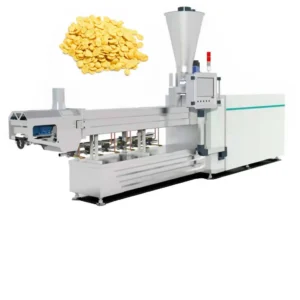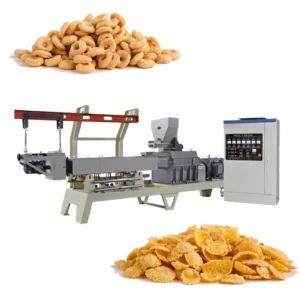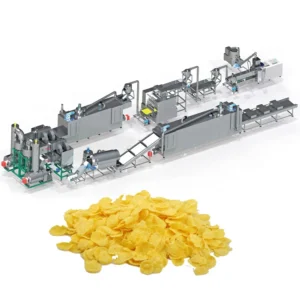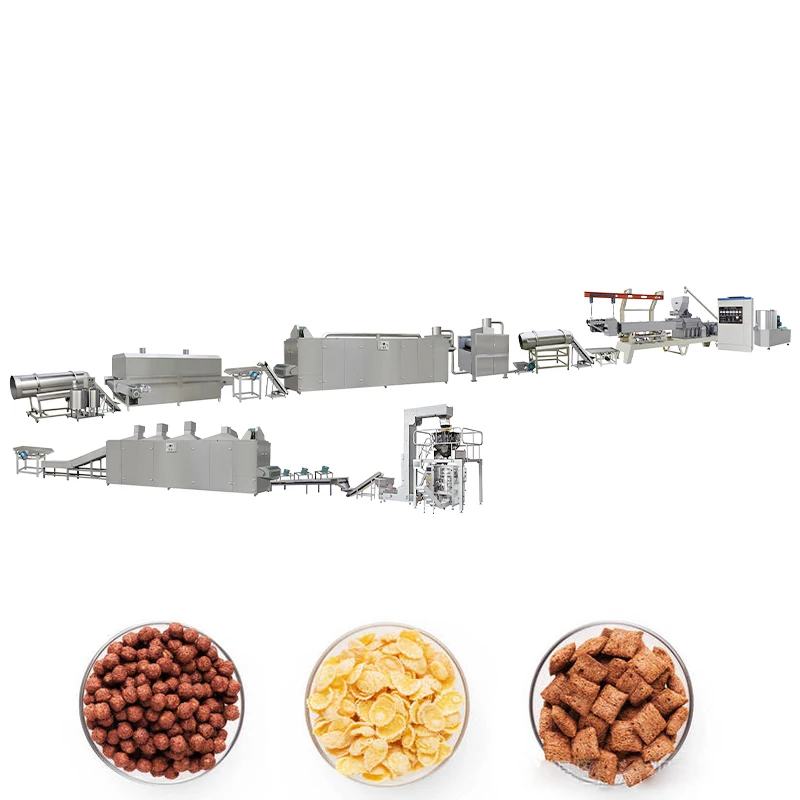
Screw configuration matched to raw material — Every corn flakes extruder production line ships with a trial run report on the buyer’s actual flour or grits blend, verifying expansion ratio and flake density before the machine leaves the factory.
Technical Specifications
| Parameter | Value |
|---|---|
| Product Type | Corn Flakes Extruder Production Line |
| Model Options | MT-65 / MT-70 / MT-85 / MT-75 |
| Screw Type | Twin-screw |
| Installed Power | 84 kW (MT-65) / 132 kW (MT-70) / 186 kW (MT-75) / 239 kW (MT-85) |
| Real Power Consumption | 59 kW (MT-65) / 92 kW (MT-70) / 140 kW (MT-75) / 167 kW (MT-85) |
| Output Capacity | 120–150 kg/h (MT-65) / 200–250 kg/h (MT-70) / 400–500 kg/h (MT-75) / 300–400 kg/h (MT-85) (basis not stated in source — confirm raw material type / moisture content) |
| Overall Dimensions | 21000×1200×2200 mm (MT-65) / 23000×1500×2200 mm (MT-70) / 24000×1500×2800 mm (MT-75) / 28000×3500×4300 mm (MT-85) |
| Control System | Button start, real-time data storage, real-time monitoring, alarm and reminder functions |
| Flaking Machine Roller Material | Cast iron |
| Flaking Machine Shaft Material | 45# steel |
| Hot Air Roaster Max Temperature | Up to 400°C |
| Dryer Heating Method | Electric or gas |
| Dryer Layers | Three, five, or seven |
| Sugar Spraying System Power | 28.75 kW |
| Sugar Spraying System Roller Size | Approx. Ø600 × 2700 mm |
| Packing Machine Options | Vertical models 420 / 520 / 620 / 720 |
| Standards | CE, ISO |
Application Suitability
| Application | Material or Output |
|---|---|
| Corn flakes and maize flakes | Corn, rice, millet, wheat, oat, barley in powder or grits form |
| Sugar-coated breakfast cereal | Plain flakes processed through sugar spraying and roasting stations |
| Plain toasted cereal | Uncoated flakes dried and roasted for crispness and extended bowl-life |
What "Rated Capacity" Means When Your Grits Have Higher Fat Content
Capacity figures only hold when the screw configuration, barrel temperature profile, and moisture input match your specific raw material.
I have watched lines rated for a certain hourly output struggle the moment the buyer switched to a local corn source with a different fat or protein profile. The shear inside the barrel changes, gelatinisation happens unevenly, and the flakes come out gummy instead of crisp. That mismatch rarely shows up in a brochure [NEED_CITE: starch gelatinisation behaviour under varying lipid content in twin-screw extrusion]. It only surfaces when you run the actual material through the barrel. A corn flakes extruder production line specifications sheet is only as honest as the trial behind it.
How Screw Profile and Barrel Zones Shape the Flake
The twin-screw configuration allows operators to adjust shear intensity along the barrel length, which directly controls how completely the starch granules gelatinise. Corn flakes require a specific degree of gelatinisation — too low and the flake stays hard and brittle, too high and it turns sticky during the flaking stage. Each barrel zone has independent temperature control, letting the process engineer build a gradient that matches the moisture content and particle size of the incoming grits. Getting this right is the difference between a flake that holds its shape in milk and one that dissolves.
Die Geometry, Moisture Management and Expansion Control
The die opening determines the thickness of the extrudate rope before it reaches the flaking rollers, and that thickness sets the upper limit for final flake density. Moisture injected during extrusion — typically steam or water — must be precisely metered because even a small deviation shifts the expansion ratio [NEED_CITE: moisture content and expansion ratio relationship in cereal extrusion]. The hot air roaster, running up to 400°C, then puffs the flake rapidly to create the internal bubble structure that defines crispness. If the die and roaster are not calibrated together, the corn flakes extruder production line produces flakes that either shatter or stay dense.
Reading the Specification Sheet Against Your Production Target
Installed power versus real power consumption tells you how much headroom the motors have under continuous load. A line drawing 59 kW in real operation against an 84 kW installed capacity has meaningful thermal margin, which matters when ambient workshop temperatures rise. The dryer layer count — three, five, or seven — directly affects residence time and therefore final moisture content before packing. Cast iron flaking rollers resist the abrasive wear that corn grits cause over long production runs, and the water cooling system built into the roller shaft keeps the gap consistent [NEED_CITE: roller gap stability and flake thickness tolerance in cereal flaking]. The control system stores process data in real time, so every batch can be traced back to its temperature and speed settings.
When the Dryer Becomes the Bottleneck
An extruder that pushes material faster than the downstream dryer can handle creates a backlog of wet flakes that clump together and block the conveyor. This is not a theoretical problem — it happens when a line is assembled from separate vendors who each quote their station in isolation. The flaking rollers press the extrudate into sheets, but if the dryer layers and heating method are undersized, those sheets arrive at the roaster still carrying too much moisture. The roaster then either fails to puff them properly or has to run longer, cutting actual throughput well below the quoted number. Matching every station from mixer to packing machine under one supplier prevents this mismatch.
Why Sourcing the Full Line From One Engineering Team Matters
The screw and die configuration is specified to your exact flour or grits blend, not copied from a generic build, because the testing workshop runs your material before the line ships. Every station — mixer, extruder, flaking machine, dryer, roaster, flavouring drum, cooling conveyor, packing machine — is throughput-matched so no single unit bottlenecks the rest. The electrical schematic and voltage are confirmed against your facility supply before production starts, avoiding commissioning delays on site. An in-house trial run generates a documented report covering output, flake density, and texture, giving you evidence rather than promises. Operator training and a wear parts list ship with the line so the first screw or die replacement does not become an emergency.
Documentation & Verification
- Line layout drawing with capacity calculation matched across every station from mixer to packing
- Screw and die configuration record specifying the profile selected for your corn or grain blend
- Trial run report on your actual raw material covering flake density, expansion and texture
- Electrical schematic with voltage and frequency confirmed to your facility supply
- CE declaration of conformity and ISO certificate for the complete production line
- Operation and maintenance manual with wear parts list for screws, dies and rollers
Installation, Commissioning & Support
- Foundation plan accounts for the 28-metre footprint and 4300 mm height of the MT-85 layout
- Dedicated power circuit sized for up to 239 kW installed load with voltage confirmed pre-shipment
- Line arrives in modular sections for sequential assembly from mixer through to packing station
- First-run commissioning includes barrel temperature profiling and die gap adjustment on your material
- Operator training covers real-time monitoring interface, alarm response and data storage retrieval
- Spare screws, dies and cast iron flaking rollers listed and available for first replacement cycle
What We Need From You to Size the Line Correctly
To configure a corn flakes extruder production line that holds its rated output on your material, share the type and grade of corn or grain you will run, along with typical moisture content and particle size. Let us know your target daily output, the workshop floor space and ceiling height available, and the local voltage and frequency at your facility. If you need sugar-coated and plain variants from the same line, specify the coating ratio so the spraying drum and dryer can be matched accordingly. Send a sample of your raw material and we will run it through the testing workshop before finalising the screw profile and die design.
Frequently Asked Questions
Q: How is output capacity verified against my specific raw material and moisture level?
A: We run your actual corn grits or flour blend through the testing workshop on the selected extruder model. The trial measures throughput, flake density, expansion ratio and texture under controlled moisture and temperature conditions. A written report accompanies the quotation so you can compare the verified output against your production target before committing.
Q: How are screw configuration and die design selected for corn flakes versus other cereal formats?
A: Corn flakes require moderate shear and a specific gelatinisation window to produce a flat, crisp flake after pressing. The screw profile is built with elements that control residence time and shear intensity for your grain type, while the die opening is sized to deliver the extrudate thickness that the flaking rollers need. Other formats like puffed pellets or porridge oats use entirely different screw and die combinations.
Q: What barrel temperature profile and moisture range control starch gelatinisation and expansion?
A: Each barrel zone is heated independently, and the gradient is set based on your material’s starch and protein content. Moisture — added as steam or water — is metered to bring the dough to the gelatinisation point without over-hydrating it. The exact profile is established during the trial run on your raw material and recorded in the configuration document supplied with the line.
Q: How is voltage, frequency and control language confirmed before the line ships?
A: During the specification stage, we collect your facility’s electrical supply details and confirm them on the electrical schematic. The control system interface language is agreed before production begins. This prevents situations where the line arrives and cannot be powered or operated without costly on-site rewiring or software changes.
Q: What trial run is performed on my raw material before the line ships?
A: Your raw material is processed through the full extruder and flaking sequence in our testing workshop. We document the screw speed, barrel temperatures, moisture input, flaking gap and roaster settings used, along with the resulting flake dimensions, density and bowl-life behaviour. This report ships with the machine so your team can replicate the results during commissioning.