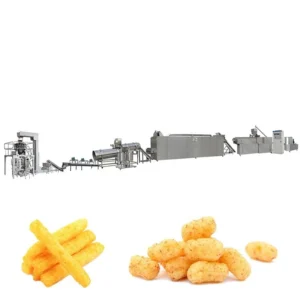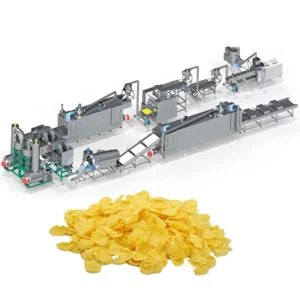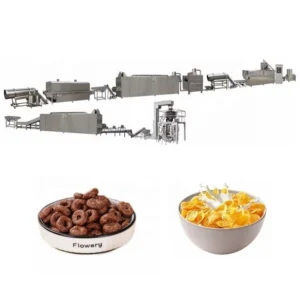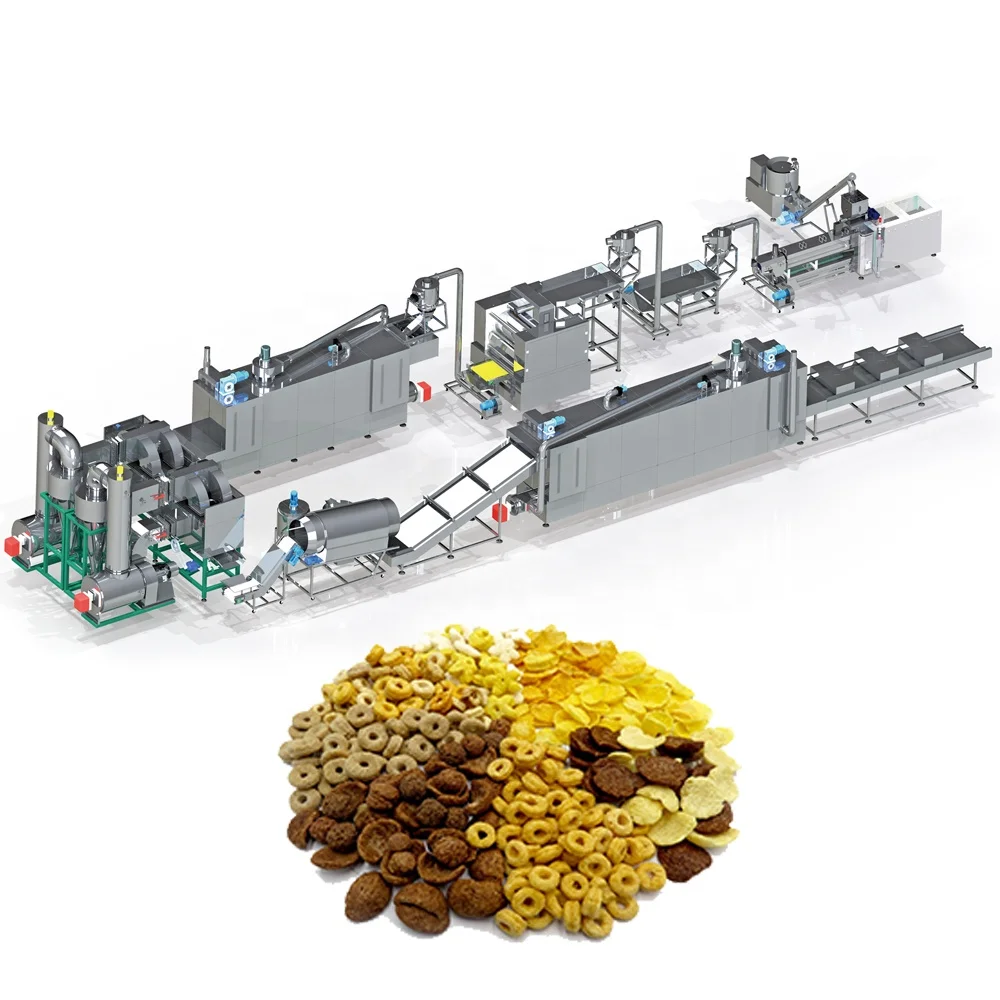
Sectional Screw Modules Matched to Your Grit Blend — screw configuration and die geometry are specified to the buyer’s corn variety and particle size before the line ships, not copied from a generic build.
Technical Specifications
| Parameter | Value |
|---|---|
| Product Type | Corn Flakes Production Line / Breakfast Cereal Extrusion Line |
| Model | MT-65 |
| Screw Type | Co-rotating twin-screw, sectional modules |
| Installed Power | 84 kW |
| Real Power | 59 kW |
| Output Capacity | 120–150 kg/h (basis not stated in source — confirm raw material, moisture, flake thickness) |
| Overall Dimensions | 12000 × 1200 × 2200 mm |
| Control System | Separate controller box (PLC/MCC to be confirmed) |
| Line Stations | Mixer → Screw Conveyor → Twin-Screw Extruder → Corn Flakes Press → High-Temperature Oven → Sugar Spraying System |
| Mixer Power / Tank | 4 kW / φ600 × 500 mm |
| Corn Flakes Press Power | 16.12 kW; Roller 510 × 310 × 1050 mm with cooling system |
| Oven Type | Gas-fired, both-side baking; 4.5 × 1.4 × 1.8 m |
| Sugar Spraying System | 28.75 kW; Roller approx. φ600 × 2700 mm |
| Extruder Features | Self-cleaning barrel, forced automatic gear-box lubrication, non-stop cutting |
| Assembly State | Complete line from batching through coating |
| Standards | CE, ISO |
Application Suitability
| Application | Material or Output |
|---|---|
| Corn flakes for retail breakfast cereal | Corn grits or corn flour blends |
| Multi-grain breakfast flakes | Rice flour, wheat flour mixed with corn |
| Fortified breakfast cereal | Grain blends with added vitamin and mineral premix |
| Corn puff snacks | Corn grits with varied die shapes |
| Core-filled snacks | Grain dough with sugar, chocolate, or peanut fillings |
What "Rated Throughput" Actually Means on Your Corn Variety
A capacity number without a raw material basis is just a motor label.
I once helped deliver a breakfast cereal line to an Eastern European plant. Factory trials on standard corn flour went smoothly — proper gelatinisation, clean flake press, consistent thickness. The moment the customer switched to their local high-fat germ corn, the screw shear could not develop adequate gelatinisation. The flakes came out thick and brittle, the entire batch was reworked, and the line sat idle for two weeks while we reconfigured the screw combination. That is the gap between a quoted number and real production. The corn flakes extrusion line screw configuration die design must be matched to your specific grit particle size and fat content before the extruder barrel is ever assembled [NEED_CITE: starch gelatinisation thresholds by corn variety].
Shear Profile and Starch Gelatinisation in the Barrel
The co-rotating twin-screw design uses sectional modules that can be arranged to create distinct transport, mixing, and cooking zones within a single barrel. For corn flakes, the goal is partial gelatinisation — enough to bind the pellet but not so much that the dough becomes gummy before reaching the flake press. Forward-flight segments move material steadily, while kneading blocks introduce the shear needed to hydrate starch granules at controlled barrel zone temperatures.
Barrel Temperature Zoning and Moisture Input
Each barrel section is heated independently, allowing the temperature profile to rise gradually from feed to die. Moisture is introduced at the mixer stage, and the exact percentage determines how much thermal energy the barrel must supply. Too little moisture and the starch remains crystalline; too much and the pellet swells prematurely, producing a flake that shatters under the press rollers rather than flattening uniformly.
Die Geometry and Pellet Density Before the Press
The die plate determines pellet cross-section and initial density. A wider die opening reduces back-pressure and yields a softer pellet suited to thin flakes, while a restricted die increases shear and produces a denser pellet for thicker, crunchier output. The corn flakes extrusion line screw configuration die design is documented in a configuration record that travels with each machine [NEED_CITE: die land length effects on extrudate density].
Reading the Spec Sheet Against Your Production Target
The MT-65 carries an installed power of 84 kW with a real running draw around 59 kW, indicating the motor is sized with thermal headroom for high-moisture doughs that demand sustained torque. The line footprint of 12000 × 1200 × 2200 mm tells a plant engineer whether the extruder, press, oven, and sugar spraying system fit an existing bay without structural modification. Gas-fired both-side baking in the 4.5 m oven addresses the moisture gradient problem common in single-pass dryers, where the top surface dries faster than the flake bed interior. The corn flakes press machine integrates a roller cooling system and adjustable gap, which directly controls final flake thickness — a parameter that buyers specify in tenths of a millimetre for bowl-life and texture targets. Self-cleaning barrel sections and forced automatic gear-box lubrication reduce the time between recipe changeovers, which matters when a plant runs both plain and fortified cereal formulations on the same line.
The Hidden Cost of a Generic Screw Build
When screw modules are arranged from a default template rather than specified to the buyer’s grit blend, the consequences appear downstream. Insufficient shear leaves un-gelatinised starch cores that crack during pressing. Over-aggressive kneading blocks generate excessive heat, scorching the pellet surface and producing dark specks on the finished flake. Both defects force operators to reduce screw speed to compensate, which drops throughput below the rated range and creates a bottleneck that the oven and coating drum were never designed to absorb [NEED_CITE: extrusion shear rate and product defect correlation].
Why Source the Extrusion Technology Here
The screw configuration and die geometry are specified to the buyer’s raw material formulation, not pulled from a standard template. An in-house testing workshop runs trial batches on the customer’s actual corn grits before the line ships, catching gelatinisation or density issues at the factory rather than on the production floor. Throughput matching across every station — mixer, extruder, press, oven, and sugar coating — is calculated during the layout phase so that no single unit bottlenecks the rest. The twin-screw platform covers corn flakes, multi-grain cereals, puff snacks, and core-filled formats from the same base extruder, protecting the buyer’s investment when product lines expand. Pre-sales consultation includes line layout and utility planning, so electrical and gas connections are confirmed before the machine leaves Jinan.
Documentation & Verification
- Screw and die configuration record matched to your corn grits particle size and fat content
- Trial run report on your raw material produced in the testing workshop before dispatch
- Electrical schematic with voltage and frequency confirmed against your plant supply
- Line layout and capacity calculation showing throughput balance across every station
- CE declaration of conformity and ISO certificate in electronic edition
Installation, Commissioning & Support
- Foundation plan accounts for the 12 m line length and press vibration isolation requirements
- Dedicated circuit sized for 84 kW installed power with voltage confirmed for your grid standard
- Extruder barrel sections and press rollers shipped separated, reassembled and aligned on site
- First-run parameter logging covers barrel zone temperatures, screw speed, and press roller gap
- Operator training includes screw module swapping for recipe changeovers between flake formats
- Wear parts list covers screw elements, die plates, and press roller bearings for first replacement cycle
Before You Send the Inquiry
Share your corn variety, grit particle size distribution, and any fat or fibre content data so the screw profile can be scoped accurately. Confirm your target flake thickness in millimetres and the bowl-life expectation for your market. Provide your plant voltage, frequency, and available floor length to ensure the oven and coating drum are sized correctly. If you are running fortified formulations, note the vitamin premix composition so barrel temperatures can be set to preserve heat-sensitive additives.
Frequently Asked Questions
Q: How is screw configuration and die design matched to my specific corn grits or flour blend?
A: We review your raw material data sheet — particle size, moisture, fat, and fibre content — then select kneading block angles, forward-flight pitch, and die land length accordingly. A trial run in the testing workshop confirms gelatinisation and pellet density before the configuration record is finalised for production.
Q: What barrel temperature profile and moisture range are needed for proper starch gelatinisation in corn flakes?
A: Barrel zones typically ramp from feed to die, with moisture set at the mixer stage. The exact temperatures and moisture percentage depend on your corn variety; high-fat germ corn requires different heat input than de-germed grits. The trial run report documents the profile that achieved target gelatinisation on your material.
Q: How is output capacity verified on my raw material before the line ships?
A: Your corn grits or flour blend is run through the extruder and press in the testing workshop. The trial run report records actual throughput, flake thickness, and pellet density, so the capacity figure you receive carries a raw material basis rather than a generic motor rating.
Q: How do flake-press roller gap and cooling settings control final flake thickness and density?
A: The press rollers on the MT-65 line are adjustable in gap and equipped with an internal cooling circuit. Narrower gap and lower roller temperature produce thinner, denser flakes; wider gap yields thicker flakes with more air pockets. Settings are logged during commissioning and can be adjusted for different product formats.