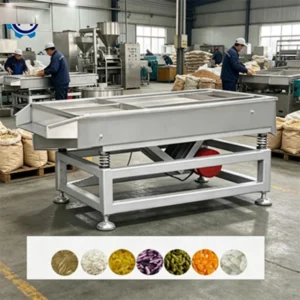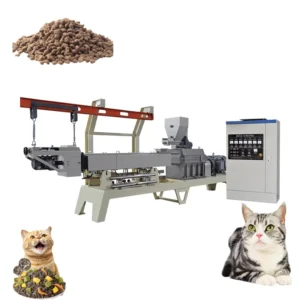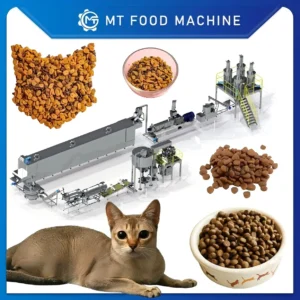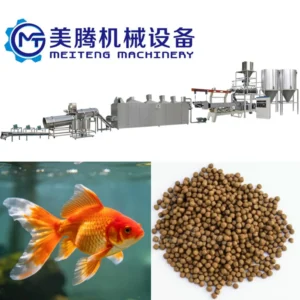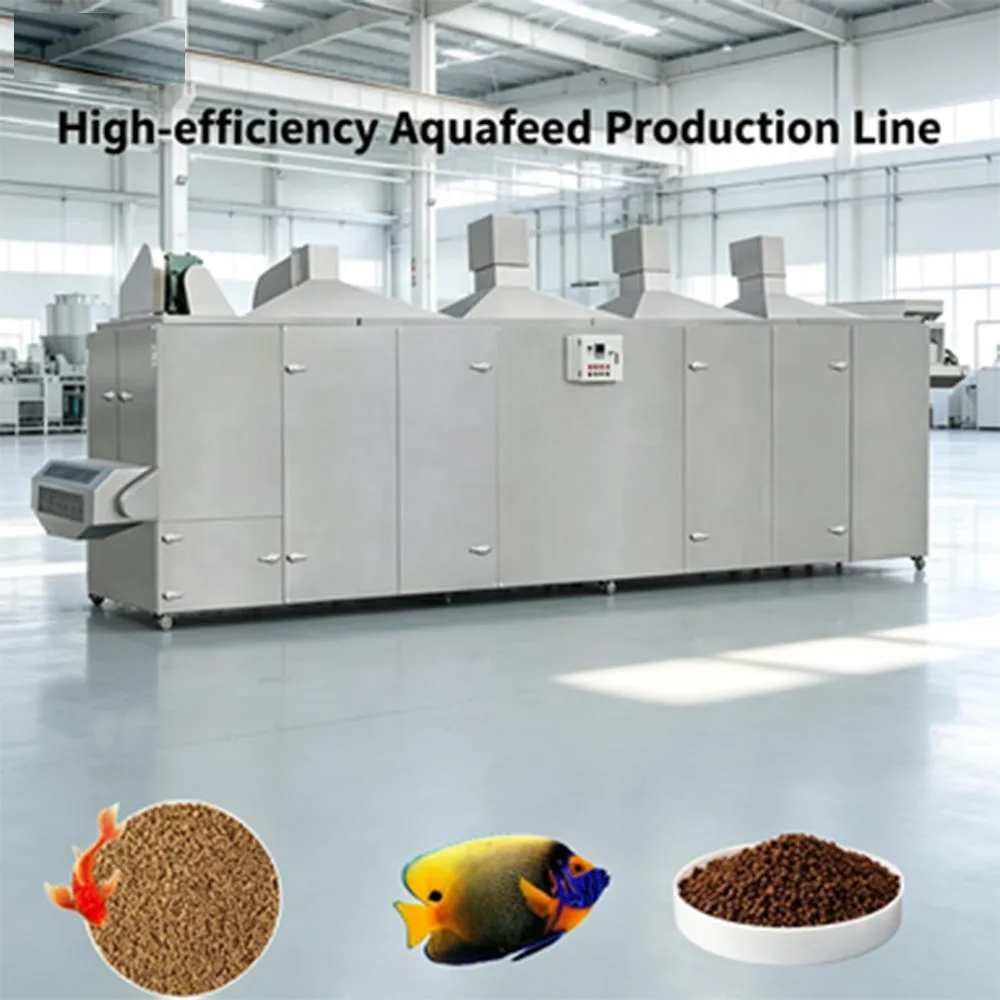
Extrusion-to-drying integration — screw configuration and continuous tunnel drying are matched to your raw material blend so pellet buoyancy holds within specification from first run.
Technical Specifications
| Parameter | Value |
|---|---|
| Product Type | Continuous Tunnel Dryer for Fish Feed Pellets |
| Equipment Type | Continuous tunnel dryer |
| Construction Material | Food-grade 304 stainless steel (machine body and material contact parts) |
| Control System | Intelligent PLC automatic control system |
| Extrusion Technology | Twin-screw extrusion (high temperature and high pressure) |
| Line Stations | Raw material mixer, extruder, dryer, seasoning coating machine, vibrating sieve, conveyor equipment |
| Pellet Adjustability | Pellet size, hardness, and buoyancy adjustable per breeding requirements |
| Operating Mode | Full continuous automatic production |
| Energy Design | Optimized energy-saving transmission structure and heating system |
| Output Capacity | (basis to be confirmed — throughput depends on pellet size and moisture content) |
| Standards | CE certified, ISO certified |
Application Suitability
| Application | Material or Output |
|---|---|
| Floating fish feed pellet production | Fish meal, soybean meal, corn powder, and compound additives |
| Sinking fish feed pellet production | High-protein aquatic formulations with adjusted starch ratios |
| Ornamental fish feed (koi, goldfish, tropical fish) | Specialty blends with pigments and nutritional supplements |
| Freshwater aquaculture feed | Locally sourced grain and protein meals for tilapia and catfish |
| Medium to large-scale commercial feed operations | Continuous mass production with PLC-coordinated extrusion and drying |
Why Floating Feed Sinks: The Extrusion-Drying Mismatch
Pellet buoyancy failures usually trace back to unmatched extrusion parameters and dryer residence time, not the extruder alone.
I have watched lines where the twin screw extrusion dryer for fish feed pellet production line was quoted on nominal capacity, but the dryer could not handle the actual moisture load coming off the die. When fish meal protein content runs high, water evaporates slower than standard grain-based formulations. The extruder keeps pushing output, but pellets exit the tunnel still holding internal moisture — and sink the moment they hit the water surface [NEED_CITE: starch gelatinisation and expansion behaviour under varying protein-to-starch ratios]. The twin screw extrusion dryer for fish feed pellet production line only delivers consistent buoyancy when screw configuration, barrel temperature zones, and tunnel residence time are all calculated against the buyer’s specific raw material blend.
Screw Configuration and Barrel Temperature Zones
Twin-screw extrusion operates at high temperature and high pressure, which is what drives starch gelatinisation and locks in the cellular structure that determines whether a pellet floats or sinks. The screw configuration — element arrangement, pitch, and L:D ratio — controls how long the material stays inside the barrel and how much shear energy it absorbs. A fish meal-heavy blend needs a different screw profile than a corn-dominant formula because protein responds to heat and shear differently than starch.
Die Design and Moisture Reduction in the Tunnel
The die geometry sets initial pellet shape and expansion ratio, but it is the continuous tunnel dryer that stabilises that expansion by pulling moisture down to the target range. If the dryer is undersized relative to extruder output, pellets spend insufficient time in the heated zones and retain internal moisture pockets. The PLC control system coordinates extrusion speed with dryer belt speed and temperature zones so the twin screw extrusion dryer for fish feed pellet production line maintains consistent density from the first batch to the last [NEED_CITE: moisture reduction curves for high-protein aquatic feed pellets in continuous tunnel dryers].
Reading the Specs That Matter
Food-grade 304 stainless steel across machine body and material contact parts prevents corrosion from the salt and mineral content common in aquatic feed formulations — carbon steel contact surfaces would degrade within months in a fish meal environment. The intelligent PLC automatic control system lets operators set and store barrel zone temperatures, screw speed, and dryer belt parameters as recipes, so switching between floating and sinking formulations does not require manual trial and error each time. Twin-screw extrusion provides more uniform shear and mixing than single-screw alternatives, which matters when compound additives and micronutrients must distribute evenly across every pellet. The optimised energy-saving transmission structure and heating system reduces thermal losses in the tunnel, keeping operating costs manageable during continuous production runs.
The Cost of Generic Configurations
When screw and die configurations are copied from a standard build rather than specified to the buyer’s actual raw material, the pellets may look acceptable at first glance but drift outside density tolerances as production continues. I recall a case where an aquaculture producer received a line configured for standard corn-based kibble, but their formulation relied heavily on local fish meal. The pellets expanded inconsistently, surface cracking appeared after drying, and buoyancy tests showed a significant portion sinking within minutes [NEED_CITE: pellet density drift caused by generic screw configurations in aquatic feed extrusion]. The line had to be reconfigured with new screw elements and a revised barrel temperature profile, costing weeks of lost production.
Why Source This Line Here
Screw configuration and die design are specified to the buyer’s actual raw material blend and target pellet density, not pulled from a generic catalogue. An in-house machine testing workshop runs trial production on customer-supplied raw material before shipment, verifying buoyancy, expansion, and surface quality against the agreed specification. Complete lines from batching through extrusion to drying and packing come from one supplier, so throughput is matched at every station rather than assembled from vendors who do not coordinate capacity. Twin-screw expertise covers aquatic feed alongside pet food, snacks, cereals, and protein applications, meaning formulation knowledge transfers across categories. Pre-sales consultation includes line layout, utility planning, and capacity calculation before the quotation stage.
Documentation & Verification
- Screw and die configuration record matched to your fish meal and grain blend
- Trial run report on customer raw material verifying pellet buoyancy before dispatch
- Line layout and capacity calculation confirming dryer-to-extruder throughput match
- Machine specification sheet documenting barrel zone count and screw L:D ratio
- Electrical schematic with voltage and control language confirmed for your market
- CE declaration of conformity and ISO certificate included with shipment
Installation, Commissioning & Support
- Foundation and floor space planning based on the full line footprint including tunnel dryer length
- Dedicated electrical circuit sized to the PLC-controlled heating system and twin-screw motor load
- Assembly from shipped modules with stainless steel tunnel sections joined and sealed on site
- First-run parameter setting for barrel zones, screw speed, and dryer temperature profiles
- Operator training on recipe storage and buoyancy adjustment through PLC interface
- Wear parts list covering screws, dies, and dryer belt segments with reorder specifications
What to Prepare Before Inquiry
To configure the twin screw extrusion dryer for fish feed pellet production line correctly, share your raw material breakdown — fish meal percentage, grain type, additive composition — along with the target pellet diameter and whether you need floating, sinking, or slow-sinking behaviour. Provide your local voltage and frequency so the electrical system matches your facility before shipment. If you have a specific daily production target, include it alongside the planned operating hours so dryer length and extruder size are calculated together.
Frequently Asked Questions
Q: How is screw configuration and die design matched to a specific fish feed raw material blend?
A: The screw element arrangement, pitch sequence, and L:D ratio are selected based on the protein-to-starch ratio of your formulation. Fish meal-heavy blends require different shear profiles than corn-dominant recipes. Die geometry is then matched to control expansion ratio and pellet density, ensuring the twin screw extrusion dryer for fish feed pellet production line produces consistent buoyancy.
Q: How do barrel temperature zones affect whether the pellet floats or sinks?
A: Each barrel zone controls a different stage of starch gelatinisation and moisture flashing. Higher temperatures near the die promote rapid expansion at exit, creating the internal air cells needed for floating behaviour. Lower temperatures or insufficient gelatinisation produce denser pellets that sink. The PLC system stores these profiles as repeatable recipes.
Q: How is dryer capacity calculated relative to extruder output?
A: Dryer belt length, temperature zones, and residence time are calculated from the extruder output rate and the moisture differential between die-exit pellets and the target final moisture. If the dryer cannot remove moisture fast enough, pellets retain internal water and fail buoyancy tests. Both stations must be matched during line layout planning.
Q: Can a trial run be done on the buyer’s own raw material before shipment?
A: Yes. The in-house testing workshop runs production trials using customer-supplied raw material to verify pellet expansion, surface quality, density, and buoyancy against the agreed specification. A trial run report is generated before shipment so any adjustments to screw configuration or barrel temperature happen at the factory, not during on-site commissioning.
Q: What starch gelatinisation degree is achieved at the specified screw speed and barrel temperature profile?
A: Gelatinisation degree depends on the combination of screw speed, barrel temperature zones, moisture content in the preconditioner, and residence time. Twin-screw extrusion at high temperature and high pressure typically achieves thorough gelatinisation for aquatic feed formulations, but the exact degree varies with raw material composition and must be verified during the trial run on your specific blend.