Precision-Driven Extrusion Engineering — screw profiles and die geometries configured to your corn or multi-grain blend, validated through in-house trial runs before the line leaves our Jinan workshop.
Technical Specifications
| Parameter | Value |
|---|---|
| Product Type | Corn Flakes Breakfast Cereal Extrusion Line |
| Model | MT70 |
| Installed Power | 160 kW |
| Power Consumption | 120 kW |
| Capacity | 150–200 kg/h (basis to be confirmed) |
| Overall Dimensions | 41 × 1.5 × 2.2 m |
| Extruder Type | Twin Screw |
| Screw Material | Special wear-resistant alloy |
| Lubrication System | Automatic lubricating system |
| Barrel Cooling | Integrated cooling function |
| Flaking Machinery | Hydraulic double rollers with separate motor drives and infrared sensor temperature control |
| Dryer Heating Source | Gas or Electric |
| Roasting Oven | Hot air with conciliation burner, dual circulating fans, cyclone dust removal |
| Coating System | Double tumble sugar melting, elevator, coating drum, spraying nozzle |
| Control System | PLC control (stated for flaking machinery) |
| Standards | CE certified; ISO certified |
Application Suitability
| Application | Material or Output |
|---|---|
| Natural corn flakes | Corn grits or corn flour blends |
| Sugar-coated corn flakes | Corn base with sugar syrup coating |
| Multi-grain breakfast cereals | Wheat, oat, barley, and rice blends |
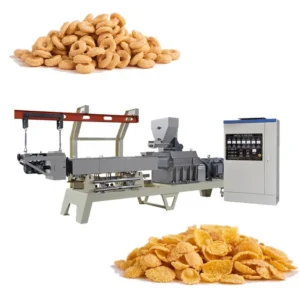
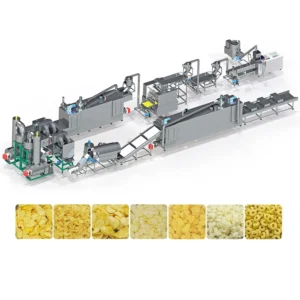
| Extruded cereal shapes | Ball, tube, ring, fruit loop, star, and wheel formats via die plate changes |
What "300 kg/h on Paper" Leaves Out About Corn Flake Lines
A rated throughput figure means little until the extruder has run on your actual raw material.
Buyers routinely receive extrusion lines quoted at a nominal capacity that simply cannot hold that output once the real formula enters the hopper. When screw elements are selected from a generic catalogue rather than matched to the starch composition, particle size, and moisture level of your specific corn source, the result is under-gelatinised dough with inconsistent expansion [NEED_CITE: importance of raw material matching in twin-screw extrusion]. I recall a project where standard screw profiles worked perfectly on fine corn flour but failed entirely on coarse local grits from the buyer’s region, requiring a complete reconfiguration of the screw element sequence and two full days of barrel temperature adjustment.
Starch Gelatinisation and the Screw Profile Connection
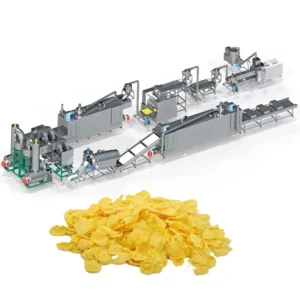
The quality of a corn flake is largely decided inside the extruder barrel, where shear force, moisture content, and temperature combine to gelatinise starch to a precise degree. A corn flakes extrusion line turnkey production setup must deliver repeatable gelatinisation across every batch, which depends on screw element geometry controlling residence time and mechanical energy input. Under-gelatinised starch produces flakes that remain brittle and fracture during flaking, while over-gelatinised material becomes sticky and clogs the die plate.
Temperature Profiling Across the Barrel Zones
A twin-screw extruder for corn flakes typically uses multiple barrel heating and cooling zones to build a temperature gradient that matches the starch transition curve. The integrated cooling function prevents localised overheating in high-shear zones near the die, where friction alone can push material temperature beyond the target range [NEED_CITE: barrel temperature profile effects on cereal extrusion]. Infrared sensor-controlled flaking rollers then receive material at a consistent plasticity, ensuring every pass through the hydraulic double rollers produces uniform flake thickness without edge cracking.
Decoding Power Ratings and Line Dimensions
The MT70 requires 160 kW installed power with a 120 kW operating consumption, indicating substantial thermal and mechanical energy available for high-moisture cereal dough processing across the 41-metre line length. The twin-screw extruder design, as opposed to single-screw alternatives, provides positive conveying action that handles the sticky, gelatinised corn dough without surging — a critical factor for maintaining steady feed into the flaking rollers. The automatic lubricating system reduces scheduled downtime around the gearbox, which on continuous cereal production runs directly affects line availability [NEED_CITE: twin-screw versus single-screw extruder maintenance requirements]. The hydraulic flaking station with separate motor drives for each roller allows independent speed adjustment, accommodating different flake thickness targets without a full mechanical changeover.
The Cost of a Generic Screw Configuration
When extruder screw elements are selected without a trial run on the buyer’s actual corn variety and moisture level, the downstream consequences compound quickly. Flakes emerge with uneven density, meaning some shatter during roasting while others remain too dense for acceptable bowl-life performance. The hot air roasting stage then struggles to remove moisture uniformly, creating batch-to-batch variation that packaging lines cannot tolerate [NEED_CITE: effect of flake density variation on roasting consistency]. Production speed drops as operators slow the line to compensate, erasing whatever capacity advantage the original specification promised.
Why This Line Is Configured Differently
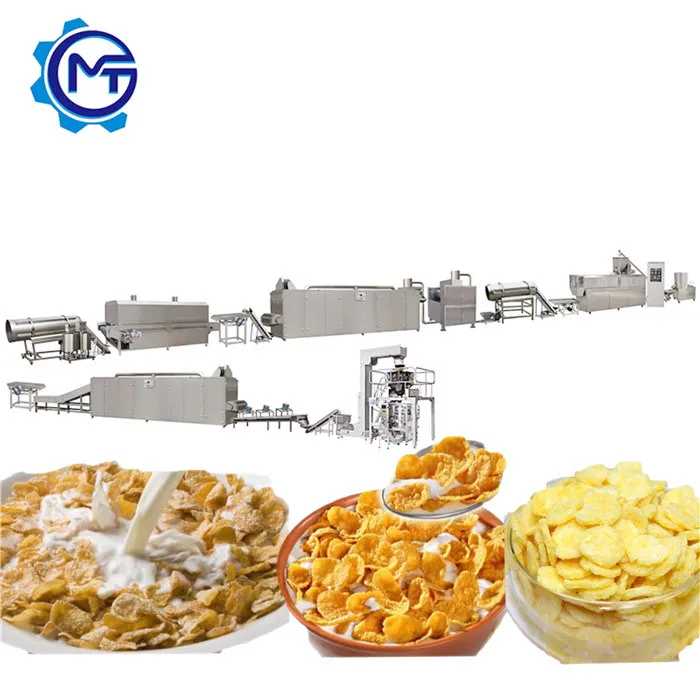
Screw configuration and die geometry are specified to your corn blend and target flake density before production begins, not copied from a standard build. The in-house machine testing workshop runs your actual raw material through the extruder, generating a trial run report that confirms expansion ratio and gelatinisation degree before the equipment ships. Line throughput is calculated station-by-station so the flaker, dryer, and hot air roaster each match extruder output, eliminating bottlenecks that commonly appear when lines are assembled from separate vendors. The conciliation burner in the roasting oven with dual circulating fans delivers controlled surface blistering and moisture removal, producing the characteristic toasted appearance buyers expect. Electrical schematics and voltage specifications are confirmed against your facility requirements during the design phase, preventing commissioning delays caused by mismatched power supplies.
Documentation & Verification
- Line layout and capacity calculation showing throughput matched across every station from mixer to packing.
- Screw and die configuration record documenting exact element arrangement selected for your corn formula.
- Trial run report on your raw material confirming flake density and expansion before dispatch.
- Electrical schematic with voltage and frequency confirmed for your facility’s power supply.
- Operation and maintenance manual covering hydraulic flaking roller service and automatic lubrication schedules.
Installation, Commissioning & Support
- The 41-metre line footprint requires a clear-span workshop with adequate ceiling height for the roasting oven exhaust ducting.
- A dedicated power circuit matching the confirmed voltage and frequency must supply the 160 kW installed load independently.
- Commissioning includes screw profile validation on your corn material with live adjustment of barrel temperature zones.
- Operator training covers hydraulic flaking roller pressure setting and infrared sensor calibration for consistent thickness.
- Wear parts list documents screw element and die plate replacement intervals specific to your corn variety’s abrasiveness.
Moving Your Inquiry Forward
To specify a corn flakes extrusion line turnkey production system accurately, we need to understand your corn source, particle size distribution, and target flake weight per litre. Share your desired daily output, workshop dimensions, and local voltage standards so the line layout and electrical design align with your facility from the start. If you produce or plan to produce sugar-coated variants, include your preferred coating formulation so the double tumble sugar melting and spraying system is configured accordingly.
Frequently Asked Questions
Q: How is screw configuration chosen for different corn blends and target flake densities?
A: The screw element sequence is selected based on the starch type, protein content, and particle size of your specific corn material. High-fat corn blends require different shear profiles than pure grits. The configuration is validated through a trial run in the testing workshop, where expansion ratio and gelatinisation are measured before the screw arrangement is locked into the build record.
Q: What barrel temperature and moisture levels produce proper starch gelatinisation in corn flakes?
A: Gelatinisation requires moisture injection and a controlled temperature ramp across the barrel zones. The exact profile depends on your corn variety and desired flake density. The integrated barrel cooling function prevents localised overheating in high-shear sections near the die, maintaining consistent material plasticity for the flaking rollers.
Q: How does die design influence flake expansion and bowl-life performance?
A: Die geometry determines the initial expansion ratio and strand cross-section entering the flaking rollers. A die that over-expands the corn dough produces thin, fragile flakes that disintegrate in milk, while under-expansion yields dense pieces with poor texture. Die selection is documented in the configuration record alongside the screw profile.
Q: Can the extruder produce multiple cereal shapes without a second line?
A: The twin-screw extruder accommodates die plate changes for different shapes including rings, balls, stars, and tubes. Changeover involves swapping the die plate and adjusting the barrel temperature profile to suit the new geometry. This flexibility supports producers expanding their product range without investing in additional extrusion capacity.
Q: Is a trial run performed on the buyer’s actual raw material before shipment?
A: Every corn flakes extrusion line turnkey production order includes a trial run in the testing workshop using your corn material. The run confirms flake density, expansion behaviour, and gelatinisation level, with results documented in a report that accompanies the shipment. Configuration changes identified during the trial are implemented before the line leaves the factory.