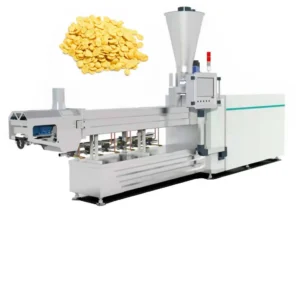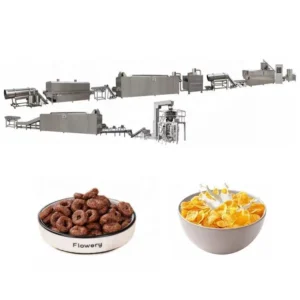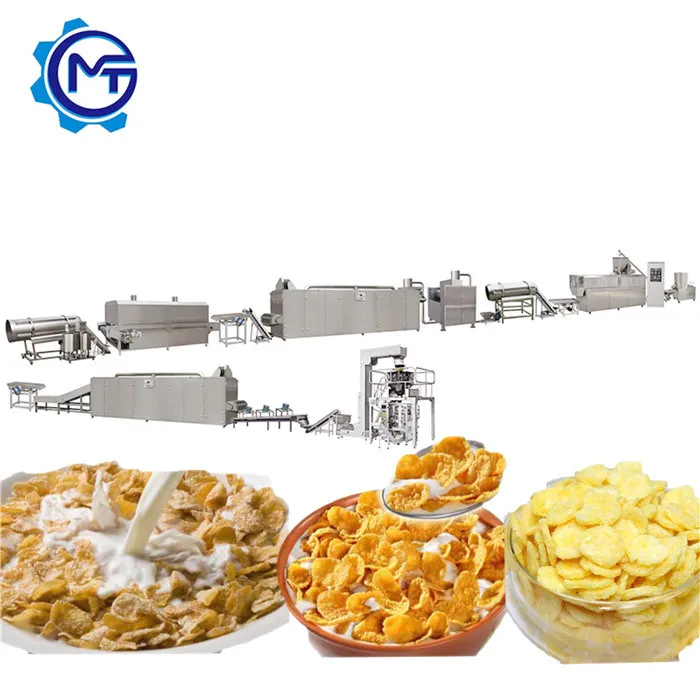
Matched Extruder Screw Geometry — screw and die profiles specified to your actual grain blend and target flake density, not copied from a generic template.
Technical Specifications
| Parameter | Value |
|---|---|
| Model | MT75 |
| Product Type | Twin Screw Corn Flakes Extrusion Line |
| Screw Type | Twin screw |
| Installed Power | 210 kW |
| Power Consumption | 150 kW |
| Output Capacity | 300–500 kg/h (basis not stated in source — confirm raw material, moisture content and product format) |
| Overall Dimensions | 45 × 1.5 × 3.5 m |
| Control System | PLC control system |
| Line Stations | Mixing → Extruding → Flaking → Drying → Hot Air Roasting → Sugar Spraying/Coating → Drying → Cooling → Packing |
| Compatible Raw Materials | Corn, rice, wheat, oat, barley powder |
| Flaking Machinery | Hydraulic double-roller system, independent dual-motor drive, infrared sensor temperature control |
| Dryer Heating Source | Gas or electric |
| Roasting Oven | Vibrating pan, conciliation burner, dual circulating fans, cyclone dust removal |
| Coating System | Double tumble sugar melter, elevator, coating drum, spraying nozzle |
| Extruder Features | Automatic lubrication and cooling, wear-resistant screw grinding technology |
| Assembly State | Complete line from batching to packing |
| Voltage & Frequency | Customized to local supply |
| Certification | CE, ISO |
Application Suitability
| Application | Material or Output |
|---|---|
| Natural corn flakes for breakfast cereal market | Corn grits and corn flour blends |
| Sugar-coated and frosted flakes | Corn, rice or multi-grain base with sugar or honey coating |
| Shaped breakfast cereals | Ball, tube, ring, star, wheel and heart profiles via die change |
| Multi-grain flake production | Wheat, oat and barley powder blends |
| Fortified breakfast cereals | Grain base with added vitamin and mineral premix |
Why a Standard Corn Flakes Spec Sheet Misses the Real Output
Corn flakes extrusion technology twin screw performance depends on the flour you actually feed into the hopper, not the flour written in the brochure.
I have seen lines shipped to South America where the buyer ran a trial on standard corn grits at the factory and got consistent flakes. Then they loaded their local corn — higher fat, different starch structure — and the expansion ratio dropped enough to change the crunch and bowl-life completely. Two extra weeks of on-site commissioning followed. A capacity figure only matters when the raw material, moisture level and die geometry behind it are documented [NEED_CITE: starch gelatinisation behaviour across corn varieties].
Screw Configuration Defines Your Flake Before It Leaves the Barrel
The twin-screw arrangement handles corn and multi-grain blends that would stall a single-screw extruder, because the intermeshing screws create a self-wiping action that prevents material build-up in the barrel. Each screw segment — conveying, kneading, reverse — is selected to match the gelatinisation window of your specific grain mix. Corn flakes extrusion technology twin screw builds that skip this matching step tend to produce flakes that either over-expand and shatter during roasting or under-expand and taste dense in the bowl.
Barrel Temperature Zones and the Gelatinisation Window
Barrel sections are heated and cooled independently so the starch passes through its gelatinisation range at a controlled rate. Too fast and the dough skins over before the flaking rollers can press it; too slow and moisture migrates unevenly through the sheet. The PLC control system logs each zone temperature continuously, which gives the operator a repeatable starting point for every batch. On a line this size, even a small drift in zone three can shift the final flake density outside the range the market expects [NEED_CITE: barrel temperature profile impact on cereal flake density].
Reading the Spec Sheet Against Your Production Target
The MT75’s installed power of 210 kW drives the main extruder motor and auxiliary systems through the full line sequence. The flaking station uses a hydraulic double-roller system with independent dual-motor drive — one motor per roller — so the nip gap stays parallel even as roller surfaces wear. Infrared sensors monitor roller temperature across the full width, which matters because uneven heat means uneven sheet thickness and therefore uneven roast colour downstream. The roasting oven pairs a vibrating pan with a conciliation burner and two circulating fans, pulling moisture off the flake surface at a rate that develops blistering without scorching. Cyclone dust removal keeps fine particulate out of the hot air loop. For sugar-coated formats, the double tumble coating system melts sugar separately and feeds it through a spraying nozzle into the rotating drum, giving a controlled glaze rather than a clumped finish.
The Hidden Cost of Ignoring Station-to-Station Throughput
An extruder running at full output is useless if the dryer cannot keep up. I have walked into plants where the flaking station sat idle twenty minutes every hour because the roasting oven was still processing the previous batch. The bottleneck is rarely the extruder itself — it is the station someone sized from a catalogue instead of from the actual product’s drying curve. That mismatch shows up as inconsistent flake colour, variable moisture content at the packing station and a capacity figure that never materialises on the shop floor [NEED_CITE: throughput balancing in multi-station cereal lines].
What We Do Differently on This Line
Every MT75 build starts with your raw material, not a default screw set. We record the screw configuration and die geometry against your flour sample so the same build can be reproduced on a reorder. The in-house testing workshop runs your actual grain blend through the extruder before the line ships, and you receive a trial run report showing expansion ratio, flake density and moisture at each station. Throughput is calculated station by station — extruder output matched to flaking roller capacity, dryer residence time matched to roaster belt speed — so no single station gates the rest. Electrical schematics are drawn to your site voltage and frequency before production starts, not after.
Documentation & Verification
- Screw and die configuration record matched to your grain blend and target flake density
- Trial run report on your raw material covering expansion ratio and moisture at each station
- Line layout with capacity calculation showing throughput balance from mixer to packer
- Electrical schematic confirming voltage, frequency and control language for your facility
- CE declaration of conformity and ISO certificate for the complete line
- Operation and maintenance manual with illustrated wear parts list
Installation, Commissioning & Support
- Foundation plan for the 45 m line length with utility drop points for gas and electric dryer options
- Dedicated electrical circuit sizing based on the 210 kW installed power requirement
- Extruder barrel alignment and flaking roller nip gap calibration during on-site commissioning
- PLC parameter upload and operator training on your specific grain recipe and target flake density
- Wear parts list covering screws, die inserts and flaking roller surfaces with reorder codes
What to Include in Your First Inquiry
Send the grain variety or blend you plan to run, including protein and fat content if you have lab data. State the flake format — natural, sugar-coated or shaped — and the daily output target in kilograms. Confirm your site voltage and frequency, and let us know whether gas or electric heating is available for the dryer and roaster. If you already have upstream milling or downstream packing equipment, include those details so the line layout accounts for the connection points.
Frequently Asked Questions
Q: How is screw configuration and die design specified to my raw material and target flake density?
A: We test your flour sample in the workshop, recording which screw segments and die geometry produce the expansion ratio and gelatinisation degree your market requires. That configuration is documented and locked in before the extruder is assembled, so the build matches your grain rather than a generic template.
Q: What barrel temperature profile produces consistent starch gelatinisation for corn flakes?
A: Each barrel zone is set independently through the PLC so the dough passes through the gelatinisation range at a controlled rate. The exact profile depends on your corn variety and moisture content, which is why we run a trial on your material before fixing the temperature set-points for production.
Q: Can I run a trial on my own raw material before the line ships?
A: Yes. Our in-house testing workshop processes your grain blend through the extruder and downstream stations. You receive a trial run report documenting expansion ratio, flake density, moisture content and product appearance at each stage before the line is packed for shipment.
Q: How do I control expansion ratio and flake thickness for my market’s crunch expectations?
A: Expansion is governed by screw configuration, die geometry and moisture at the barrel exit. Flake thickness is set at the hydraulic flaking rollers, where infrared sensors maintain even temperature across the roller surface. Adjusting these parameters together lets you dial in the crunch and bowl-life your buyers expect.
Q: How do I avoid throughput bottlenecks between the extruder, flaker and dryer?
A: We calculate capacity station by station, matching extruder output to flaking roller speed and dryer residence time to roaster throughput. The line layout document shows every station’s rated capacity against your product format so no single machine gates the rest.