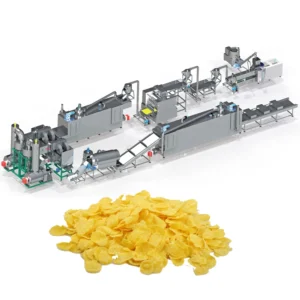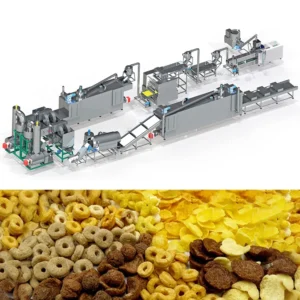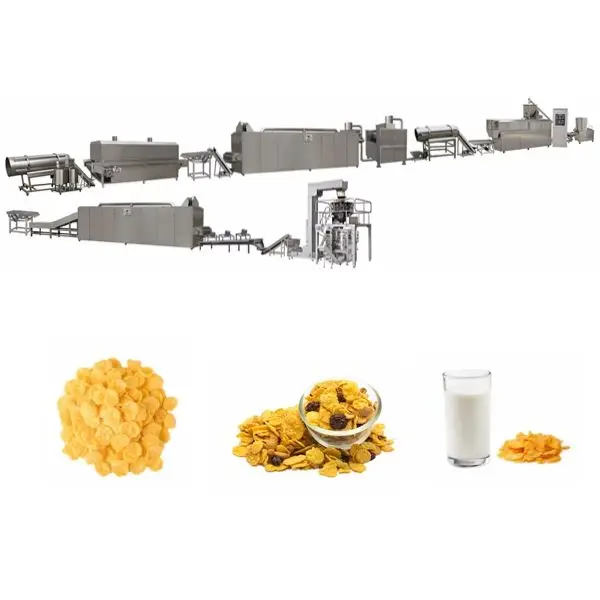
Screw-Configuration Matching — the MT70 twin-screw extruder is specified to the buyer’s grain formulation before production begins, with die geometry and barrel temperature profile tuned to achieve correct starch gelatinisation for corn, rice, wheat or oat blends.
Technical Specifications
| Parameter | Value |
|---|---|
| Model | MT70 / MT85 / MT75 |
| Product Type | Corn Flake Extrusion Production Line |
| Screw Type | Twin Screw |
| Installed Power | 160 kW (MT70); 190 kW (MT85); 210 kW (MT75) |
| Power Consumption | 120 kW (MT70); 140 kW (MT85); 150 kW (MT75) |
| Output Capacity | 150–200 kg/h (MT70); 300–400 kg/h (MT85); 300–500 kg/h (MT75) (basis to be confirmed) |
| Overall Dimensions (L×W×H) | 41 × 1.5 × 2.2 m (MT70); 43 × 1.5 × 3.2 m (MT85); 45 × 1.5 × 3.5 m (MT75) |
| Control System | PLC |
| Extruder Working Principle | Feeding system, extruding system, cutting system, heating system, gearing system, controlling system |
| Screw Feature | Automatic lubricating and cooling function; wear-resistant construction |
| Flaking Machine | PLC control; hydraulic system for double rollers; double motors for separate roller driving; infrared sensor temperature control |
| Dryer Heating Source | Gas or Electric |
| Roasting Oven | Vibrating pan with high temperature spraying tubes; conciliation burner; two separate circulating fans; cyclone dust removal device |
| Coating System | Double tumble for sugar melting, elevator, coating drum, spraying nozzle |
| Line Stations (Natural Corn Flakes) | Mixing → Extruding → Flaking → Drying → Hot Air Roasting → Cooling → Packing |
| Line Stations (Sugar Coated Corn Flakes) | Mixing → Extruding → Flaking → Drying → Hot Air Roasting → Sugar Spraying → Sugar Coating → Drying → Cooling → Packing |
| Basic Raw Materials | Corn, rice, wheat, oat, barley powder |
| Final Product Shapes | Ball, tube, stick, ring, fruit loop, star, wheel, flower, heart (by adjusting extruder mould) |
| Assembly State | Complete line (turnkey) |
| Voltage & Frequency | Customized to local requirement (source value — verify against manufacturer catalog) |
| Standards | CE |
Application Suitability
| Application | Material or Output |
|---|---|
| Breakfast cereal production | Natural corn flakes, sugar-coated corn flakes |
| Variety-shaped breakfast cereal snacks | Ball, tube, stick, ring, fruit loop, star, wheel, flower, heart |
| Cereal grain processing | Corn, rice, wheat, oat, barley as base material |
Why "Nominal Capacity" Misleads on Cereal Extrusion Lines
Capacity claims on a corn flake extrusion line mean nothing until the screw profile meets your actual grain blend. A line quoted at 200 kg/h on standard yellow corn meal may stall at 120 kg/h when the buyer switches to a local maize variety with lower starch content and inconsistent moisture. The twin screw has to work harder to achieve gelatinisation, and the whole throughput calculation collapses. This is why the first question on any serious corn flake extrusion line specifications twin screw inquiry should be about raw material provenance, not output figures. [NEED_CITE: starch gelatinisation behaviour in low-starch maize varieties during extrusion]
Barrel Temperature Zones and Starch Behaviour
Each barrel section on the twin screw extruder operates under a distinct temperature profile, and the sequence of those zones dictates how starch granules absorb water, swell, and eventually rupture. On a corn flake extrusion line, getting the gelatinisation curve right means the flake will hold together during roasting and deliver the crispness the market expects. Misaligned zones leave hard centres or cause excessive expansion that shatters the flake downstream.
Screw Element Sequencing for Different Grains
The corn flake extrusion line specifications twin screw architecture allows operators to rearrange conveying, kneading, and reverse-flight elements inside the barrel. A rice-heavy formulation requires a gentler shear profile than pure corn because rice starch gelatinises at a lower temperature and degrades quickly under excessive mechanical energy. Reconfiguring the screw stack for each grain blend is not optional if the target flake density is to be maintained across product runs. [NEED_CITE: mechanical energy input and starch degradation during twin-screw extrusion]
How Installed Power, Flaker Hydraulics and Oven Airflow Define Final Flake Quality
The 160 kW installed power on the MT70 determines how much mechanical and thermal energy the extruder can deliver per hour, directly governing the degree of cook achieved before the pellet enters the flaker. The hydraulic double-roller flaking station then compresses that pellet to a precise thickness, and the infrared sensor monitors roller surface temperature to prevent sticking or cracking. If the rollers run too cool, the pellet fractures instead of flattening; too hot and it smears. Downstream, the roasting oven uses two separate circulating fans and a cyclone dust removal device to pull moisture evenly from the flake surface. Uneven airflow causes blistering on one side and sogginess on the other, which buyers spot immediately when the flake hits milk. The PLC control ties these stations together so that a speed adjustment at the extruder automatically propagates through the flaker gap and oven dwell time.
The Hidden Cost of Ignoring Raw Material Variation
When a line ships with a generic screw configuration copied from a standard build, the first production run on the buyer’s local grain often reveals density problems that require weeks of on-site re-tuning. Flake texture drifts outside specification, roasting times extend to compensate, and energy consumption climbs without a corresponding increase in saleable output. Operators burn through replacement screws and dies searching for a workable setup, and the commissioning period stretches far beyond the planned schedule. [NEED_CITE: extrusion line commissioning delays caused by untested raw material substitutions]
What Sets This Build Apart
Every corn flake extrusion line specifications twin screw package from Meiteng ships with a screw and die configuration record that is built around the buyer’s specific grain sample, not pulled from a generic template. The in-house testing workshop runs the buyer’s actual raw material through the extruder before the line is crated, producing a trial run report that documents achievable throughput, flake density and moisture targets. Throughput matching across the extruder, flaker, dryer, roasting oven and coating drum prevents the bottleneck effect that plagues lines assembled from separate vendors. Electrical schematics, voltage and frequency are confirmed against the buyer’s facility supply before production starts, eliminating the commissioning delays that occur when a 50 Hz motor arrives at a 60 Hz plant. The PLC control system language is set to the operator’s requirement so that the HMI is readable from day one.
Documentation & Verification
- Screw and die configuration record matched to your grain formulation and target flake density
- Trial run report on your raw material conducted in the in-house testing workshop before shipment
- Electrical schematic with voltage and frequency confirmed against your facility supply
- Line layout drawing with throughput calculation across every station from mixer to packer
- CE declaration of conformity covering the complete extrusion and roasting line
- Operation and maintenance manual with wear parts list for screws, dies and flaker rollers
Installation, Commissioning & Support
- Foundation plan accounts for the 41 m line length of the MT70 with anchor bolt positions for each station
- Dedicated electrical circuit sized to the 120 kW operating draw of the MT70 with voltage confirmation before energising
- Extruder barrel sections arrive pre-assembled; flaker and roasting oven bolted on site to the main frame
- First-run commissioning includes screw speed, barrel zone temperatures and flaker gap calibration on your grain
- Operator training covers PLC interface navigation, screw element replacement and hydraulic roller adjustment
- Wear parts list identifies screw segments, die inserts and flaker roller shells with recommended stock quantities
Before You Send an Inquiry
To move past generic quotations, share the specific grain varieties you plan to run, their typical starch and moisture ranges, and whether your target is natural or sugar-coated flake. Include your facility voltage, frequency and preferred control language so the electrical package is specified correctly from the start. If you have an existing dryer or packing station you intend to keep, provide its throughput rating so the new extrusion section can be matched without over- or under-sizing.
Frequently Asked Questions
Q: How is output capacity verified against my specific grain blend and moisture level?
A: Before the line ships, your raw material is run through the extruder in the testing workshop. The trial documents actual throughput, flake density and moisture at the die exit, so the capacity figure you receive reflects your grain, not a laboratory standard.
Q: What screw configuration and die design is specified for my target flake density?
A: The screw element sequence and die geometry are selected based on your grain’s starch content and the flake thickness you need. A configuration record is provided showing every element position and the die orifice diameter matched to your product.
Q: How are barrel temperature zones and moisture injection calibrated for different cereal grains?
A: Each barrel zone has independent heating and cooling control. During the trial run, zone temperatures are adjusted in sequence while monitoring pellet surface condition and expansion behaviour, and the final profile is saved in the PLC for repeat production.
Q: Can a trial run be performed on my raw material before the line ships?
A: Yes. The testing workshop runs your grain through the extruder, flaker and a bench-scale roaster. You receive a trial run report with throughput data, flake density readings and recommended operating parameters before the full line is dispatched.
Q: How is throughput balanced between the extruder, flaker, dryer and roasting oven to avoid bottlenecks?
A: Each station is sized during the line layout stage so that the mass flow leaving the extruder matches the flaker’s compression rate, the dryer’s evaporation capacity and the roasting oven’s dwell time, preventing accumulation or starvation at any point.