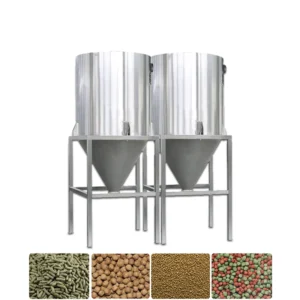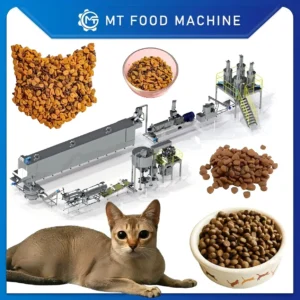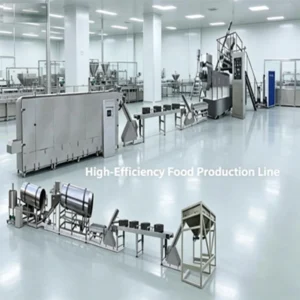
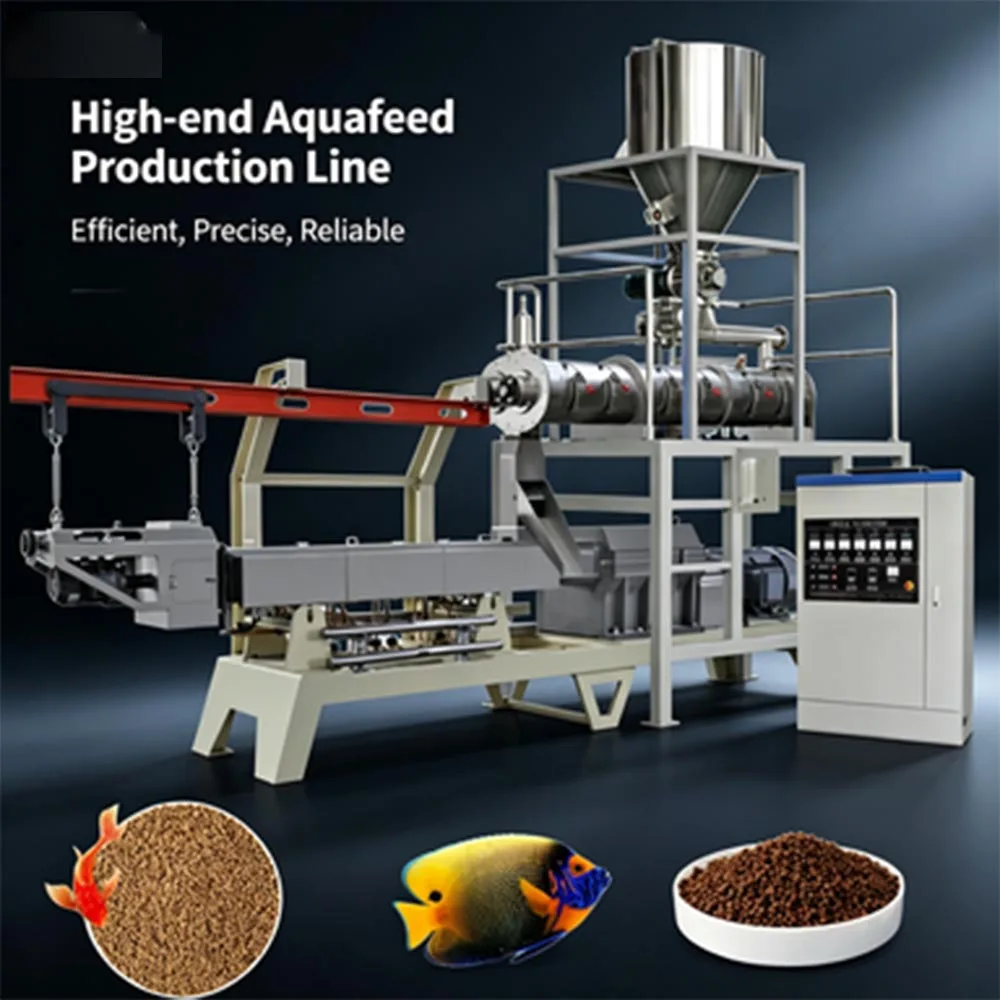
In-House Testing Workshop — Every twin screw fish feed extrusion technology build is validated on your exact raw material blend before it leaves our Jinan factory.
Technical Specifications
| Parameter | Value |
|---|---|
| Product Type | Twin Screw Fish Feed Extruder Production Line |
| Extruder Configuration | Twin screw, configuration matched to formulation |
| Control System | PLC automatic control system |
| Contact Material | Food grade 304 stainless steel |
| Line Stations | Mixer, extruder, dryer, seasoning coater, vibrating sieve, conveyors |
| Pellet Characteristics | Adjustable size, hardness, and buoyancy (floating or sinking) |
| Raw Material Compatibility | Fish meal, soybean meal, corn powder, compound additives |
| Target Aquatic Species | Koi, goldfish, tropical fish, freshwater species |
| Production Mode | Full continuous automatic operation |
| Output Capacity | Large stable processing capacity (basis to be confirmed) |
| Assembly State | Complete matched turnkey production line |
| Standards | International food hygiene standards (CE/ISO to be confirmed) |
Application Suitability
| Application | Material or Output |
|---|---|
| Commercial floating feed production | Fish meal, soybean meal, corn powder blends for tilapia and catfish |
| Sinking pellet manufacturing | High-protein compound formulations for bottom-feeding species |
| Ornamental fish feed processing | Precision-sized pellets for koi, goldfish, and tropical fish |
| Large-scale aquaculture feed milling | Continuous uninterrupted production for medium to large industrial plants |
When "Universal" Screw Profiles Sink Your Floating Pellets
Screw configuration must be calculated from your specific starch-protein-fat ratio, not copied from a generic build.
I have seen lines ship with a screw profile designed for high-starch corn snacks, then get fed a 40% fish meal formulation. The result is pellets that fracture in the water column or sink before they reach the surface. Buyers lose credibility with farms that measure floating rate at the pond edge, and the extruder sits idle while replacement screws are air-freighted across borders. Generic twin screw fish feed extrusion technology setups cannot compensate for this mismatch after installation [NEED_CITE: starch gelatinisation thresholds in high-protein aquatic formulations].
Barrel Temperature Profiling and Moisture Control
The barrel is divided into multiple heating and cooling zones, each managed independently by the PLC. Maintaining a precise temperature gradient from the feed inlet to the die face determines how completely the starch gelatinises and how much moisture flashes off at the die exit. Incomplete gelatinisation leaves pellets that disintegrate in water within minutes, while excessive heat degrades the amino acids in fish meal. The control system holds each zone within a tight band, so the operator does not have to chase drifts manually during long production runs.
Die Geometry and Pellet Density Targeting
The die plate is the last mechanical variable before the pellet takes its final shape. Orifice diameter, land length, and face pattern together control the expansion ratio as superheated moisture escapes. For floating pellets, the die must allow enough expansion to trap a closed-cell air structure; for sinking pellets, higher land length compresses the melt into a denser form. Twin screw fish feed extrusion technology only delivers the intended buoyancy when the die is selected alongside the screw profile and the buyer’s raw material data sheet.
Reading the Specifications That Actually Matter
Motor power on the main extruder dictates how much mechanical shear can be applied to viscous, high-fat formulations — a motor sized for lean corn grits will stall when the formulation shifts to 12% added fat. The length-to-diameter ratio of the screws determines residence time inside the barrel; shorter barrels may not fully cook soybean meal blends, leaving anti-nutritional factors intact. Food grade 304 stainless steel on all contact parts is not optional for fish feed, as residual chlorides from fish meal accelerate corrosion in lower grades. PLC control with recipe memory means the operator can recall a proven temperature and speed profile instead of rebuilding it from scratch after every product changeover [NEED_CITE: stainless steel corrosion resistance in chloride-rich feed environments].
The Cost of Mismatched Downstream Stations
An extruder that produces uniform pellets means nothing if the dryer cannot remove moisture fast enough to prevent mould in the bag. I once audited a line where the coating drum was sized for half the extruder’s output — the result was a bottleneck that forced the extruder to run at reduced feed rate, ruining pellet consistency. When throughput is not matched across the mixer, dryer, seasoning station, and vibrating sieve, the weakest link governs the entire line’s output. Buyers discover this only after commissioning, when the promised capacity proves unreachable.
What We Build Differently
Screw and die configuration is specified against your raw material formulation and target pellet buoyancy, not pulled from a standard catalogue. Every line undergoes a trial run in our Jinan testing workshop using your actual fish meal and additives, so pellet density and floating rate are confirmed before crating. The complete line — mixer through extruder, dryer, coater, and sieve — is engineered as one system with matched throughput at every station. PLC control parameters are set and documented in your preferred language before the control cabinet is wired. Wear parts lists specify exact screw element and die plate dimensions, so first replacements arrive without a second round of measurement.
Documentation & Verification
- Screw and die configuration record matched to your raw material data sheet
- Trial run report on your formulation confirming pellet buoyancy and surface finish
- Line layout drawing with throughput calculation at every station
- Electrical schematic with voltage and frequency confirmed for your market
- Operation and maintenance manual in your specified language
- Wear parts list with exact screw element and die dimensions
Installation, Commissioning & Support
- Foundation plan accounts for extruder vibration and dryer thermal expansion
- Electrical room layout confirms dedicated circuit for the PLC control cabinet
- Line arrives in modular skids sized for standard container loading
- First-run parameter tuning on your raw material during on-site commissioning
- Operator training covers recipe recall and barrel temperature zone management
- Spare screw elements and die plates shipped with the initial installation package
What to Include in Your Inquiry
To size the extruder and select the correct screw profile, we need your raw material formulation with protein, fat, and starch percentages, plus the target pellet diameter and whether you need floating or sinking output. Share your local voltage and frequency so the motor and control cabinet can be specified correctly. If you have existing upstream mixers or downstream packing equipment, tell us the throughput they handle so we can match the extruder station accordingly.
Frequently Asked Questions
Q: How is screw configuration determined for different fish feed formulations?
A: We map your raw material data — protein, fat, starch, and moisture content — against screw element geometry, compression ratio, and kneading block arrangement. Floating pellets with high fat content need a different shear profile than lean sinking pellets. The configuration is documented before production and validated during your trial run.
Q: What barrel temperature and moisture range are needed for proper gelatinisation?
A: Fish meal and soybean meal blends typically require a barrel profile that reaches specific temperature thresholds in the cooking zones, with preconditioning moisture adjusted to the starch source. The PLC maintains each zone independently so gelatinisation is complete without degrading heat-sensitive amino acids.
Q: Can a trial run be performed before shipment?
A: Yes. We run your actual raw material through the complete twin screw fish feed extrusion technology line in our Jinan testing workshop. Pellet density, floating rate, surface texture, and dimensional consistency are measured and recorded in a trial run report that ships with the equipment.
Q: How is extruder throughput matched with downstream stations?
A: Every station — mixer, dryer, seasoning coater, vibrating sieve — is calculated against the extruder’s confirmed output on your formulation. No station is allowed to become a bottleneck. The line layout document shows the rated capacity at each point so you can verify the match before production begins.