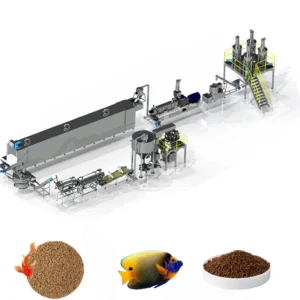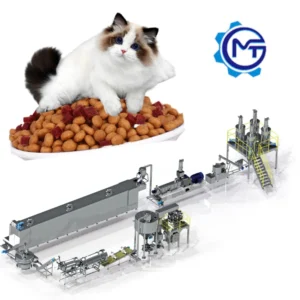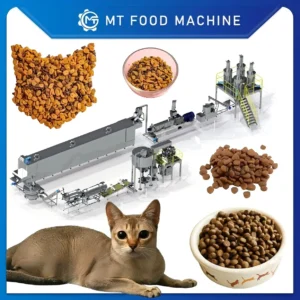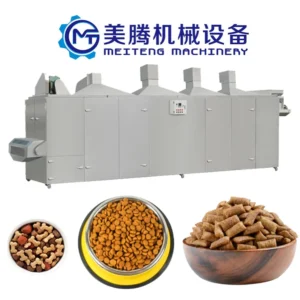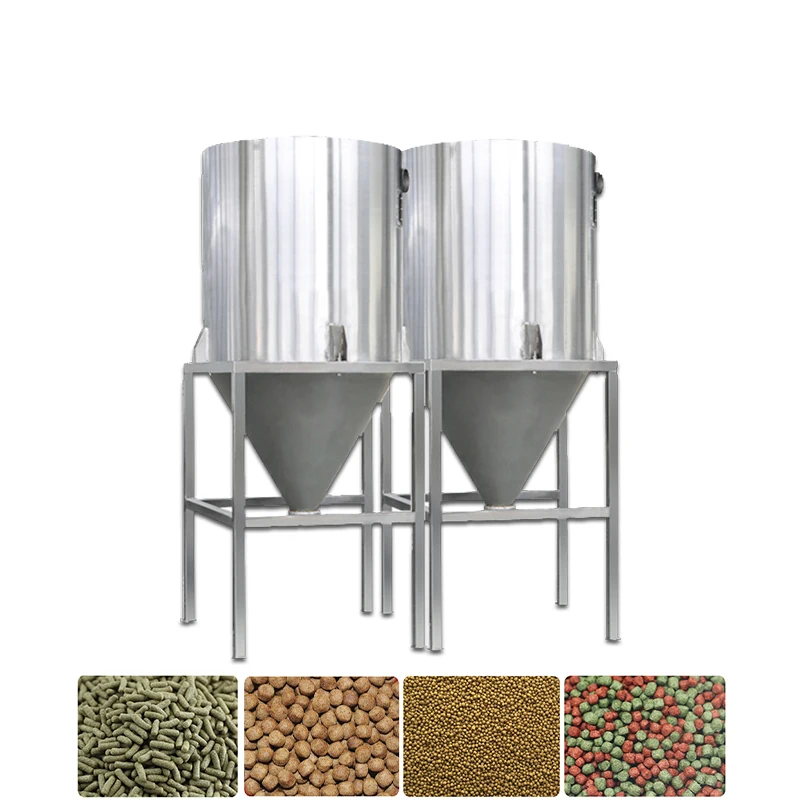
Extrusion Parameters Defined by Raw Material — screw configuration and barrel temperature profile are matched to your kibble formulation, not copied from a generic build sheet.
Technical Specifications
| Parameter | Value |
|---|---|
| Product Type | Pet Food Extrusion Production Line |
| Output Capacity | Up to 3 tons per hour (basis not stated in source — confirm raw material, moisture, pellet size) |
| Applications | Dry pet food (dog and cat kibble), aquatic feed (fish feed) |
| Process Documentation | Fish feed process drawing included |
| Warranty | 1-year warranty |
| Screw Type | Not stated in source |
| Model | Not stated in source |
| Rated Power (kW) | Not stated in source |
| Voltage & Frequency | Not stated in source |
| Control System | Not stated in source |
| Barrel Zones | Not stated in source |
| Die Configuration | Not stated in source |
Application Suitability
| Application | Material or Output |
|---|---|
| Dry dog and cat kibble production | Corn, meat meal, poultry by-products, grain blends at varying moisture levels |
| Floating aquatic feed for fish | Starch-rich formulations requiring controlled expansion and buoyancy |
| Sinking aquatic feed | High-protein formulations with density targets above water displacement threshold |
| Premium pet food formats | Multi-texture kibble requiring precise shear and gelatinisation control |
Why "Rated Capacity" Means Nothing Without Your Formulation
A pet food extrusion machine specifications sheet that omits raw material and moisture conditions tells you almost nothing about actual throughput.
When I was on the assembly floor, we shipped a line rated at a certain hourly output. The buyer’s recipe ran heavy on meat meal — close to half the mix. The material didn’t flow the same way corn grits do. Shear behaviour was different, starch gelatinisation happened at a different barrel zone, and actual output dropped well below the nameplate. The screw combination had to be rebuilt from scratch after installation. That experience changed how we approach every pet food extrusion machine specifications review: formulation first, then capacity [NEED_CITE: formulation impact on twin-screw extrusion throughput].
How Screw Configuration Controls Kibble Expansion
The screw profile determines residence time, shear intensity, and how thoroughly the raw material is worked through each barrel zone. A formulation high in animal protein demands a different flight arrangement than a starch-dominant mix. When the pitch and kneading block sequence are matched to your specific recipe, the extruder maintains consistent expansion without surging or dead zones. Getting the pet food extrusion machine specifications right at this stage prevents texture variation across production runs.
Barrel Temperature Zones and Starch Gelatinisation
Each barrel section contributes differently to the cooking process. Early zones hydrate the mix; middle zones drive gelatinisation; final zones condition the dough before it reaches the die. If the temperature profile does not match the starch source and moisture content, you get incomplete gelatinisation — which means inconsistent expansion, poor digestibility, and kibble that fractures during drying. Process engineers reviewing how to choose twin-screw extruder for pet food should request the barrel zone map against their exact formulation [NEED_CITE: starch gelatinisation temperature ranges by grain type].
Reading the Die and Moisture Parameters
Die aperture geometry and land length directly set the expansion ratio and surface texture of the finished kibble. A small-diameter die with a long land produces dense pellets suited to sinking aquatic feed. A larger opening with a short land yields the open-cell structure expected in premium dry dog food. Moisture at the die face — typically controlled by preconditioner steam and barrel injection — interacts with die selection to lock in the target density. The interplay between these three variables defines what the line can actually produce, independent of motor size or screw diameter.
The Hidden Cost of a Copied Screw Build
When a supplier copies a screw and die configuration from a different product line without adjusting for your raw material, the consequences surface weeks into production. Kibble density drifts outside specification. The dryer cannot remove moisture evenly because pellet geometry varies. Downstream coating drums apply seasoning unevenly because surface texture is wrong. These are not minor adjustments — they require pulling the screw shaft, reconfiguring elements, and potentially replacing dies, all while the line sits idle [NEED_CITE: screw element replacement downtime in food extrusion].
What Sets This Line Apart in Practice
The screw configuration and die design are specified to your raw material and target product before the extruder is assembled. Throughput calculations balance every station — extruder, dryer, coating drum — so no single unit bottlenecks the line. An in-house testing workshop runs your actual formulation before the equipment leaves the factory, generating a trial run report you can review before shipment. Complete documentation accompanies the line, including the specific screw and die configuration record tied to your recipe, not a generic catalogue entry.
Documentation & Verification
- Screw and die configuration record matched to your pet food formulation
- Trial run report on your raw material conducted in testing workshop before dispatch
- Line layout and capacity calculation showing throughput balance across all stations
- Electrical schematic with voltage and frequency confirmed for your facility
- Operation and maintenance manual with wear parts list specific to your extruder build
Installation, Commissioning & Support
- Foundation requirements based on extruder weight and vibration characteristics
- Dedicated power circuit matching confirmed voltage and frequency specification
- Full line assembled and aligned on-site by commissioning engineers
- First-run parameter adjustment using your raw material and target kibble density
- Operator training covering screw changeover, barrel temperature adjustment, and die swap procedures
- Wear parts supply including replacement screw elements and die plates for your configuration
What We Need to Configure Your Line
To build a pet food extrusion machine specifications package that reflects your actual production conditions, share your raw material formulation with approximate percentages, target kibble size and density, and the moisture range you typically work with. Include your facility voltage and frequency so the control cabinet and motor drives are specified correctly from the start. If you have an existing dryer or coating system that must integrate, provide its throughput rating so the extruder output is matched accordingly.
Frequently Asked Questions
Q: How is screw configuration selected for my specific pet food formulation?
A: We review your raw material percentages — protein source, starch type, fat content, fibre — and select screw elements that deliver the correct shear and residence time. The kneading block sequence and flight pitch are adjusted so your formulation reaches proper gelatinisation without surging. A configuration record is provided with your documentation, specific to your recipe rather than a generic template.
Q: What barrel temperature profile achieves the right starch gelatinisation?
A: The profile depends on your starch source and incoming moisture. Corn-based recipes gelatinise at different zone temperatures than wheat or rice-heavy blends. We map each barrel zone to your formulation during the trial run, documenting the set points so your operators can reproduce results from day one. This data is included in the trial run report shipped with the line.
Q: How is output capacity verified before the line ships?
A: We run your actual raw material in our testing workshop and measure throughput, expansion ratio, and kibble density under production-like conditions. The trial run report documents these results with the specific formulation tested. This is how we confirm the line meets your requirements rather than relying on a nominal capacity figure calculated on a reference material.
Q: What die configuration controls whether aquatic feed floats or sinks?
A: Floating feed requires a die that allows sufficient expansion to trap air cells inside the pellet, keeping density below water displacement. Sinking feed uses a tighter die with longer land length to compress the extrudate into a dense structure. We select die geometry based on your target buoyancy and verify floatation percentage during the pre-shipment trial run.
Q: How are moisture and shear adjusted when switching formulations?
A: Each recipe has documented set points for preconditioner steam, barrel moisture injection, and screw speed. When you switch from a dog food to a cat food or fish feed formulation, operators follow the parameter sheet specific to that recipe. The trial run establishes these values for your materials, and they are recorded in the documentation provided with the line.