Precision-Matched Screw Geometry — Every barrel zone and die profile on the MT75 line is tuned to your exact corn blend, ensuring the starch gelatinisation degree holds steady across every production run.
Technical Specifications
| Parameter | Value |
|---|---|
| Model | MT75 |
| Product Type | Twin Screw Extrusion Corn Flakes Production Line |
| Screw Type | Twin Screw |
| Installed Power | 210 kW |
| Power Consumption | 150 kW |
| Output Capacity | 300–500 kg/h (basis not stated in source — confirm raw material and moisture content) |
| Overall Dimensions (L×W×H) | 45 × 1.5 × 3.5 m |
| Control System | PLC and MCC control |
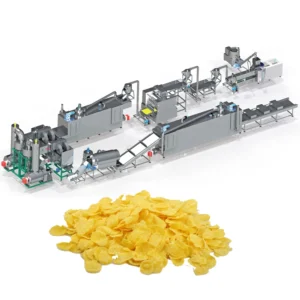
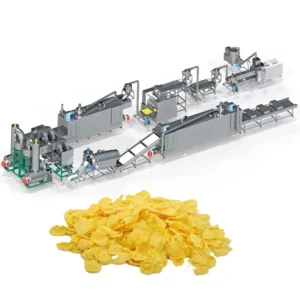
| Line Stations | Mixing → Extruding → Flaking → Drying → Hot Air Roasting → Sugar Coating (optional) → Cooling → Packing |
| Flaking Machine | Hydraulic double-roller, PLC-controlled, infrared sensor temperature control |
| Dryer Heating Source | Gas or Electric |
| Roasting Oven | Vibrating pan, dual circulating fans, cyclone dust removal |
| Coating System | Double tumble drum, elevator, spraying nozzle |
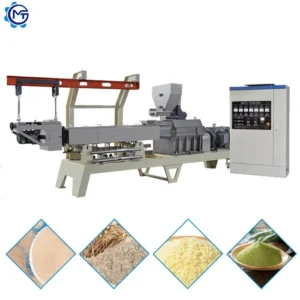
| Basic Raw Materials | Corn, rice, wheat, oat, barley powder |
| Die Configuration | Adjustable mould for multiple shapes (ball, tube, stick, ring, fruit loop, star, wheel, flower, heart) |
| Assembly State | Complete production line |
| Voltage & Frequency | Customized to local voltage per site requirement |
| Certification | CE, ISO |
Application Suitability
| Application | Material or Output |
|---|---|
| Natural corn flakes production | Unsweetened flakes from corn grits with consistent bowl-life crunch |
| Sugar-coated breakfast cereals | Glazed corn flakes requiring uniform surface adhesion |
| Multi-grain cereal formats | Wheat, oat, and barley powder blends in ring, loop, and star shapes |
| Fortified breakfast cereals | Vitamin and mineral-enriched corn and rice base materials |
What "300 kg/h" Leaves Out About Corn Flake Density
Throughput means nothing when the flakes crack in the coating drum. I spent two weeks in a Nigerian plant watching corn flake batches shatter at the sugar-coating station because the extrusion shear profile was calibrated for fine-milled corn flour, while the local mill was delivering a noticeably coarser grind. The twin screw extruder was pushing mass at the quoted rate, but the starch gelatinisation was uneven — the flakes looked right coming off the flaking rollers and then fractured under the tumbling action of the coating drum. [NEED_CITE: starch retrogradation and moisture gradient effects on flake structural integrity]
This is the gap that corn flakes extrusion technology twin screw systems must address before the line leaves the factory. When the raw material particle size shifts, the residence time inside the barrel changes, and the die pressure required for proper expansion shifts with it. A screw configuration copied from a generic build will produce flakes that are either too dense — sinking in the milk bowl — or too fragile to survive the hot-air roasting and coating stages. The real question is never whether the extruder can move material fast enough. The question is whether the screw elements, barrel temperature zones, and die geometry have been specified for your grain blend at your moisture content.
How Screw Configuration Controls Gelatinisation Uniformity
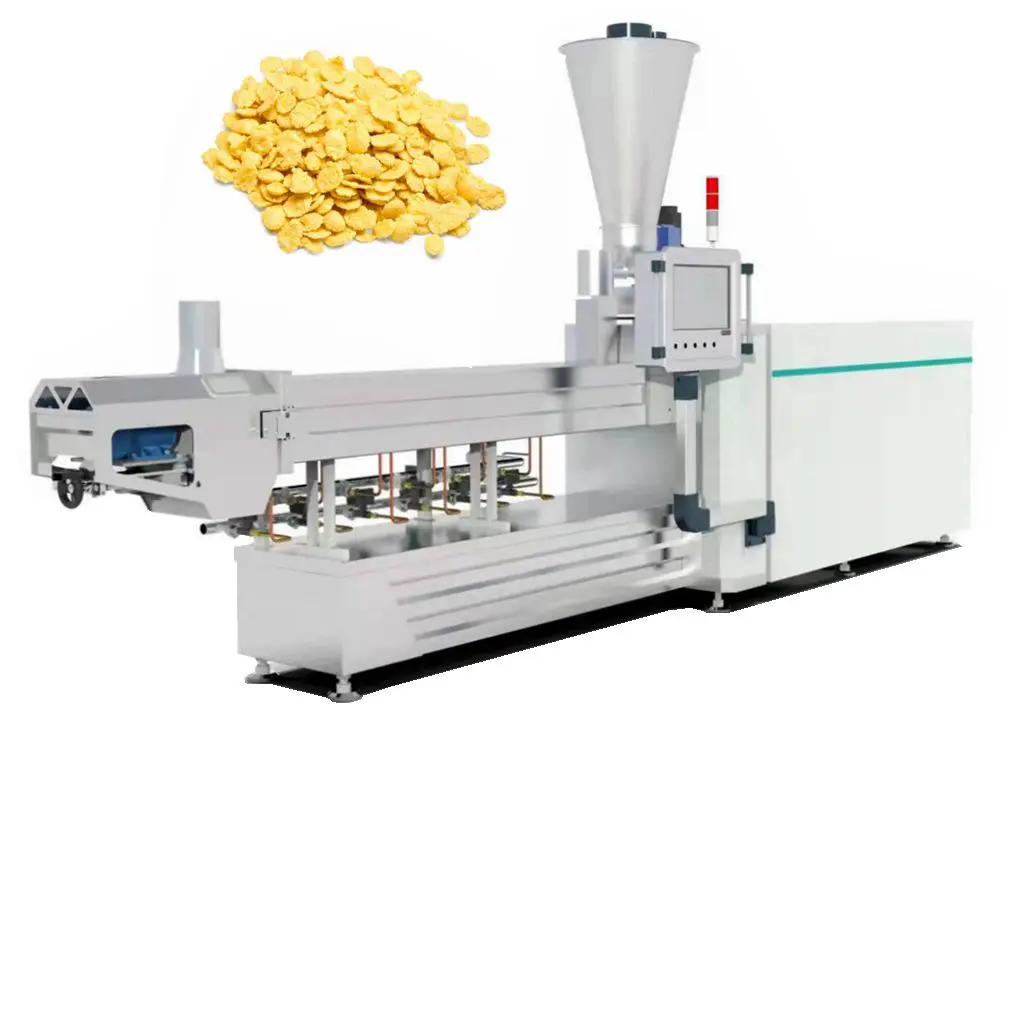
The twin-screw arrangement in the MT75 allows each screw element to be positioned along the barrel in a specific sequence — conveying, kneading, reverse-conveying — so that the corn mash experiences a controlled shear and thermal history. When processing a high-fibre oat blend, the kneading blocks are typically spaced further apart to reduce shear intensity and prevent over-gelatinisation, which would produce a gummy extrudate that tears during flaking. For pure corn grits, a tighter kneading zone arrangement drives the starch conversion further, producing a more elastic pellet that flattens cleanly under the hydraulic rollers. This screw element arrangement is what corn flakes extrusion technology twin screw engineering is fundamentally about: matching the mechanical energy input to the specific carbohydrate chemistry of your grain blend.
Barrel Temperature Profiling and the Surface Blister Pattern
Each barrel section on the MT75 has independent heating and cooling circuits, creating a temperature gradient that the PLC coordinates with screw speed. The early zones operate at lower temperatures to hydrate the grain particles without premature gelatinisation, while the final zones push the starch into the targeted conversion range. This staged thermal profile is what creates the microscopic steam pockets inside the pellet. During hot-air roasting, those trapped pockets expand and rupture the surface, forming the characteristic blister pattern that consumers associate with crunchy corn flakes. [NEED_CITE: barrel zone temperature profiling effects on extrudate expansion and surface blister formation in breakfast cereal production] If the temperature ramp is too aggressive, the blisters merge into large bubbles that collapse after cooling. Too gradual, and the surface stays flat, producing a flake that tastes dense and cardboard-like regardless of the roasting time.
Reading the Specs Beyond Installed Power
The MT75 carries a 210 kW installed power rating with 150 kW typical power consumption, which reflects the energy demand of driving twin screws through a viscous corn mash at the pressures required for proper pellet formation. The overall line footprint of 45 × 1.5 × 3.5 m encompasses every station from mixing through packing, meaning the flaking rollers, the dryer, and the roasting oven are all engineered as a throughput-matched sequence rather than sourced independently. The hydraulic double-roller flaking station uses infrared sensor temperature control to keep the roller surfaces within a narrow band — preventing the corn pellet from sticking at higher moisture levels or cracking from thermal shock when moisture content drops between batches. The PLC and MCC control system coordinates extruder screw speed, barrel zone temperatures, dryer retention time, and roasting oven temperature as a single automated process, so that a change at the mixing station propagates correctly through every downstream station.
The Hidden Cost of Skipping the Trial Run
When a corn flakes line ships without a trial run on the buyer’s actual raw material, every parameter — screw speed, barrel zone temperatures, roller gap, roasting oven dwell time — starts as a guess. I have stood in plants where the first three weeks of production were consumed by trial and error, burning through raw material and generating unsaleable product while the local operators and the commissioning engineer argued over whether the problem was the grain, the machine, or the recipe. [NEED_CITE: typical commissioning delays caused by untested raw material and machine parameter mismatches] The flakes might extrude correctly but fail at the flaking stage because the roller gap was set for a different moisture content. Or the roasting oven temperature profile might be right for the trial grain but completely wrong for the blend that actually arrives at the factory door. These problems do not show up in a brochure, and they do not resolve themselves on the production floor.
Why Source the MT75 Through This Line
The screw configuration and die design on the MT75 are specified to the buyer’s raw material and target product, not copied from a standard build sheet. The in-house testing workshop runs your actual corn, wheat, or oat blend through the extruder before the line ships, generating a trial run report that documents expansion ratio, pellet density, and flake texture against your specifications. Every station from batching through packing sits under one supplier, so the flaker capacity, dryer throughput, and roasting oven volume are matched to the extruder output rather than assembled from separate vendors with incompatible cycle times. The complete electrical schematic and voltage confirmation are validated against your site’s power supply before production begins, preventing the delays that happen when a 50 Hz machine arrives at a 60 Hz facility. Pre-sales consultation through on-site installation, commissioning, and ongoing maintenance support is handled by the same engineering team that configured the screw elements and programmed the PLC.
Documentation & Verification
- Line layout and capacity calculation matching MT75 extruder output to flaker and roaster throughput
- Screw and die configuration record documenting the exact element layout specified for your grain blend
- Trial run report on your corn or multi-grain raw material confirming expansion and flake texture before dispatch
- Electrical schematic and voltage confirmation validated against your installation site power supply
- CE declaration of conformity and ISO certificate for customs and regulatory clearance
- Operation and maintenance manual with wear parts list for screw elements, dies, and roller surfaces
Installation, Commissioning & Support
- Foundation planning for the 45 m line footprint with utility connections for 210 kW installed power and gas or electric dryer supply
- PLC and MCC control language and interface configuration set to operator requirements before the MT75 leaves the factory
- On-site assembly supervision covering flaking roller alignment and roasting oven circulating fan calibration
- First-run parameter tuning with the buyer’s local grain supply to validate the trial run report against actual production conditions
- Operator training on screw element inspection, die changeover for shape variations, and hydraulic roller gap adjustment
- Wear parts supply programme covering twin screw elements, dies, flaking roller surfaces, and roasting oven spray tubes
What to Prepare Before Requesting a Quotation
Share the specific grain blend you intend to process — corn, wheat, oat, or a multi-grain mix — along with the particle size distribution and moisture content from your local mill. Confirm the target production volume per shift, the available workshop floor area and ceiling height, and the local voltage and frequency at the installation site. If you plan to produce both natural and sugar-coated variants, note the coating specification so the double tumble drum and spraying system are included in the initial line layout. Sending a raw material sample for a pre-shipment trial run allows the screw configuration and barrel profile to be locked in before the MT75 is built.
Frequently Asked Questions
Q: How does screw configuration change when switching between corn, wheat, oat, or multi-grain blends?
A: Each grain has a different starch composition and fibre content, which changes the shear response inside the barrel. Corn grits typically need tighter kneading zones for full gelatinisation, while oat blends require wider spacing to avoid over-processing. The MT75 screw elements are rearranged and documented for each specific blend, and the configuration record travels with the machine so future changeovers have a validated starting point.
Q: What barrel temperature profile produces the optimal surface blister pattern after roasting?
A: The target is a staged thermal ramp that fully gelatinises the starch without driving off too much moisture before the pellet exits the die. Early barrel zones hydrate the grain at moderate temperatures, while final zones push conversion further. The trapped moisture then expands during hot-air roasting, rupturing the surface into the characteristic blisters. The exact zone setpoints depend on your grain blend and are established during the trial run.
Q: How is throughput matched between the extruder, flaker, dryer, and roaster?
A: Each station on the MT75 line is sized so that its cycle time and holding capacity align with the extruder output. The flaker roller width and speed, the dryer belt length and air volume, and the roasting oven pan area are all calculated from the same throughput basis. This prevents material pile-up at any single station, which would otherwise create bottlenecks and force the extruder to idle.
Q: Can the same extruder produce both natural corn flakes and multi-shape puffed cereals?
A: The MT75 die plate accepts adjustable moulds for shapes including rings, loops, stars, and balls. Switching from a corn flake pellet to a puffed cereal shape requires a die change and typically a screw configuration adjustment, since the expansion behaviour differs between a pellet intended for flaking and a shape intended to puff directly at the die. Both setups are documented for repeatable changeovers.
Q: What extrusion parameters must be re-validated during on-site commissioning with local raw material?
A: The commissioning engineer re-checks barrel zone temperatures, screw speed, moisture addition rate, and die pressure against the actual grain supply at the installation site. Local milling conditions often differ from the sample used in the factory trial run. The flaking roller gap and roasting oven temperature profile are then fine-tuned to match the pellet characteristics emerging from the extruder under local conditions.