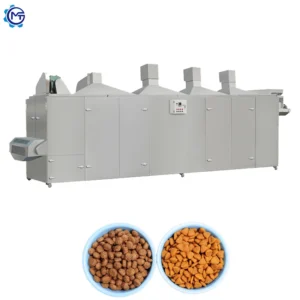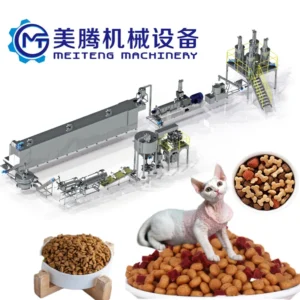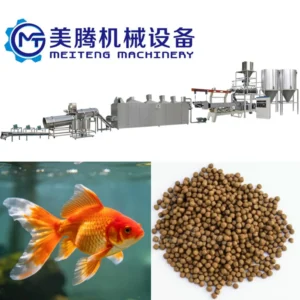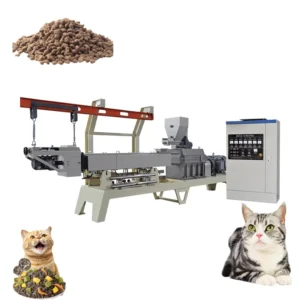
Precision-matched screw and die geometry — Every barrel section and die orifice is configured around your actual fish meal ratio and target pellet buoyancy before the twin screw fish feed extrusion line manufacturer ships the line.
Technical Specifications
| Parameter | Value |
|---|---|
| Product Type | Twin Screw Fish Feed Extrusion Production Line |
| Screw Configuration | Twin screw, segmented modular design |
| Barrel Material | Food-grade 304 stainless steel (contact parts) |
| Control System | PLC automatic control with humanized operation interface |
| Production Mode | Full continuous automatic production |
| Line Stations | Raw material mixer, extruder, dryer, seasoning/coating machine, vibrating sieve, conveyor equipment |
| Pellet Adjustability | Size, hardness, and buoyancy adjustable via screw and die configuration |
| Output Product Types | Floating and sinking fish feed pellets |
| Pellet Characteristics | Uniform density, smooth surface, high molding rate |
| Processing Conditions | High temperature and high pressure extrusion |
| Output Capacity | Basis to be confirmed (dependent on model and raw material formulation) |
| Energy Design | Optimized energy-saving transmission structure and heating system |
| Certification | CE compliant |
Application Suitability
| Application | Material or Output |
|---|---|
| Koi and goldfish feed production | Fish meal, soybean meal, corn powder, compound additives |
| Tropical fish pellet extrusion | High-protein blends with variable fat content |
| Freshwater aquaculture feed | Compound formulations requiring both floating and sinking formats |
| Medium to large-scale commercial feed mills | Continuous uninterrupted production runs on mixed grain and protein bases |
Why Buoyancy Fails When the Formula Changes
Floating pellets sink, or sinking pellets drift — the fault almost always traces back to a screw configuration that was never matched to the buyer’s actual raw material.
A twin screw fish feed extrusion line manufacturer that quotes a line on a standard corn-based test recipe is selling you a machine calibrated to a material you will never run. When your formulation carries a high fish meal percentage or a different starch-to-protein ratio, the shear profile inside the barrel shifts entirely. The expansion rate drops, the cell structure collapses, and pellets that should ride the surface go straight to the bottom of the pond. I spent three days on a job in Saudi Arabia reconfiguring screw elements and die clearance after the local high-fish-meal formula turned every floating pellet into a sinker [NEED_CITE: starch gelatinisation behaviour under varying protein-to-starch ratios in twin-screw extrusion]. The line was mechanically sound — the configuration was simply wrong for that feedstock.
Shear, Moisture, and the Gelatinisation Window
Extrusion cooking depends on a precise balance between mechanical shear, barrel temperature, and feed moisture. In a twin screw fish feed extrusion line manufacturer setup, the segmented screw elements can be arranged to create distinct zones — conveying, kneading, and high-shear — each controlling how completely the starch gelatinises. Under-gelatinised starch produces weak, crumbly pellets that disintegrate in water. Over-processed material burns at the die face and blocks flow. The PLC system maintains consistent barrel temperature profiles zone by zone, but the mechanical configuration of the screws is what determines whether the material reaches the right gelatinisation point at the right moment.
Die Geometry and Pellet Density Control
The die plate is where expansion actually happens. Orifice diameter, land length, and face pattern together determine how much the pellet expands as it exits the high-pressure barrel into ambient conditions. For floating feed, the die must allow maximum radial expansion so the pellet traps enough air to stay buoyant. For sinking feed, longer land lengths restrict expansion, producing a denser pellet that drops through the water column [NEED_CITE: die land length influence on extrudate density in aquatic feed production]. Swapping die plates is straightforward, but the screw configuration upstream must be retuned as well — otherwise the material arrives at the die at the wrong pressure and moisture level, and no die change will correct it.
Reading the Specs That Actually Matter
The twin-screw design gives this line its range. Unlike single-screw extruders, which rely on friction to drag material forward, intermeshing twin screws provide positive displacement — meaning the machine can handle high-fat, high-moisture, and high-protein formulations that would stall a single-screw unit. The food-grade 304 stainless steel contact parts resist the corrosive salts in fish meal and extend screw and barrel life under continuous operation. PLC control with a humanized interface lets operators monitor barrel zone temperatures, screw speed, and feeder rates from one screen, reducing the chance of batch-to-batch drift during long production runs. The full line — mixer, extruder, dryer, coating drum, vibrating sieve, and conveyors — is throughput-matched so no single station chokes the others.
What Happens When Stations Are Mismatched
A dryer that cannot handle the extruder’s output moisture load forces the entire line to slow down. A coating drum that is undersized for the pellet volume creates uneven fat distribution, which in turn causes pellets to go rancid at different rates in storage. I have walked into plants where the extruder was industrial-grade but the downstream dryer was a catalog pick that simply could not keep up — the result was a bottleneck that cut real output well below the nameplate rating [NEED_CITE: throughput balancing across extrusion line stations]. The vibrating sieve at the end catches fines and broken pellets, but if upstream density control is poor, the reject rate climbs and margin erodes quietly.
Why This Line Is Built Differently
Screw and die configurations are specified against your raw material blend and target pellet buoyancy — not copied from a generic build sheet. The in-house testing workshop runs your actual formulation before the line ships, producing a trial run report that documents pellet density, expansion ratio, and surface quality. Throughput is calculated across every station so the mixer, dryer, and coating drum all match the extruder’s real output rather than its theoretical maximum. Electrical schematics and voltage specifications are confirmed against your facility’s power supply before production begins, preventing the kind of commissioning delay that costs weeks on site.
Documentation & Verification
- Line layout drawing with station-by-station throughput calculation for your aquatic feed formulation
- Screw element arrangement and die plate specification record matched to your raw material
- Trial run report on your fish meal and grain blend from the in-house testing workshop
- Electrical schematic with voltage, frequency, and PLC language confirmation
- CE declaration of conformity and ISO certification documentation
- Operation and maintenance manual with wear parts replacement schedule
Installation, Commissioning & Support
- Foundation plan aligned to the full line footprint including mixer, extruder, and dryer stations
- Dedicated power circuit specification matching the PLC-controlled extruder’s rated electrical load
- Modular assembly sequence allowing station-by-station commissioning from batching to packing
- First-run parameter setting on your raw material with screw speed and barrel temperature calibration
- Operator training covering PLC interface navigation, die changeover, and buoyancy adjustment procedures
- Wear parts list identifying screws, dies, and seals with recommended replacement intervals
Before You Request a Quote
Send your raw material formulation — including fish meal percentage, starch source, fat content, and any compound additives — along with the target pellet diameter and whether you need floating, sinking, or both formats. Specify your facility’s voltage, frequency, and preferred PLC language. If you have existing upstream batching or downstream packing equipment, share the model and throughput so the line can be matched to your current setup.
Frequently Asked Questions
Q: How is output capacity verified and what raw material premise is it based on?
A: Capacity is confirmed through a trial run using your specific raw material blend in the in-house testing workshop. The resulting report documents actual throughput, pellet density, and expansion rate. We never quote a number based solely on a standard corn test recipe — the capacity figure you receive reflects the formulation you will actually run on the production floor.
Q: How do you ensure floating feed actually floats and sinking feed sinks to market specification?
A: Screw element arrangement, barrel temperature profile, and die plate geometry are all configured together to control expansion and density. The trial run validates buoyancy by measuring pellet behavior in water, and adjustments to screw configuration or die clearance are made until the result meets your market’s specification before the line ships.
Q: Can the line run a trial on our own raw material before shipment?
A: Yes. The in-house testing workshop conducts a full trial run on the buyer’s raw material before dispatch. The trial run report records pellet size, surface quality, density, and buoyancy, giving you verified production data before the equipment arrives at your facility.
Q: What voltage, frequency, and control language options are confirmed before production?
A: Electrical schematics and voltage requirements are confirmed against your facility’s power supply during the specification stage. The PLC interface language is set to your operator’s preference. This confirmation happens before production starts, preventing delays during on-site commissioning.