Screw Configuration Engineered to Your Formula — Every MT70 build starts with your actual raw material blend and target kibble density, not a generic screw stack pulled from a catalog.
Technical Specifications
| Parameter | Value |
|---|---|
| Model | MT70 |
| Product Type | Pet Food Processing Line |
| Output Capacity | 100-200 kg/h (basis not stated in source — confirm raw material formulation and moisture content) |
| Screw Type | Twin-screw |
| Voltage & Frequency | 380V 50Hz Three Phase |
| Control System | PLC and MCC control |
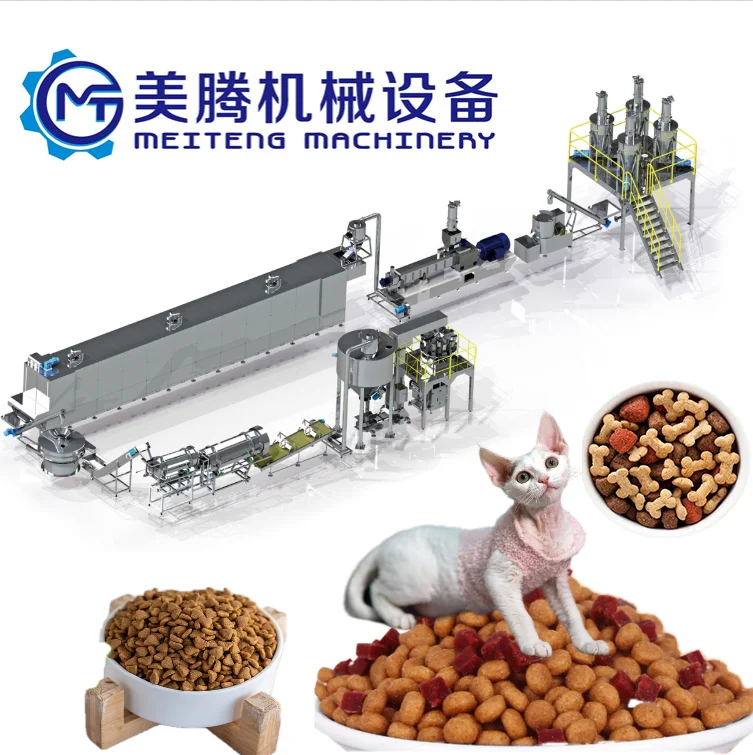
| Line Stations | Mixing, extrusion, drying, packaging |
| Certification | CE, ISO, FDA compliance |
| Recipe Adaptability | Dry kibble, semi-moist pet food, pet treats |
| Assembly State | Complete turnkey production line |
Application Suitability
| Application | Material or Output |
|---|---|
| Dry kibble production | Corn, rice, wheat, meat meal, fish meal blends for dogs and cats |
| Semi-moist pet food | Higher moisture formulations with humectants and protein concentrates |
| Pet treat manufacturing | Chewable and crunchy treat formats with varying starch and fat ratios |
| Breed-specific kibble | Smaller kibble geometries for toy breeds or larger geometries for working dogs |
| Functional pet food | Fortified blends with added vitamins, minerals, or joint-support compounds |
Why Generic Screw Stacks Sink Kibble That Should Float
A copied screw configuration cannot hold your target density when your protein content deviates from the builder’s test flour.
I learned this the hard way on a cat food job a few years back. The line was quoted at a nominal throughput, and the screw stack was a standard build that worked fine on our workshop test material. But the customer’s actual recipe had noticeably higher protein and fat than what we trialed. The kibble came out hard, dense, and every piece sank during the float test. We had to reconfigure the screw elements on-site and swap the die plate before the line could produce anything the market would accept. That is why the pet food processing line screw configuration extrusion technology conversation must happen before the purchase order, not after the containers arrive. [NEED_CITE: starch gelatinisation behaviour at varying protein and fat ratios in twin-screw extrusion]
How Screw Elements Shape Kibble Density
The twin-screw assembly inside the MT70 is not a fixed component. Each screw section — conveying, kneading, reverse — can be rearranged to change shear intensity, residence time, and the degree of starch gelatinisation your formula achieves. A recipe heavy in corn and rice needs aggressive kneading blocks to fully cook the starch and generate the expansion that produces a light, crunchy bite. A formula loaded with meat meal and fat requires a gentler profile, because excessive shear breaks down protein structure and collapses the air cells that give kibble its float and crunch. The pet food processing line screw configuration extrusion technology behind this line lets your process engineer specify the element sequence that matches your exact ingredient ratios rather than accepting whatever the factory floor defaulted to.
Barrel Temperature Zones and Moisture Control
The MT70 barrel is divided into multiple heating and cooling zones, each independently controlled through the PLC. This zoning matters because starch gelatinisation does not happen at a single temperature — it progresses through stages as the material moves from the feed section to the die. Too much heat too early and the outer layer of the dough cooks before the core hydrates, leaving a hard shell and a raw center. Too little heat in the metering zone and the dough arrives at the die without enough expansion energy, producing flat, dense pieces. Moisture injection points along the barrel allow fine-tuning of the dough consistency in real time, compensating for seasonal variation in raw material humidity. [NEED_CITE: barrel zone temperature profiling in twin-screw food extrusion]
Reading the Spec Sheet Against Your Production Reality
The 380V 50Hz three-phase supply is standard for many export markets, but if your facility runs on 440V 60Hz or a different local grid, the motor, heaters, and PLC power supply must be specified accordingly before production starts. The PLC and MCC control architecture means every barrel zone temperature, screw speed, and feeder rate is logged and repeatable — critical when you need to reproduce the same kibble batch after batch. The twin-screw design handles a broader range of ingredient particle sizes and fat levels than a single-screw alternative, which matters when your recipe includes coarse meat meal or sticky binder additions. Line stations from mixing through extrusion to drying and packaging are throughput-matched, so the dryer capacity is not undersized relative to the extruder output — a mismatch that otherwise creates a bottleneck and forces you to run below the extruder’s capable rate.
What Happens When the Line Is Not Trial-Tested on Your Formula
Shipping an extruder without a documented trial run on the customer’s actual raw material means the first real production test happens on the buyer’s floor, with raw material already staged and packaging suppliers waiting. If the kibble density misses specification, the screw stack must be reconfigured on-site — a process that involves pulling the screws, rearranging elements, reassembling, and running new tests while downtime accumulates. Die plate changes compound the delay if the original hole diameter or land length does not produce the target piece geometry. In the worst cases I have witnessed, the dryer was sized for a lower throughput than the extruder could deliver, forcing the entire line to idle while product backed up in the conveyor transition. [NEED_CITE: on-site commissioning delays caused by untested extrusion configurations]
Why Procurement Starts With the Formula, Not the Brochure
Every MT70 line is configured from the screw stack outward based on the buyer’s submitted formulation, not a standard build held in inventory. The in-house testing workshop runs your actual raw material through the configured extruder before shipment, generating a trial report that documents screw arrangement, barrel temperatures, moisture settings, and the resulting kibble density and expansion. Line throughput is calculated station by station — mixer cycle time, extruder screw speed and fill factor, dryer belt length and air temperature, coating drum capacity — so no single station chokes the output of the others. Electrical schematics and control language are confirmed against your facility’s power supply and operator preference before the panel is wired. CE and ISO documentation ships with the machine, supporting customs clearance and local regulatory registration.
Documentation & Verification
- Screw and die configuration record matched to your submitted pet food formulation
- Trial run report on your raw material documenting expansion, density, and gelatinisation results
- Electrical schematic with voltage and frequency confirmed to your facility grid
- CE declaration of conformity and ISO certificate for import and regulatory filing
- Line layout drawing showing station-by-station throughput balance
- Wear parts list with screw element and die plate specifications
Installation, Commissioning & Support
- Foundation plan accounts for the MT70 twin-screw extruder weight and vibration isolation requirements
- Dedicated three-phase 380V 50Hz circuit with confirmed breaker rating for combined extruder and dryer load
- On-site screw configuration verification against trial run report before first production shift
- PLC parameter upload and HMI language set to operator preference during commissioning
- Spare screw elements and die plates included for first replacement cycle
- Dryer belt tension and airflow calibration matched to extruder output rate
What We Need to Configure Your Line
To move from inquiry to a line proposal that holds up on your production floor, share your raw material formulation including protein, fat, and starch ratios along with target moisture content. Specify the kibble size, shape, and whether the end product must pass a float test. Provide your facility voltage, frequency, and preferred control language. If you have existing upstream mixing or downstream packaging equipment, send the model and throughput so the MT70 stations are matched to your full line rather than operating in isolation.
Frequently Asked Questions
Q: How is the screw configuration determined for my specific pet food formulation?
A: We request your full ingredient list with protein, fat, starch, and moisture percentages. Our process team builds a screw element sequence that delivers the shear and residence time your formula needs for complete starch gelatinisation without collapsing the protein matrix. The configuration is documented and trialed in our testing workshop before the line ships.
Q: What barrel temperature profile does my kibble recipe require?
A: Barrel zones are set based on your starch source and its gelatinisation onset temperature. High-corn recipes typically need a progressive ramp across the zones, while meat-heavy formulas run cooler to prevent protein denaturation. The PLC stores your profile so every batch repeats the same thermal curve.
Q: Can I run a trial on my raw material before the line ships?
A: Yes. Our in-house testing workshop is equipped to run your actual raw material through the configured MT70 extruder. You receive a trial report covering screw configuration, barrel settings, kibble density, expansion ratio, and starch gelatinisation assessment before the equipment leaves the factory.
Q: How do you keep kibble density consistent across the full throughput range?
A: Consistency depends on matched throughput at every station. The mixer cycle time, extruder screw speed, dryer belt speed, and coating drum rotation are all calculated so the extruder never starves or overfeeds. The PLC monitors barrel temperatures and screw load in real time, adjusting feeder rates to maintain the target density.
Q: What if the kibble does not meet my density specification after installation?
A: The trial run report establishes the baseline configuration. If on-site results deviate, our commissioning engineer adjusts screw elements, barrel temperatures, and die selection using the documented parameters as a starting point. Having the trial data means adjustments are targeted corrections, not blind experimentation on your production floor.