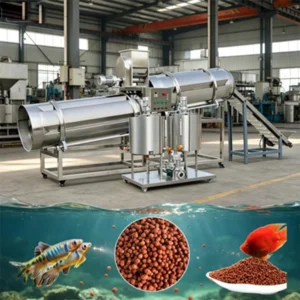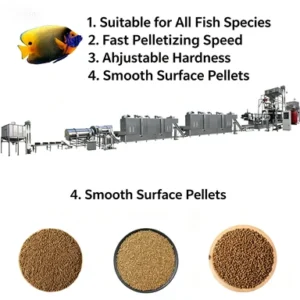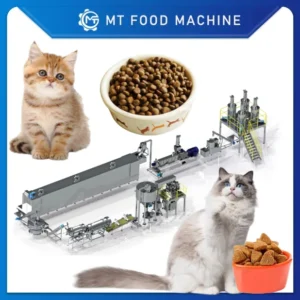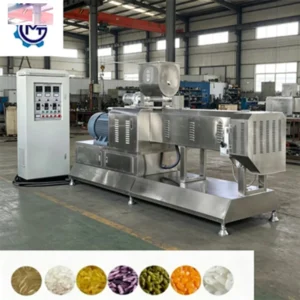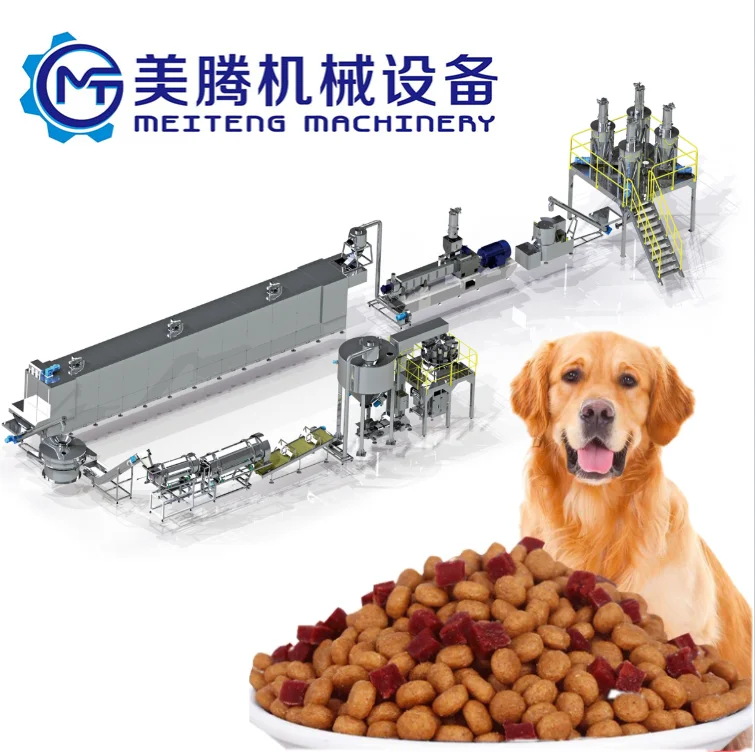
Precision Extrusion Parameter Tuning — screw configuration and barrel temperature profile are documented against the buyer’s specific raw material formula, not pulled from a generic build library.
Technical Specifications
| Parameter | Value |
|---|---|
| Product Type | Pet Food Extrusion Production Line |
| Extruder Type | Twin-screw |
| Automation Level | Fully automated from mixing through drying to packaging |
| Control System | Advanced sensors with precision PLC/MCC controls |
| Contact Materials | Food-grade stainless steel across all extrusion zones |
| Recipe Range | Dry kibble, semi-moist formats, and pet treats |
| Line Configuration | Mixing, extrusion, drying, packaging stations |
| Output Capacity | Confirmed against raw material moisture and protein content (basis to be confirmed) |
| Energy Design | Integrated energy-saving technology |
| Component Layout | Modular design for quick cleaning and maintenance |
| Standards | CE, FDA compliant |
Application Suitability
| Application | Material or Output |
|---|---|
| Dry kibble for dogs and cats | Corn, meat meal, poultry by-product, grain blends |
| Semi-moist pet food | High-moisture meat-based formulas with humectants |
| Floating aquatic feed | Fish meal, starch binders for catfish and tilapia |
| Sinking aquatic feed | Dense protein formulations for shrimp and bottom feeders |
| Bird and cattle feed pellets | Grain, vitamin premix, and fiber blends |
| Pet treats and bites | Flavor-intense, small-format extruded shapes |
Why Kibble Density Fails When Extrusion Parameters Are Guesswork
Floating feed that sinks on arrival, or kibble that arrives denser than the market specification demands — the root cause traces back to a pet food extrusion production line extrusion technology package where screw geometry, barrel heat zones, and die aperture were never matched to the buyer’s actual formula.
I spent years on workshop floors in Shandong assembling these machines one station at a time. One Middle East client ran a line rated for a certain throughput, but their meat meal carried high protein and high viscosity. The extruder pushed material through, but the kibble came out misshapen and actual yield fell well below the nameplate figure. The screw profile and die land length had been selected from a standard catalog, not calculated for that particular ingredient behavior. That kind of mismatch does not show up until raw material is actually running through the barrel [NEED_CITE: starch gelatinisation behavior under varying protein and moisture conditions].
Screw Geometry and Die Land Length for Target Kibble Density
The twin-screw configuration controls how much shear energy transfers into the dough as it moves through each barrel zone. Forward-pitch elements push material quickly with lower shear, while kneading blocks hold the dough longer under higher mechanical stress. For a high-meat formula, the screw profile must balance enough shear to gelatinise starch without overworking proteins that make the dough too viscous to expand at the die face. Die land length then governs how much back-pressure builds before the dough exits — shorter lands yield more expansion, longer lands produce denser kibble.
Barrel Temperature Profiling Across Multiple Heating Zones
Each barrel zone operates at an independent temperature set-point, creating a gradient that the recipe demands. Early zones stay lower to hydrate starch granules without premature gelatinisation; middle zones climb to activate expansion; final zones stabilize melt temperature before the die. Moisture injection points between zones allow operators to fine-tune water activity in the dough. When the barrel profile is flat or poorly staged, starch gelatinisation becomes inconsistent across the cross-section of each kibble piece, leading to uneven expansion and texture variation between the center and the surface [NEED_CITE: barrel temperature zone staging in twin-screw food extrusion].
Reading the Specifications That Actually Matter
The L:D ratio — the length of the screw relative to its diameter — determines how much residence time the material has inside the barrel. A higher ratio gives more time for starch conversion and protein denaturation, which matters when recipes contain raw grain or high-fiber inclusions. Motor power must be sized for the peak torque required by the stiffest recipe in the production plan, not just the lightest grain blend. Barrel zone count defines how many independent temperature stages exist; fewer zones mean coarser thermal control. Food-grade contact materials throughout every zone prevent corrosion from acidic ingredients like tomato pomace or citrus pulp that appear in some pet formulations.
The Hidden Cost of Skipping Raw Material Trials
When a line ships without a trial run on the buyer’s actual formula, commissioning becomes product development. Engineers adjust screw elements, barrel temperatures, and moisture ratios on-site while production schedules wait. Wear parts consumption rises because the screw configuration is being reworked repeatedly. Kibble density drifts batch to batch until someone documents a stable parameter set. Buyers end up paying for raw material waste and lost production days that a pre-shipment test would have prevented [NEED_CITE: pre-shipment factory trial runs for extrusion line validation].
Why Procurement From This Facility Works
Every line station — from batching through extrusion to drying and packaging — is sourced under one supplier, so throughput is matched across every stage rather than assembled from mismatched vendors. Screw configuration and die design are specified to the buyer’s raw material analysis and target kibble density, with the configuration record documented before production begins. An in-house machine testing workshop allows trial runs on the buyer’s actual ingredients before the line ships, generating a test report that confirms expansion ratio, density, and texture. Twin-screw expertise spans pet food, aquatic feed, snack, cereal, starch, and protein applications, so parameter selection draws from a wide process knowledge base rather than a single product category.
Documentation & Verification
- Line layout drawing showing throughput matching between each station
- Screw and die configuration record tied to your raw material formula
- Trial run report documenting kibble density and expansion on your ingredients
- Electrical schematic with voltage, frequency, and control language confirmed
- Operation and maintenance manual with wear parts replacement intervals
- Packing photographs and customs documentation support for your destination port
Installation, Commissioning & Support
- Foundation plan and utility routing based on your confirmed line footprint and station layout
- Power supply verification matching the extruder motor rating and control panel voltage specification
- Modular station assembly with throughput balancing across mixing, extrusion, drying, and packaging
- First-run parameter tuning using your raw material to replicate trial run density and texture results
- Operator training covering screw element changes, barrel zone set-points, and die cleaning procedures
- Wear parts list with reorder specifications for screws, dies, and barrel liners
What We Need From Your Side to Size the Line
Provide your raw material formulation with protein, fat, starch, and moisture percentages so the screw profile and barrel temperature staging can be calculated before quotation. Share your target kibble size, density range, and whether the product must float or sink if aquatic feed is involved. Confirm your workshop voltage, frequency, and preferred control panel language so the electrical package is built correctly from the start.
Frequently Asked Questions
Q: How do you select screw configuration and die design for my specific raw material?
A: We review your ingredient formulation — protein content, fat level, starch source, and moisture — then calculate the shear profile and residence time needed for proper gelatinisation. Screw elements are arranged and die land length is set to hit your target kibble density. The configuration is documented and available for review before the extruder enters production.
Q: Can you run a trial on my actual raw material before the line ships?
A: Yes. Our in-house testing workshop runs your ingredients through the configured extruder, and we document expansion ratio, kibble density, texture, and moisture content in a trial run report. This confirms the line will produce to specification upon arrival rather than requiring on-site recipe development.
Q: What barrel temperature profile is needed for proper starch gelatinisation?
A: The profile depends on your starch source and moisture level. Corn-based recipes typically need a staged ramp across multiple barrel zones, while tapioca-heavy formulas behave differently. We set and document zone-by-zone temperatures during the trial run so your operators have a validated starting point at commissioning.
Q: How do I verify that output capacity holds on my real formula?
A: Output capacity is confirmed during the trial run on your raw material, not assumed from a nameplate rating. The trial report records actual throughput in kg/h at the validated screw speed and moisture setting, so you see the figure your specific formula produces before the equipment leaves the factory.