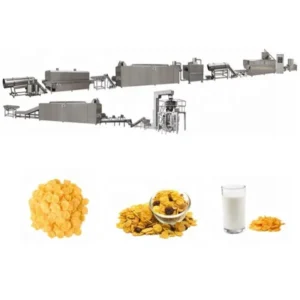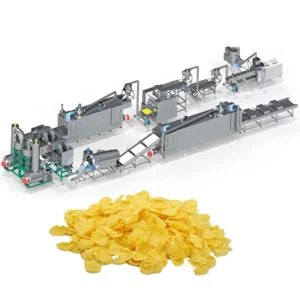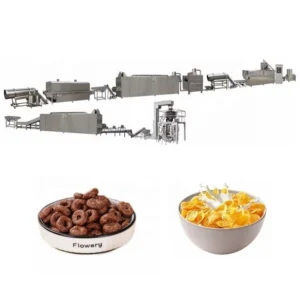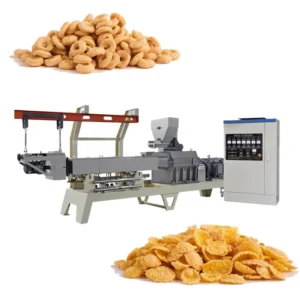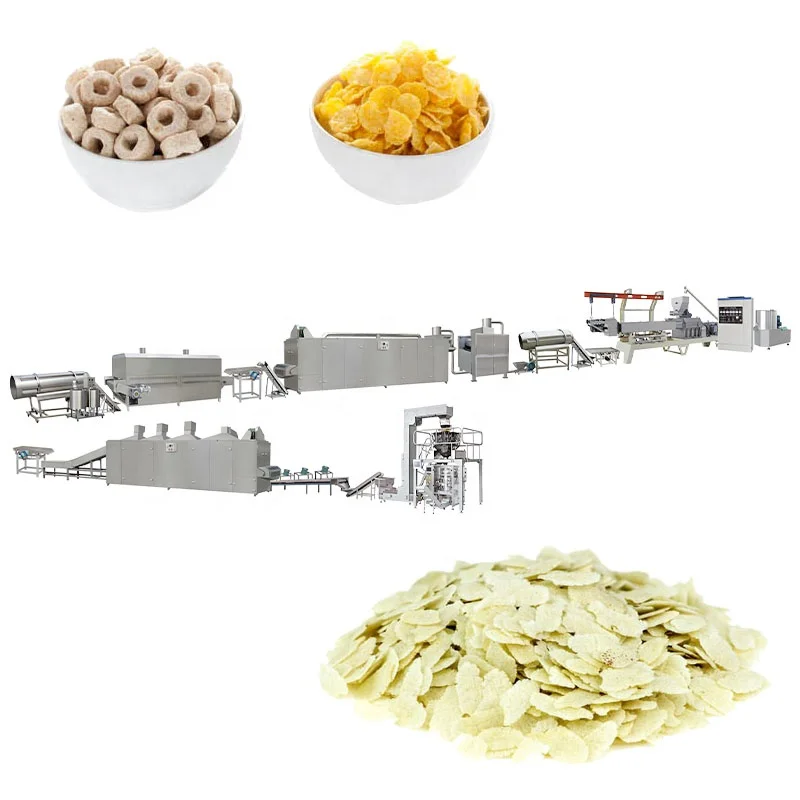
Screw Configuration Matched to Raw Material — Trial runs on customer-supplied grain blends validate screw profile and die geometry before the corn flake extrusion technology production line ships, ensuring starch gelatinisation and flake density align with target market specifications.
Technical Specifications
| Parameter | Value |
|---|---|
| Product Type | Corn Flake Production Line |
| Models Available | MT70, MT85, MT75 |
| Extruder Type | Twin Screw |
| Installed Power (MT70) | 160 kW |
| Power Consumption (MT70) | 120 kW |
| Output Capacity (MT70) | 150–200 kg/h (basis not stated in source — confirm raw material / moisture content) |
| Installed Power (MT85) | 190 kW |
| Power Consumption (MT85) | 140 kW |
| Output Capacity (MT85) | 300–400 kg/h (basis not stated in source — confirm raw material / moisture content) |
| Installed Power (MT75) | 210 kW |
| Power Consumption (MT75) | 150 kW |
| Output Capacity (MT75) | 300–500 kg/h (basis not stated in source — confirm raw material / moisture content) |
| Overall Dimensions (MT70) | 41 × 1.5 × 2.2 m |
| Overall Dimensions (MT85) | 43 × 1.5 × 3.2 m |
| Overall Dimensions (MT75) | 45 × 1.5 × 3.5 m |
| Control System | PLC (flaking machinery), MCC |
| Flaking Machinery Drive | Double Motors for Separate Roller Driving |
| Flaking Roller System | Hydraulic System for Double Rollers |
| Flaking Temperature Control | Infrared Sensor for Even Temperature Pipe Control |
| Dryer Heating Source | Gas or Electric (configurable) |
| Roasting Oven | Hot Air Roasting with Conciliation Burner, Two Circulating Fans, Cyclone Dust Removal |
| Coating System | Double Tumble for Sugar Melting, Elevator, Coating Drum, Spraying Nozzle |
| Extruder Lubrication | Automatic Lubricating and Cooling Function |
| Line Stations | Mixing → Extruding → Flaking → Drying → Hot Air Roasting → Sugar Spraying / Coating → Drying → Cooling → Packing |
| Raw Materials | Corn, Rice, Wheat, Oat, Barley Powder |
| Final Product Shapes | Ball, Tube, Stick, Ring, Fruit Loop, Star, Wheel, Flower, Heart (by adjusting extruder mould) |
| Certification | CE, ISO |
Application Suitability
| Application | Material or Output |
|---|---|
| Natural corn flakes for breakfast cereal packaging | Degerminated corn grits, corn flour, corn powder |
| Sugar-coated corn flakes with honey or malt syrup glaze | Corn base with sugar, honey, malt coating inputs |
| Multi-grain breakfast cereal flakes | Blends of rice, wheat, oat, and barley powder with corn |
| Shaped cereal snacks (rings, stars, fruit loops, balls) | Corn and rice blends with die geometry change |
| Fortified breakfast cereals for institutional nutrition programmes | Grain base with added vitamin and mineral premix |
Why Generic Screw Profiles Sink Your Corn Flake Density
The screw configuration must be designed around the specific starch composition and moisture behaviour of your actual grain blend, not a catalogue default.
I have seen this play out more than once on corn flake extrusion technology production line installations: the supplier copies a screw profile from a standard build, and the resulting flakes come out either too dense to meet the "light and crispy" expectation or so over-expanded that they shatter during packing and transport. The root cause is almost always a mismatch between the shear profile inside the barrel and the gelatinisation temperature window of the raw material actually being fed into the hopper [NEED_CITE: starch gelatinisation temperature ranges for common cereal grains]. When the corn grits arrive with a slightly different particle size distribution or the rice flour ratio shifts by even a small margin, the residence time and barrel temperature profile need to shift with it — something a generic screw build simply cannot accommodate.
Shear, Moisture, and the Gelatinisation Window
The twin-screw extruder at the heart of this corn flake extrusion technology production line operates by controlling three interdependent variables simultaneously: mechanical shear from the screw elements, thermal energy from the barrel heating zones, and moisture introduced during mixing. Starch gelatinisation in corn typically initiates within a narrow temperature band, and the screw configuration determines how long the material dwells within that band. A configuration with too many conveying elements and not enough kneading blocks will push material through before the starch fully gelatinises, producing flakes with a hard, glassy centre that resist flaking and taste raw.
Barrel Temperature Profiling Across Multiple Zones
Each barrel zone along the extruder is independently heated and monitored, creating a temperature gradient that the process engineer can tune to the specific gelatinisation curve of the raw material blend. For a formulation heavy in oat or barley — grains with different starch structures and lipid content than corn — the profile shifts substantially [NEED_CITE: cereal grain starch behaviour differences during extrusion]. The PLC control system stores these profiles so that once validated, the same thermal map reproduces consistently across production batches, eliminating the drift that plagues lines relying on manual temperature adjustment.
What the Installed Power Figures Tell You
Looking at the three models, installed power ranges from 160 kW on the MT70 to 210 kW on the MT75, with corresponding power consumption of 120 kW and 150 kW. These figures reflect the mechanical energy available for shear inside the barrel, which directly governs the degree of starch breakdown and melt viscosity. A higher installed power allows the extruder to process more viscous doughs — typical when oat or wheat ratios increase — without stalling the screw or forcing a reduction in throughput. The gap between installed and consumed power also indicates thermal headroom: the motors are not running at their limit during normal operation, which supports stable long-run extrusion without overheating. The hydraulic double-roller flaking system downstream further demands consistent extrudate viscosity; if the melt varies, the rollers cannot produce uniform flake thickness regardless of how precisely their gap is set. The automatic lubricating and cooling function on the extruder gearbox maintains bearing temperature within specification during extended runs, preventing the gradual viscosity drift that thermal soak can introduce.
The Hidden Cost of Skipping a Material-Specific Trial
When a line ships without a trial run on the buyer’s actual raw material, the first weeks of commissioning become an expensive experiment. Screw elements get swapped, barrel zones retuned, and flaking pressure adjusted while production schedules slip and raw material is consumed without generating saleable product [NEED_CITE: typical commissioning delays without factory pre-testing]. For breakfast cereal manufacturers working with multiple grain sources across seasons, the variation in starch content and particle size between batches is significant enough that a screw profile validated on one supplier’s corn grits may not perform identically on another’s. The consequence is not just downtime — it is a product whose density and bowl-life fall outside the specification the retail buyer expects, damaging brand credibility before the first full production run is complete.
What Sets This Engineering Approach Apart
The screw configuration and die design for each corn flake extrusion technology production line are specified against the buyer’s raw material formulation and target flake density, not pulled from a generic template. An in-house testing workshop conducts trial runs using customer-supplied grain blends before shipment, generating a documented extrusion profile that travels with the machine. The complete line — from batching through extrusion, flaking, drying, roasting, coating, and packing — is engineered under one supplier so that throughput is balanced at every station rather than bottlenecked by mismatched capacity. Hot air roasting with a conciliation burner and dual circulating fans delivers consistent surface blistering, while the PLC-controlled flaking machinery with hydraulic rollers and infrared regulation holds flake thickness within tight tolerance. Process documentation including screw and die configuration records, electrical schematics, and trial run reports ships with every line.
Documentation & Verification
- Screw and die configuration record matched to your grain blend and target flake density
- Trial run report on your raw material conducted in the testing workshop before dispatch
- Line layout and capacity calculation confirming throughput balance across every station
- Electrical schematic with voltage and frequency confirmation for your local power supply
- CE declaration of conformity and ISO certificate for import compliance
- Operation and maintenance manual with wear parts list for screws, dies, and roller surfaces
Installation, Commissioning & Support
- Foundation plan accounts for the MT75 line length of up to 45 m and dynamic loads from the hydraulic flaking unit
- Dedicated power circuit sized for up to 210 kW installed capacity with voltage and frequency confirmed pre-build
- Extruder barrel segments and screw shafts ship disassembled for container loading, reassembled on site
- First-run parameter tuning covers barrel temperature zones, screw speed, and flaking roller pressure on your material
- Operator training addresses PLC recipe management for different grain formulations and product shapes
- Wear parts stock includes screw elements, die inserts, and roller covers matched to your line configuration
Before You Request a Quotation
To specify the right extruder model and screw configuration, share your primary grain blend composition, moisture content at the mixer, and target flake density or bowl-life specification. Confirm your local voltage and frequency, the control language for the PLC interface, and whether your workshop has gas supply for the dryer and roasting oven or requires full electric heating. If you are developing a new formulation, indicate whether you can ship a sample batch of raw material for a pre-shipment trial run.
Frequently Asked Questions
Q: How is the screw configuration selected for different corn flake densities?
A: The screw element arrangement — conveying, kneading, and reverse sections — is designed based on your raw material’s starch composition and the target flake density. A trial run in the testing workshop on your actual grain blend validates the configuration before shipment, and the documented screw profile ships with the line for future reference.
Q: What role does barrel temperature profiling play in starch gelatinisation?
A: Each barrel zone is independently controlled to create a thermal gradient matching your grain blend’s gelatinisation curve. The PLC stores validated temperature profiles so that oat, barley, or rice-heavy formulations reproduce consistently across batches without manual recalibration between runs.
Q: Can I send my own raw material for a test run before ordering?
A: Yes. The in-house testing workshop accepts customer-supplied grain blends for trial extrusion. The resulting report documents screw speed, barrel temperatures, moisture levels, and flake density achieved, giving you verified process data before the production line is finalised.
Q: How does the hydraulic roller system ensure uniform flake thickness?
A: The double-roller flaking unit uses a hydraulic system to maintain consistent pressure, while an infrared sensor monitors roller temperature in real time. This combination prevents thickness variation caused by thermal expansion or dough viscosity fluctuation during continuous production runs.
Q: What parameters in the roasting oven affect corn flake crispness?
A: The hot air roasting oven uses a conciliation burner with two independent circulating fans and cyclone dust removal. Airflow balance and temperature settings determine surface blistering consistency and final moisture content, which directly control the crispness and shelf stability of the finished corn flake.