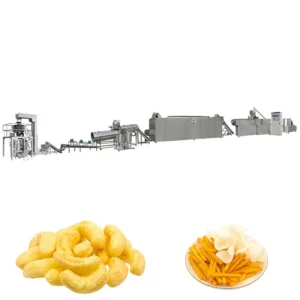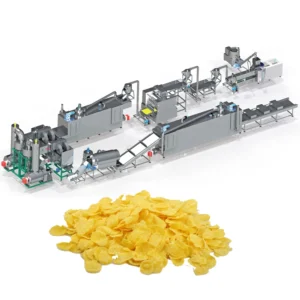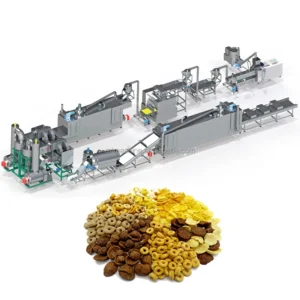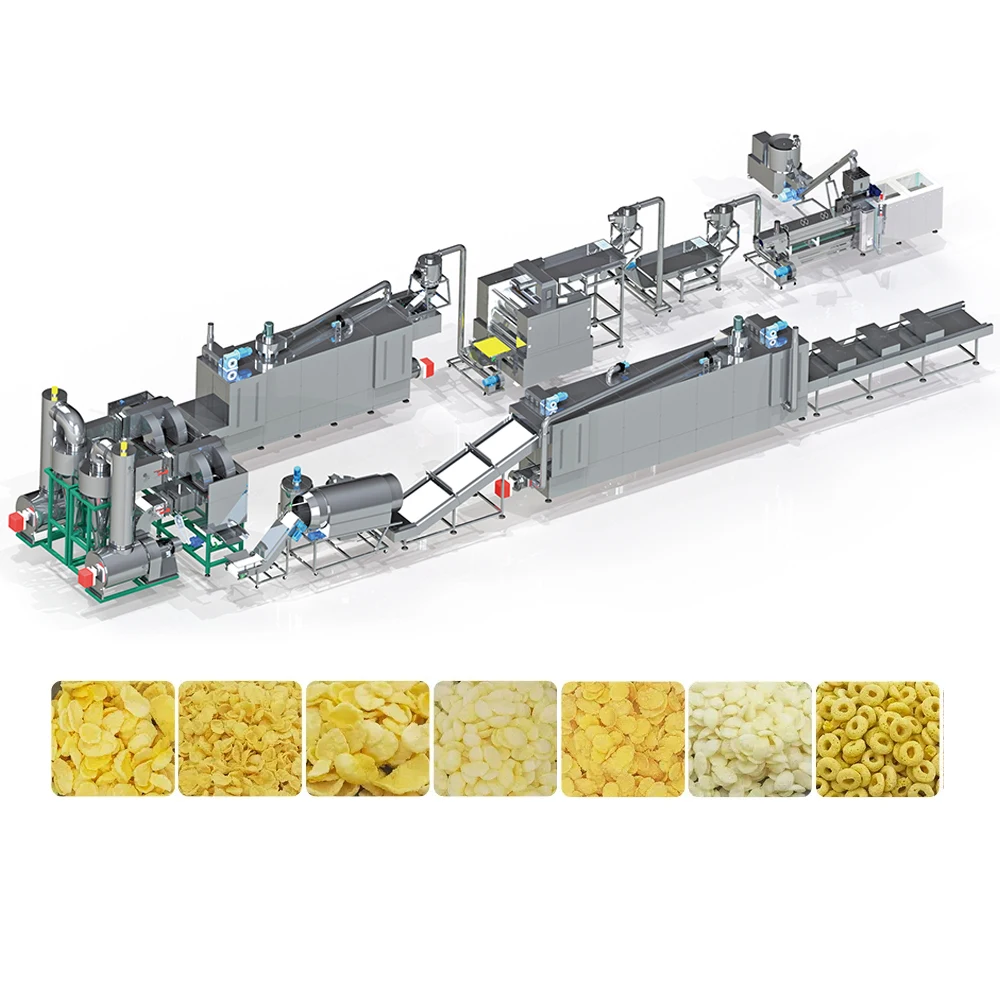
Engineered screw profiles — MT70 twin-screw configuration is matched to the buyer’s actual corn variety and moisture content, validated through in-house trial runs before shipment.
Technical Specifications
| Parameter | Value |
|---|---|
| Model | MT70 |
| Product Type | Corn Flakes Production Line |
| Screw Type | Twin-screw |
| Installed Power | 160 kW |
| Power Consumption | 120 kW |
| Output Capacity | 150–200 kg/h (basis not stated in source — confirm raw material and moisture) |
| Overall Dimensions | 41 × 1.5 × 2.2 m |
| Control System | PLC and MCC |
| Extruder Working Principle | Feeding, extruding, cutting, heating, gearing, and controlling systems |
| Screw Feature | Automatic lubricating and cooling; wear-resistant technology |
| Flaking Machinery | Hydraulic double-roller system; separate dual-motor drive; infrared temperature pipe control |
| Dryer Heating Source | Gas or Electric |
| Roasting Oven | Vibrating pan; high-temperature spraying tubes; reconciliation burner; dual circulating fans; cyclone dust removal |
| Coating System | Double tumble sugar melting, elevator, coating drum, spraying nozzle |
| Line Stations (Natural) | Mixing → Extruding → Flaking → Drying → Hot Air Roasting → Cooling → Packing |
| Line Stations (Sugar-Coated) | Mixing → Extruding → Flaking → Drying → Hot Air Roasting → Sugar Spraying → Sugar Coating → Drying → Cooling → Packing |
| Raw Material Compatibility | Corn, rice, wheat, oat, barley powder |
| Final Product Shapes | Natural flakes, coated flakes, ball, tube, stick, ring, fruit loop, star, wheel, flower, heart (via mould adjustment) |
| Assembly State | Complete production line |
| Standards | CE, ISO |
Application Suitability
| Application | Material or Output |
|---|---|
| Natural Corn Flake Cereal | Milled corn grits processed through extrusion, flaking, and roasting |
| Sugar-Coated Breakfast Cereal | Extruded corn or multi-grain base with sugar spraying and tumble coating |
| Multi-Grain Flaked Cereal | Blends of rice, wheat, oat, and barley powders requiring adjusted screw shear |
| Shaped Cereal Snacks | Fruit loops, rings, stars, and wheels produced by changing the extruder die plate |
Why Nominal Capacity Fails When the Corn Blend Changes
Extrusion output is meaningless unless the screw configuration and barrel profile are tuned to your specific raw material.
A production line might run smoothly during factory acceptance tests using standard corn flour, only to fail completely when it arrives at your facility and encounters a local corn variety with different fat or starch ratios. The expansion collapses, the flakes come out dense, and the roasting oven cannot salvage the texture. This happens because the corn flakes extrusion technology was not calibrated to the actual material you intend to process day in and day out. [NEED_CITE: impact of raw material lipid content on twin-screw extrusion expansion]
Calibrating Shear and Moisture for Starch Gelatinisation
The core of corn flakes extrusion technology lies in managing how mechanical shear and thermal energy convert raw starch into a gelatinised matrix. The twin-screw setup allows operators to adjust the screw element sequence—alternating between conveying, kneading, and reverse elements—to control residence time and shear intensity. If the corn blend has a coarse particle size, the barrel temperature profile must compensate to ensure complete gelatinisation before the material reaches the die.
Managing Die Geometry and Flaking Tolerances
Once the extrudate exits the die, it must be sliced and immediately fed into the hydraulic double-roller flaking machinery. The die orifice diameter and the roller gap together dictate the final flake thickness and the degree of surface blistering that occurs during hot air roasting. Infrared sensors monitor the temperature pipe to prevent moisture condensation, which can cause sticking or uneven compression across the roller face. [NEED_CITE: relationship between flaking roller pressure and corn flake bowl-life]
Reading the Power and Dimension Specs
The MT70 draws 160 kW of installed power with a working consumption around 120 kW, meaning the electrical infrastructure at the installation site must handle sustained thermal loads across the extruder, dryer, and roasting oven simultaneously. The 41-meter line footprint requires a clear, level floor with adequate clearance for the vibrating roasting pan and the cyclone dust removal exhaust. Gas or electric heating options for the dryer must be selected based on local utility costs and availability, as this choice fundamentally alters the thermal balance of the drying and roasting stages. The PLC control system centralises these parameters, allowing recipe storage for different corn blends or multi-grain formulations so that batch-to-batch consistency is maintained without relying on operator memory.
The Hidden Cost of a Generic Screw Build
When an extruder ships with a generic screw configuration copied from a standard build, the buyer often discovers the problem only after installation. The flakes may lack the characteristic blister pattern the market expects, or they may shatter during packing due to improper density. Correcting this on-site means ordering new screw elements, waiting for international freight, and losing weeks of production time while the machine sits idle. [NEED_CITE: downtime costs associated with post-installation extruder reconfiguration]
Why Engineering Alignment Matters Here
The screw configuration and die design are specified to the buyer’s raw material and target flake density, not pulled from a generic catalogue. An in-house testing workshop conducts trial runs on the customer’s actual corn blend before the line ships, confirming extrusion behaviour and flake quality. Twin-screw expertise spans breakfast cereals, pet food, and aquatic feed, ensuring cross-application knowledge informs the barrel temperature profile. Pre-sales consultation covers line layout and throughput matching between the extruder, flaking rollers, and roasting oven so no single station bottlenecks the line. Documentation includes the screw and die configuration record alongside the trial run report, giving the buyer a verified baseline from day one.
Documentation & Verification
- Line layout and capacity calculation matched to your target corn flake output and workshop dimensions
- Screw and die configuration record documenting the exact element sequence chosen for your corn blend
- Trial run report on customer raw material confirming flake density, blistering, and bowl-life before dispatch
- Electrical schematic with voltage and frequency locked to your site’s power grid specification
- Operation and maintenance manual covering PLC recipe management and hydraulic roller adjustment
Installation, Commissioning & Support
- The 41-meter line footprint requires a level concrete slab with anchoring points for the vibrating roasting pan
- 160 kW installed power demands a dedicated circuit with voltage and frequency confirmed before electrical cabinet wiring
- Hydraulic flaking rollers are calibrated on-site to match the die output and achieve target flake thickness
- PLC interface language and control parameters are set during commissioning to match operator requirements
- Wear-resistant screw elements and die plates are inventoried, with a recommended first-replacement schedule provided
Preparing a Technical Inquiry
To receive an accurate line configuration and layout proposal, please provide the specific corn variety or multi-grain blend you intend to process, including typical moisture content and particle size distribution. Specify your target hourly output and whether the final product will be natural or sugar-coated flakes. Include your facility’s available floor space, ceiling height, and local voltage and frequency standards so the electrical and mechanical design can be aligned before quotation.
Frequently Asked Questions
Q: How is the screw configuration determined for different corn varieties?
A: The screw element sequence—conveying, kneading, and reverse elements—is arranged based on the starch content, lipid ratio, and particle size of your specific corn blend. A trial run on your actual raw material in the testing workshop confirms the configuration achieves the correct gelatinisation and expansion before the extruder is shipped.
Q: What barrel temperature profile prevents over-expansion?
A: Barrel zones are heated and cooled independently to create a gradient that manages starch gelatinisation without causing the extrudate to puff excessively. The profile is adjusted during the trial run to match your corn blend’s moisture content, ensuring the pellet density is correct for subsequent flaking and roasting.
Q: How does die design influence flake blistering after roasting?
A: The die orifice size controls the extrudate diameter, which, when compressed by the hydraulic flaking rollers, determines the internal moisture pockets that expand into blisters during hot air roasting. The die geometry is selected alongside the roller gap to achieve the surface texture the breakfast cereal market expects.
Q: Can extrusion parameters be adjusted for new recipes on-site?
A: The PLC control system stores multiple recipes, allowing operators to recall specific screw speed, barrel temperature, and moisture settings for different corn or multi-grain blends. Physical screw element changes can also be made if a new recipe requires a fundamentally different shear profile.