Screw Configuration Expertise — Every MT-75 corn flakes line ships with screw elements and die geometry matched to your grain blend, verified in our testing workshop before the crate is sealed.
Technical Specifications
| Parameter | Value |
|---|---|
| Product Type | Corn Flakes Production Line with Twin Screw Extruder |
| Model Options | MT70 / MT75 / MT85 |
| Extruder Type | Twin Screw |
| Installed Power | 160 kW (MT70) / 210 kW (MT75) / 190 kW (MT85) |
| Power Consumption | 120 kW (MT70) / 150 kW (MT75) / 140 kW (MT85) |
| Capacity | 150–200 kg/h (MT70) / 300–500 kg/h (MT75) / 300–400 kg/h (MT85) (basis not stated in source — confirm raw material type and moisture content) |
| Overall Dimensions | 41 × 1.5 × 2.2 m (MT70) / 45 × 1.5 × 3.5 m (MT75) / 43 × 1.5 × 3.2 m (MT85) |
| Control System | PLC control with MCC integration |
| Flaking Machinery | Hydraulic double-roller system, dual motors, infrared sensor temperature control |
| Dryer Heating Source | Gas or Electric (configurable) |
| Roasting Oven | Conciliation burner, dual circulating fans, cyclone dust removal, vibrating pan with high-temperature spraying tubes |
| Coating System | Double tumble sugar melting, elevator, coating drum, spraying nozzle |
| Screw Feature | Wear-resistant alloy, automatic lubricating and cooling function |
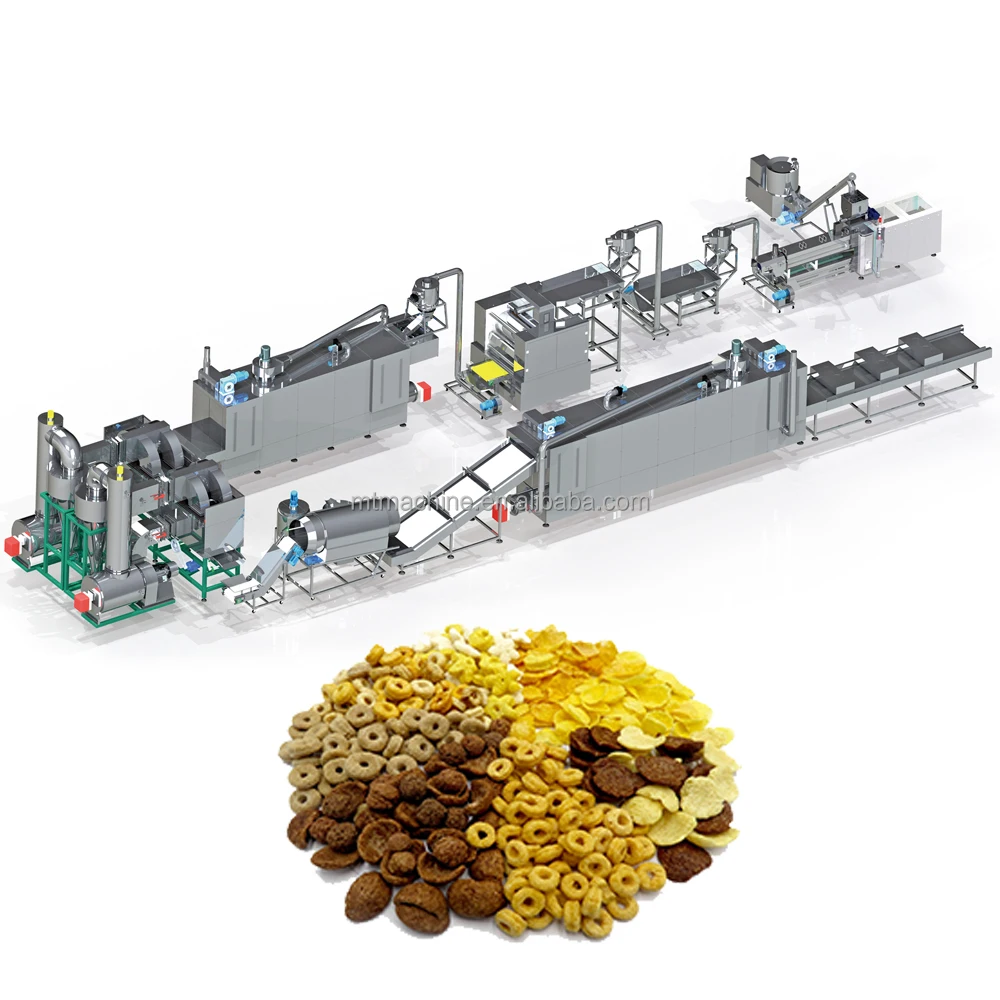
| Line Stations | Mixing → Extruding → Flaking → Drying → Hot Air Roasting → Sugar Coating → Drying → Cooling → Packing |
| Standards | CE (since 2014), ISO certified |
Application Suitability
| Application | Material or Output |
|---|---|
| Natural corn flakes | Corn grits, whole corn meal |
| Sugar-coated corn flakes | Corn base with sugar syrup coating |
| Multi-grain breakfast cereals | Oat, barley, rice, wheat powder blends |
| Shaped cereal pieces | Ball, tube, ring, star, wheel, heart, fruit loop formats via die change |
| Fortified cereal programs | Vitamin and mineral pre-mixed grain formulations |
Why a Generic Screw Build Ruins Flake Density
A copied screw and die configuration produces flakes that either disintegrate in milk or remain too hard to chew — the two complaints we hear most when buyers switch from poorly configured lines.
The corn flakes extrusion line screw configuration die design must be specified to your exact grain formulation, not borrowed from a catalogue default.
When the screw element sequence and die orifice diameter are not matched to the starch gelatinisation behaviour of your specific corn variety and moisture level, the extrudate exits the barrel at the wrong expansion ratio. The flaking rollers then compress an inconsistent pellet, yielding flakes with variable thickness and uneven roasting behaviour downstream. We have seen entire production runs scrapped because the die land length was set for rice flour when the buyer intended to run coarse corn grits [NEED_CITE: starch gelatinisation thresholds by grain type in twin-screw extrusion].
Barrel Temperature Zones and Moisture Balance
The extrusion stage is where flake character is decided. Barrel temperature profile, screw speed and moisture injection together control the degree of starch gelatinisation inside the dough. Too little gelatinisation and the flaked pellet crumbles under the roller pressure; too much and the dough becomes gummy, sticking to the die face and producing ragged edges. The MT-75 series twin-screw extruder provides multiple independently heated barrel zones, allowing the operator to build a gradient that matches the thermal absorption curve of corn, oat or multi-grain blends.
Die Geometry and Expansion Control
Die orifice diameter, land length and face pattern directly govern how much the extrudate expands as it exits atmospheric pressure. For traditional corn flakes, a low-expansion die produces dense pellets that flatten into thin, crisp flakes under the hydraulic roller. For shaped cereals such as rings or stars, the die must balance expansion with shape retention so that the cereal piece survives the drying and roasting stages without collapsing. Every corn flakes extrusion line screw configuration die design we deliver is documented in a configuration record so that you can reorder identical wear parts or adjust parameters when you reformulate [NEED_CITE: die land length effect on extrudate expansion ratio].
Reading the Spec Sheet Beyond Power Ratings
Installed power and overall dimensions tell only part of the story. The flaking station uses a hydraulic double-roller system with dual independent motors, which means each roller can be adjusted separately to compensate for wear or to set different nip gaps for thin versus thick flake targets. Infrared sensor temperature control on the flaking rollers prevents dough adhesion during high-throughput runs. The roasting oven’s dual circulating fans and cyclone dust removal device are sized to handle the fines generated during hot-air toasting of corn flakes — a detail often overlooked when roasters are sourced separately from the extruder. PLC control with MCC integration keeps barrel temperature, screw speed, dryer temperature and coating drum rotation synchronised across every station, so that a recipe change at the mixer propagates correctly through the entire line.
The Cost of Mismatched Station Throughput
When the extruder is sized correctly but the dryer or roasting oven is not, you get a bottleneck that caps real output well below the nameplate capacity. Flakes pile up on the conveyor, cool unevenly, and enter the coating drum at varying moisture levels, producing batches that alternate between properly crisp and unpleasantly chewy. This throughput mismatch is the most common reason buyers return to us after a disappointing first line from another supplier [NEED_CITE: line throughput balancing in food extrusion projects].
Why Buyers Specify Meiteng for Extrusion-Critical Lines
Screw configuration and die design are specified to the buyer’s raw material and target flake density — not pulled from a generic build sheet. Our in-house testing workshop runs your actual grain blend before shipment, producing a trial run report that confirms expansion, density and surface texture. The complete line from batching through packing is supplied under one responsibility, meaning every station’s throughput is calculated against the same capacity target rather than assembled from separate vendor quotes. PLC and MCC control architecture is designed in-house, so the electrical schematic and control language are confirmed to your facility before production begins. Twin-screw expertise spans corn flakes, multi-grain cereals, shaped pieces and fortified formulations, so reformulation does not require a new machine — only a documented screw and die adjustment.
Documentation & Verification
- Line layout and capacity calculation matching every station from mixer to packer
- Screw and die configuration record documenting element sequence and orifice dimensions for your grain blend
- Trial run report on your actual raw material proving expansion, flake density and surface texture before dispatch
- Electrical schematic with voltage, frequency and control language confirmed to your facility
- Factory test record with barrel temperature profiles and PLC parameter sets archived for your reference
- CE declaration of conformity and ISO certificate included with shipping documentation
Installation, Commissioning & Support
- Foundation and floor space planned around the MT-75 line’s 45 × 1.5 × 3.5 m footprint and utility connections
- Dedicated electrical circuits specified for 210 kW installed power with voltage and frequency matched to your plant
- Line arrives in modular sections; extruder, flaking rollers and roasting oven assembled and aligned on site
- First-run commissioning includes barrel temperature mapping and screw speed tuning against your grain formulation
- Operator training covers PLC recipe management, hydraulic roller gap adjustment and coating drum spray calibration
- Wear parts list provided with lead times for screws, dies, roller shells and spraying nozzles
What to Share with Your Inquiry
Tell us the grain or grain blend you intend to run — corn, oat, barley, rice or a multi-grain mix — along with typical moisture content and target flake thickness. Confirm your local voltage and frequency, the control language your operators need, and whether you plan to produce natural flakes, sugar-coated flakes or both. If you have an existing dryer or packing system that the new line must integrate with, share its throughput rating so we can match station capacities from the start.
Frequently Asked Questions
Q: How is screw configuration and die design matched to my specific grain blend and target flake density?
A: We start with your raw material sample and target flake specification. Screw elements are arranged to achieve the correct shear and residence time for your grain’s starch gelatinisation threshold, and die orifice diameter and land length are selected to produce the expansion ratio your flake density requires. The build is validated in our testing workshop before shipment.
Q: What barrel temperature profile and moisture range produce the correct expansion for crispy corn flakes?
A: The profile depends on your corn variety and grit size, but generally a stepped gradient from the feed zone to the die zone combined with moisture conditioning between 18% and 24% achieves full gelatinisation without gumminess. The MT-75 barrel zones are independently controlled via PLC so the profile can be fine-tuned during commissioning.
Q: Can the line handle alternative grains such as oat, barley or multi-grain blends without screw replacement?
A: Minor formulation changes can often be absorbed by adjusting screw speed, barrel temperature and moisture. Larger shifts — for example moving from pure corn to a high-oat blend — may require rearranging screw elements or swapping to a different die plate. Both adjustments are documented so your maintenance team can repeat them.
Q: What starch gelatinisation degree is achieved in the extruder, and how does it affect final flake crispness?
A: Twin-screw extrusion typically achieves a high degree of gelatinisation across the dough cross-section because of the intermeshing screw action and controlled barrel heating. Complete gelatinisation ensures the flaked pellet holds together during roasting and delivers a uniform crisp texture that survives milk immersion without immediate disintegration.