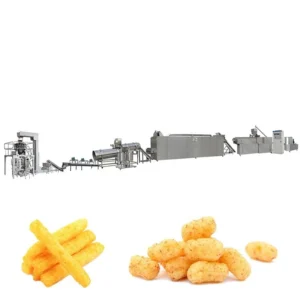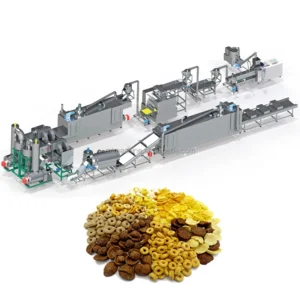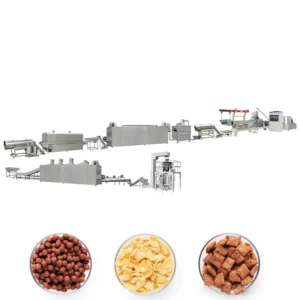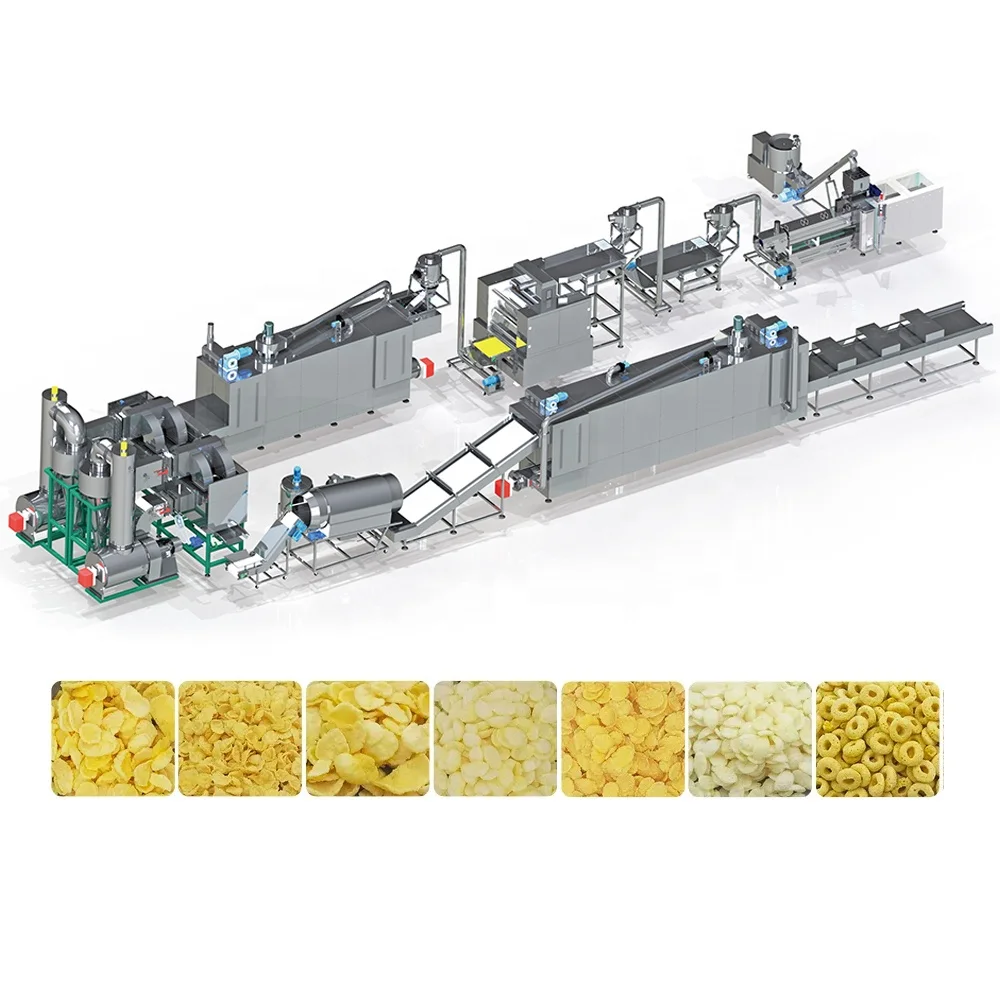
Screw Profile Tuning — The MT-75 twin screw extrusion breakfast cereal production line uses sectional co-rotating modules that let you rearrange forward transport, mixing, de-gassing and cooking zones to match your specific grain blend and target density.
Technical Specifications
| Parameter | Value |
|---|---|
| Model | MT-75 |
| Product Type | Twin Screw Breakfast Cereal Extrusion Line |
| Screw Type | Twin screw, co-rotating, sectional modules |
| Line Stations | Flour Mixer → Screw Elevator → Double-screw Extruder → Elevator → Dryer → Elevator → Coating Line → Vibrating Spreader → Elevator → Dryer → Cooling Conveyor → Packing Machine |
| Mixer Output | 10–30 kg per load |
| Mixer Power | 4 kW |
| Mixer Tank Size | Ø600 × 500 mm |
| Screw Conveyor Power | 0.75 kW |
| Corn Flakes Press Machine Power | 16.12 kW |
| Corn Flakes Press Machine Size | 1550 × 1300 × 2000 mm |
| Corn Flakes Press Machine Roller | 510 × 310 × 1050 mm |
| Corn Flakes Press Machine Features | Large roller with cooling system; adjustable roller distance for flake thickness |
| High-temperature Oven Size | 4.5 × 1.4 × 1.8 m |
| High-temperature Oven Power | 3.75 kW |
| High-temperature Oven Heating | Gas-fuelled, both-side baking system |
| Sugar Spraying System Total Power | 28.75 kW |
| Sugar Spraying System Dimension | 4000 × 1900 × 1880 mm |
| Sugar Spraying System Roller Size | Ø600 × 2700 mm |
| Sugar Spraying System Composition | Conveyor, melting tank, temperature-keeping roller |
| Output Capacity | (basis to be confirmed — depends on raw material, moisture and target format) |
| Voltage & Frequency | Configurable: 3ph 380V 50Hz, 3ph 380V 60Hz, 3ph 415V 60Hz, 3ph 220V 60Hz, etc. |
| Control System | PLC and MCC; separate controller box for press machine |
| Contact Materials | Food-grade stainless steel |
| Die / Mould Options | Ring, ball, star, stick and other shapes via interchangeable moulds |
| Standards | CE |
Application Suitability
| Application | Material or Output |
|---|---|
| Corn flakes production | Corn flour, rice flour; sheeted and flaked via press roller |
| Choco hoops and fruit loops | Corn and oat flour blends; ring-shaped extrudates with sugar or cocoa coating |
| Crunchy wheat cereal rings | Whole wheat flour with vitamin premix; ring die extrusion |
| Coated leisure cereal variants | Extruded shapes with sugar syrup or honey coating line |
| Fortified breakfast cereals | Grain flour with vitamin and mineral additives; controlled barrel temperature to preserve nutrient integrity |
Why Generic Screw Builds Sink Your Cereal Density
The extruder was never tuned to your grain blend.
I have walked into factories where the corn flakes came out dense and the choco hoops collapsed within minutes of leaving the die. The screw profile was copied from a standard maize grits build, but the buyer’s actual recipe was a whole wheat and oat mix with different starch gelatinisation behaviour. Barrel temperature zones were set for a single cereal type, and the die expansion ratio was never validated against the target crunch specification [NEED_CITE: starch gelatinisation temperature ranges vary by grain composition]. The result is a line that runs, but produces cereal that fails bowl-life tests and gets rejected by retailers.
How Sectional Screw Modules Control Shear and Gelatinisation
The co-rotating twin screw on the MT-75 uses sectional modules that can be rearranged along the barrel to change the balance between forward transport, mixing, de-gassing and cooking. For a whole wheat and oat blend targeting hoop cereal, you need longer residence time in the cooking zone to achieve full starch gelatinisation without scorching the bran fraction. A corn-only recipe with lower fibre content requires less shear and a shorter cooking section to avoid over-expansion. The modular design lets process engineers build the screw configuration around your specific raw material rather than forcing your recipe into a fixed barrel layout. This is where the twin screw extrusion breakfast cereal production line earns its flexibility.
Die Expansion and Moisture Interaction at the Barrel Exit
When the gelatinised mass reaches the die, the sudden pressure drop drives moisture flash-off and product expansion. The die geometry — ring for hoops, flat for flakes before pressing — determines the initial cross-section, while barrel temperature and moisture content at the final zone control how much that cross-section expands. Too much moisture and the hoop swells beyond specification, losing its defined ring shape; too little and the extrudate stays dense, producing a cereal that softens in milk within two minutes [NEED_CITE: extrusion expansion ratio dependency on moisture and die geometry]. The MT-75 line pairs interchangeable die moulds with adjustable barrel zone temperatures, giving you two variables to dial in before the product even reaches the dryer.
Press Roller Gap and the High-Temperature Oven Working Together
After extrusion, corn flakes pass through the press machine where the 510 × 310 × 1050 mm roller sets flake thickness. The integrated cooling system on the roller stabilises the sheeted pellet before it enters the gas-fuelled high-temperature oven. The 4.5 × 1.4 × 1.8 m oven uses a both-side baking system to reduce moisture uniformly across the flake surface. If the roller gap is set too wide, the flake enters the oven too thick and the core stays soft; set it too narrow and the flake fractures before drying begins. The press machine and oven must be treated as one system, not two separate stations, and the twin screw extrusion breakfast cereal production line is designed with that coupling in mind.
What Happens When Dryer Capacity Does Not Match Extruder Output
One pain point I see repeatedly: the extruder runs at full speed, but the dryer cannot keep up, so wet cereal piles up on the cooling conveyor and starts clumping. The MT-75 line includes two drying stages — the high-temperature oven after pressing and a second dryer after the sugar spraying system — each sized to match the extruder’s continuous output. The vibrating spreader between the coating line and the second dryer distributes coated cereal evenly across the belt, preventing sugar pooling that would otherwise create uneven drying and sticky clusters. When throughput is matched across every station, the twin screw extrusion breakfast cereal production line runs without the bottleneck that forces operators to throttle the extruder and lose capacity.
Why Trial Runs on Your Raw Material Matter Before Shipment
Years ago a client ordered a cereal line tested on standard maize grits, but their actual grain was a whole wheat and oat blend. The hoops came out dense with no crunch. We rebuilt the screw profile and re-tuned barrel temperatures from scratch. Now the in-house testing workshop runs trial batches on the buyer’s own flour mix before any twin screw extrusion breakfast cereal production line ships. The trial run report documents screw configuration, barrel temperature profile, die selection, moisture content at the die face and the physical properties of the finished cereal — giving you a baseline to compare against production samples after installation [NEED_CITE: importance of raw material-specific trial runs in extrusion line procurement].
Engineering Support Across the Full Line, Not Just the Extruder
The MT-75 is supplied as a complete line from flour mixer through packing, so throughput matching is calculated across every station rather than assembled from separate vendors. Screw configuration and die design are specified to your raw material and target product, not pulled from a generic catalogue. Voltage and frequency are confirmed against your target market before production begins, and the PLC control language is set to your preference. On-site installation, commissioning and operator training follow shipment, with wear parts lists and ongoing maintenance support included in the scope.
Documentation & Verification
- Line layout and capacity calculation matched to your raw material and target cereal format
- Screw and die configuration record specific to your grain blend and expansion ratio
- Electrical schematic with voltage, frequency and control language confirmation
- Trial run report on your actual flour mix conducted before shipment
- CE declaration of conformity and ISO certificate
- Wear parts list covering screws, dies and dryer belt components
Installation, Commissioning & Support
- Floor space planning for the full line footprint including the 4.5 m high-temperature oven and 4 m sugar spraying system
- Power supply verification for configurable voltage options including 3ph 380V 50Hz and 3ph 415V 60Hz
- Assembly of the 12-station line from flour mixer to packing machine with utility connections
- First-run commissioning with barrel temperature profiling and die expansion adjustment
- Operator training covering PLC interface, screw module replacement and die changeover
- Spare wear parts package for screws, dies and press roller components
Getting a Meaningful Quotation for Your Cereal Project
To receive an accurate line configuration and quotation, share your target cereal format — corn flakes, hoops, rings or another shape — along with the raw material composition and any vitamin or mineral additives. Include your local voltage and frequency standard, preferred control language and the daily production volume you need to reach. If your grain blend differs from standard maize grits, a trial run on your flour mix can be scheduled before the quotation is finalised.
Frequently Asked Questions
Q: How is the screw configuration matched to my grain blend and target cereal density?
A: The co-rotating twin screw uses sectional modules that are rearranged based on your raw material’s starch gelatinisation behaviour and your target expansion ratio. A trial run on your flour mix in the testing workshop determines the optimal barrel temperature profile and module sequence before the screw configuration record is finalised for production.
Q: What does the starch gelatinisation process look like inside the MT-75 barrel?
A: Flour and water enter the barrel where co-rotating screws generate shear and heat across multiple temperature zones. Starch granules absorb moisture, swell and gelatinise as they move forward. The final zone controls moisture content and pressure at the die face, which together determine how much the product expands when it exits [NEED_CITE: starch gelatinisation mechanics in twin screw food extrusion].
Q: Can I run a trial on my raw material before the line ships?
A: Yes. The in-house testing workshop runs trial batches on your actual flour mix. The trial run report documents screw configuration, barrel temperatures, die selection, moisture at the die face and the physical properties of the finished cereal, giving you a production baseline.
Q: How are dryer and coating drum capacities matched to extruder output?
A: The line includes two drying stages and a sugar spraying system, each sized to handle the continuous output of the MT-75 extruder. The vibrating spreader distributes coated cereal evenly before the second dryer, preventing bottlenecks that would otherwise force the extruder to slow down.