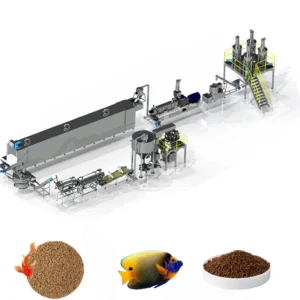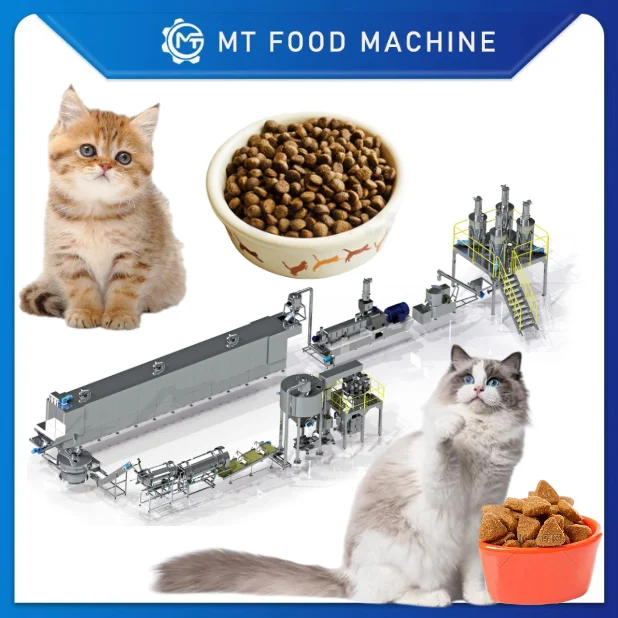
Matched Throughput Stations — every downstream dryer, coater, and cooler is sized against the extruder’s actual output curve on your specific formulation rather than a generic nameplate figure.
Technical Specifications
| Parameter | Value |
|---|---|
| Product Type | Twin-Screw Pet Food Extrusion Line |
| Output Capacity | 450–550 kg/h (basis not stated in source — confirm raw material formulation, moisture content and kibble size) |
| Control System | PLC Controlled |
| Screw Configuration | Twin-Screw, geometry matched to formulation |
| Automation Level | Automated process control with recipe memory |
| Line Configuration | Complete processing line (specific stations to be confirmed — mixing, extrusion, drying, coating, packing modules available) |
| Application Range | Dry kibble for dogs and cats, aquatic feed, bird feed, cattle feed |
| Certification Standard | CE (verify applicability to specific line configuration) |
Application Suitability
| Application | Material or Output |
|---|---|
| Dry dog and cat kibble | Corn, wheat, rice, meat meal, fish meal, vitamin premix blends |
| Floating and sinking aquatic feed | Soy protein, starch, fish meal, oil-based attractants |
| Avian and wild bird feed | Grain mixes, seed coatings, fat-enriched pellets |
| Cattle supplement pellets | Urea-mineral concentrates, protein meals, molasses carriers |
What the Capacity Plate Leaves Unexplained About Your Kibble Line
A 450–550 kg/h rating tells you nothing until you confirm the exact formulation, moisture target, and kibble geometry used to measure it.
When I planned a multi-species pet feed line last year for a buyer in the Middle East, the nominal capacity looked solid on paper. Once their actual recipe arrived — protein content running well above the trial standard — extrusion expansion dropped sharply and kibble came out dense and brittle. The screw profile that worked on a starch-heavy test blend completely failed under high-meat loading. We had to reconfigure the screw elements and die geometry on site, then re-run the line at adjusted throughput to hit the correct bulk density [NEED_CITE: formulation-dependent extruder capacity variance in high-protein kibble production]. This twin-screw pet food extrusion line PLC controlled setup is designed so that capacity verification happens before steel is cut, not after the container arrives at your dock.
Barrel Profiling and Shear Control Across Recipe Changeovers
The barrel on this twin-screw pet food extrusion line PLC controlled system is divided into independently heated and cooled zones. Process engineers set each zone to a target temperature, and the PLC holds that profile through recipe changeovers. When you switch from a high-starch dog kibble formula to a high-protein cat diet, shear intensity and residence time must shift accordingly. The segmented barrel lets you rebuild the thermal gradient without mechanical modification — a critical feature when one platform serves multiple species formulations on the same production shift.
Die Geometry and the Expansion-Density Relationship
Final kibble density is determined at the die face. Moisture content entering the die, combined with die orifice diameter and land length, governs how much the extrudate expands the instant pressure drops. Floating fish feed demands maximum expansion and low bulk density, while a slow-sinking shrimp pellet requires restricted expansion through a longer die land. Operators adjust screw speed and barrel moisture in tandem with die selection to hold density within the narrow band each species market expects [NEED_CITE: die land length influence on extrudate expansion in aquatic feed manufacturing].
Reading the Specs That Actually Move the Needle
The twin-screw designation matters here because it defines the shear window available to the process engineer. Unlike single-screw platforms, the intermeshing screw pair generates self-wiping action that prevents material hang-up when recipes contain sticky binders or high fat levels. L:D ratio governs total residence time — a longer barrel gives starch granules more time to gelatinize under moderate shear, which is essential for digestibility in premium kibble. PLC automation stores complete thermal and mechanical profiles per recipe, so a Monday morning dog kibble run and a Wednesday afternoon cat formula both start from validated parameters rather than operator guesswork. Moisture injection points along the barrel allow staged hydration, controlling the glass transition point of the starch matrix and directly influencing the internal cell structure of each kibble piece.
The Hidden Cost of Ignoring Screw-Die Matching
Buyers who skip formulation-specific screw configuration often discover the problem only after the line is bolted to their floor. Kibble that expands too much crumbles during coating drum transit, generating fines that contaminate packaging seals. Kibble that is too dense sinks when the market demands a floating product, triggering buyer rejections. I have watched entire production batches get written off because the die orifice was specified for a corn-dominant blend while the customer was running a meat-meal-heavy recipe [NEED_CITE: kibble density rejection rates in commercial pet food manufacturing]. Downstream stations also suffer — a mismatched extruder output profile forces the dryer to run longer cycles, which in turn starves the coating drum and breaks the continuous flow the line was designed around.
Why Engineers Source This Line from MT
The testing workshop runs your actual raw material before the extruder leaves Jinan, so screw element sequencing and die selection are locked to your formulation — not copied from a catalog build. Every station from batching through packing is specified under one engineering scope, meaning dryer belt length, coating drum volume, and cooler conveyor speed are all calculated against verified extruder output rather than generic assumptions. The PLC platform records every barrel zone temperature, screw RPM, and feed rate per batch, giving your QA team full traceability when a retail customer asks for process documentation. Pre-sales engineering produces a line layout with throughput calculations for each station, so you see where material accumulates or gaps before installation begins. On-site commissioning includes operator training on recipe changeover procedures specific to your product mix.
Documentation & Verification
- Line layout drawing with throughput-matched station capacities for your formulation
- Screw element sequence and die geometry record tied to your raw material blend
- Trial run report from in-house testing workshop on your supplied ingredients
- PLC program printout showing recipe profiles and alarm parameter sets
- Electrical schematic with confirmed voltage, frequency, and control language
- CE declaration of conformity with machinery directive scope stated
Installation, Commissioning & Support
- Foundation plan reflecting full line footprint and per-station load points for the PLC-controlled extrusion platform
- Dedicated electrical circuit sizing based on confirmed total connected load and PLC panel requirements
- Modular shipping configuration with labeled reassembly sequence for the twin-screw barrel and drive train
- First-run commissioning with screw speed, barrel temperature, and moisture injection tuning on your production recipe
- Operator training covering recipe changeover, die swap procedures, and PLC fault diagnostics
- Wear parts inventory list specifying screw elements, barrel liners, and die plates matched to your formulation abrasiveness
What We Need to Configure Your Line Accurately
Share your primary formulation breakdown — protein source, starch base, fat percentage, and any functional additives — along with the kibble shape and bulk density your market requires. Confirm your facility voltage and frequency standard, and whether the PLC interface language should default to English or another option. If you have existing upstream mixers or downstream packaging equipment that must integrate, provide model details and throughput ratings so the line can be matched end to end.
Frequently Asked Questions
Q: How is the 450–550 kg/h capacity figure verified for my specific recipe?
A: That range is established under test conditions that may differ from your formulation. We run your actual raw material in the testing workshop, record achievable throughput at target kibble density and expansion, and quote based on those results — not a generic nameplate value.
Q: How do you match screw configuration and die design to my ingredient blend?
A: We analyze your protein-to-starch ratio, fat content, and moisture targets, then select screw element geometry and die land dimensions accordingly. The configuration is documented and tested on your material before the extruder ships.
Q: What PLC language options and voltage configurations are available?
A: The PLC interface supports multiple language packs confirmed during the specification stage. Voltage and frequency are set to match your facility’s electrical standard, and the electrical schematic is submitted for your approval before production begins.
Q: Can I conduct a trial run on my own raw material before shipment?
A: Yes. Send your formulation ingredients to the testing workshop. We run the complete extrusion process, document output rate, kibble density, expansion ratio, and starch gelatinization degree, then share the trial report for your sign-off before dispatch.
Q: How do you prevent bottlenecks between the extruder and downstream stations?
A: Every dryer belt, coating drum, and cooler conveyor is sized against the verified extruder output for your specific product. The line layout document shows calculated throughput at each station, ensuring continuous material flow without accumulation points.