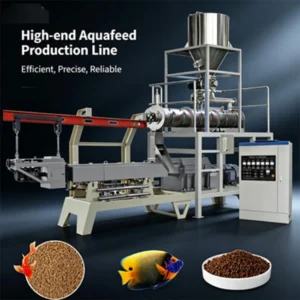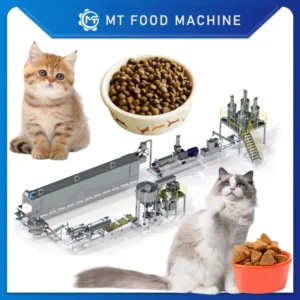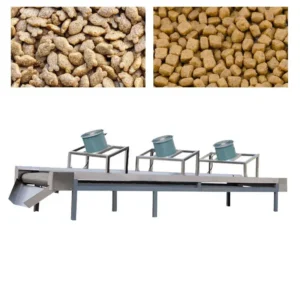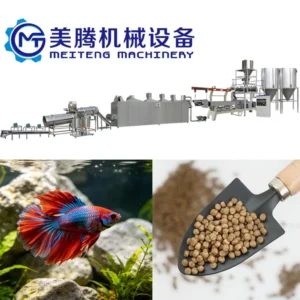
Screw Geometry Specified to Your Formulation — rather than shipping a generic build, we map screw elements and die land length to the starch-protein matrix of your actual raw material before the barrel is assembled.
Technical Specifications
| Parameter | Value |
|---|---|
| Product Type | Twin-Screw Extrusion Fish Feed Production Line |
| Assembly State | Complete production line from batching to packing |
| Screw Configuration | Twin-screw, elements matched to raw material and pellet density target |
| Control System | PLC and MCC automated control |
| Voltage | 380V (basis not stated in source — confirm frequency and phase for local grid) |
| Contact Materials | Food-grade stainless steel throughout product zones |
| Operation Mode | Full-automatic |
| Output Capacity | basis to be confirmed based on raw material and pellet size |
| Product Formats | Floating and sinking aquatic feed pellets |
| Standards | CE (since 2014), ISO certified |
Application Suitability
| Application | Material or Output |
|---|---|
| Floating catfish and tilapia feed | High-starch formulations requiring maximum expansion at the die face |
| Sinking shrimp pellet production | High-protein formulations requiring controlled density and slow water stability |
| Aquaculture feed expansion for existing producers | Adding floating or sinking SKUs to current milling capacity |
| Pet food manufacturers diversifying into aquatic feed | Leveraging existing twin-screw knowledge for new pellet formats |
Why Pellet Density Fails Before the Line Even Starts
Floating feed that sinks, or sinking feed that floats, is almost always a screw-and-die configuration mismatch — not a machine defect.
When a buyer receives a fish feed extrusion production line turnkey and the pellets do not match the market specification, the immediate assumption is that the extruder itself is underpowered. In my experience running trial tests across dozens of formulations, the root cause usually traces back to a screw profile copied from a generic catalogue rather than engineered for the buyer’s specific starch-to-protein ratio. A formulation heavy in fish meal behaves completely differently inside the barrel than one based on corn and soybean meal, yet many suppliers ship the same screw elements for both [NEED_CITE: starch gelatinisation behaviour under shear in twin-screw extruders]. The consequence is a pellet that either expands too much and crumbles during conveying, or fails to trap enough steam to float at all.
Barrel Segmentation and Temperature Zones
The barrel on a twin-screw extruder is not a single heated tube but a series of independently controlled zones. For a fish feed extrusion production line turnkey installation, how those zones are mapped determines whether the starch in your formulation fully gelatinises before the material reaches the die. If the feed zone runs too hot, the material begins to expand prematurely and the screws lose their grip, causing surging at the die face. We specify the heating and cooling arrangement on each segment based on the thermal profile of your raw material, rather than applying a single temperature curve across every aquatic feed line we build.
Die Land Length and Pellet Expansion Control
The die is where the pellet takes its final shape and where density is locked in. A longer die land restricts flow and increases pressure inside the barrel, which generally produces a denser, slower-expanding pellet suited to sinking applications. A shorter land allows rapid expansion as superheated moisture flashes off, creating the open cell structure needed for floating feed. Our die design process starts with your target pellet diameter and the specific gravity your market expects, then works backward to determine the land length and orifice count that will deliver that density at the rated throughput [NEED_CITE: die geometry influence on extrudate expansion in aquatic feed production].
Moisture, Shear and the Starch Gelatinisation Window
In a twin-screw fish feed extrusion production line turnkey setup, moisture addition and screw shear work together to bring the starch fraction through its gelatinisation window. Too little moisture and the material remains granular, producing a pellet with poor water stability that disintegrates before the fish can consume it. Too much moisture and the extrudate becomes gummy, sticking to the dryer belt and creating blockages downstream. The screw configuration — specifically the arrangement of kneading blocks and reverse elements — determines how much mechanical energy is converted into shear heat, supplementing or reducing the need for external barrel heating. This balance is different for every formulation, which is why a screw profile that runs well on a corn-based diet may fail entirely on a high-fat salmonid feed.
The Dryer Bottleneck That Stops the Whole Line
I have watched a newly installed aquatic feed line grind to a halt in its first week because the dryer could not keep pace with the extruder. The extruder was pushing moist pellets at its rated throughput, but the dryer had been sized on a nominal figure that did not account for the actual moisture load or the ambient humidity at the buyer’s site. Within days, the belt was overloaded, pellets were sticking and clumping, and the operator was forced to throttle the extruder back to keep the line moving [NEED_CITE: thermal load calculation for belt dryers in high-humidity environments]. That is why on every fish feed extrusion production line turnkey project I am involved with, I calculate the dryer heat load based on the real moisture differential between extruder output and target final moisture, then cross-check against the worst-case ambient conditions the buyer will face during their humid season. I would rather overspec the dryer by one increment than let a bottleneck shut down the entire operation.
What Happens When Stations Are Sourced Separately
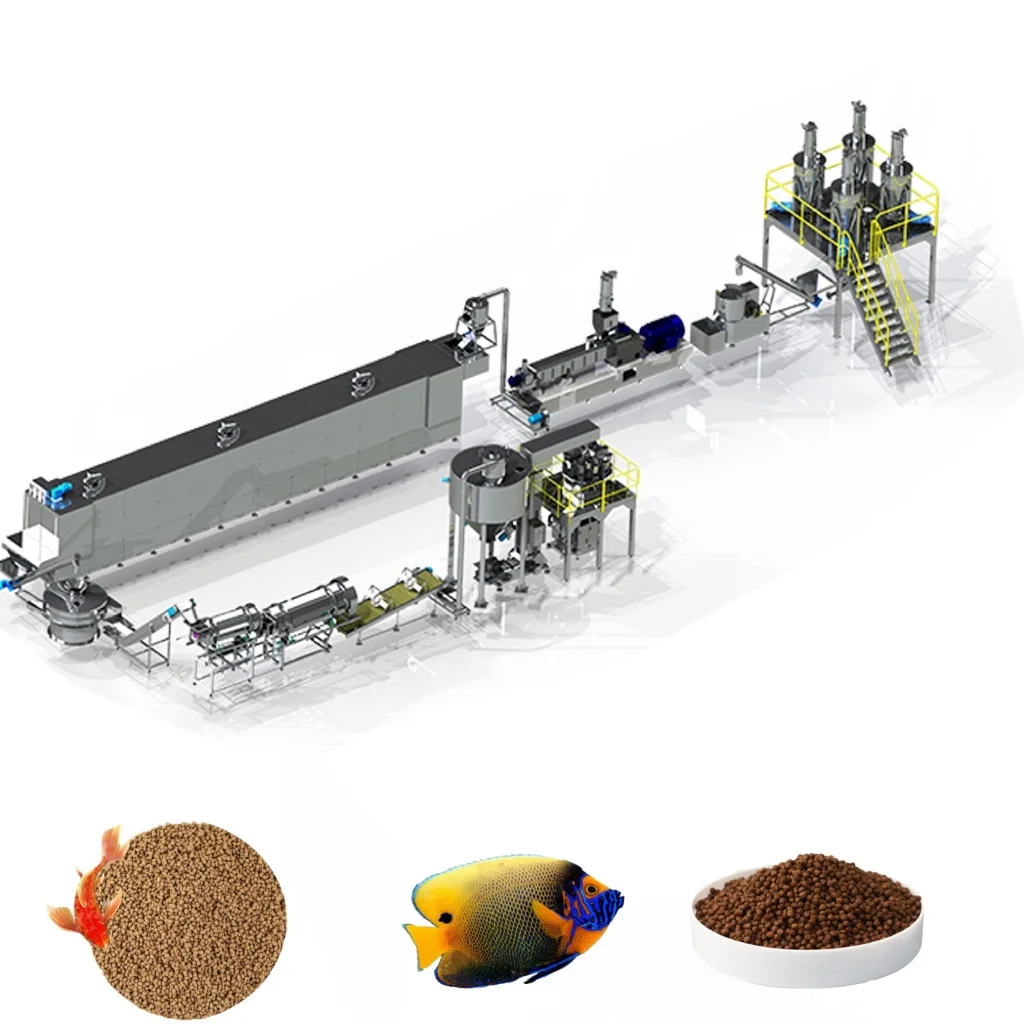
When a buyer assembles a fish feed line from multiple vendors — one for the extruder, another for the dryer, a third for the coating drum — the throughput of each station is rarely matched. The extruder may be rated for a certain output on a reference material, but the cooler downstream may only handle two-thirds of that volume once the pellets have been coated with oil and fat. The result is a line that never reaches its nameplate capacity and constant buffer stockpiling between stations. We supply the complete line from batching through extrusion, drying, flavouring, cooling and packing as a single integrated system, so the throughput at every station is calculated against the same formulation and the same target output.
Why Procure the Full Line from One Source
Our in-house testing workshop allows us to run your raw material on the actual screw configuration before the line ships, producing a trial run report that documents pellet density, expansion ratio and water stability against your specification. The PLC and MCC control system is programmed and labelled in your preferred language, with voltage and frequency confirmed against your site utilities before production begins — eliminating the commissioning delays that arise when a control cabinet arrives with the wrong transformer ratio or an HMI in a language the operators cannot read [NEED_CITE: industrial control language and voltage matching for international machinery supply]. Every contact surface is food-grade stainless steel, and the screw and die configuration record travels with the machine so your maintenance team knows exactly which elements to reorder when the first replacement cycle arrives.
Documentation & Verification
- Screw and die configuration record specific to your raw material formulation and target pellet density
- Line layout and capacity calculation showing throughput matching across every station from batching to packing
- Trial run report generated on your supplied raw material in our testing workshop before shipment
- Electrical schematic with confirmed voltage, frequency and phase for your site grid
- CE declaration of conformity and ISO certificate applicable to the extrusion line scope
- Operation and maintenance manual with wear parts list and first replacement schedule
Installation, Commissioning & Support
- Foundation and floor loading plan based on the full line footprint including extruder, dryer and cooling conveyor
- Dedicated power circuit specification covering PLC and MCC panel draw plus extruder main motor starting current
- On-site assembly supervision for modular barrel sections, dryer belt tensioning and pneumatic connections
- First-run parameter setting covering screw speed, barrel zone temperatures and feeder rate on your raw material
- Operator training on PLC interface navigation, alarm response and routine screw and die changeover procedure
- Wear parts list with recommended reorder quantities for screw elements, die plates and barrel liners
Before You Request a Quote
To configure a fish feed extrusion production line turnkey system that actually holds its rated throughput on your formulation, we need to understand your raw material profile — specifically the protein, starch and fat fractions — your target pellet diameter and whether you need floating, sinking or both formats. Share your site voltage and frequency, the available floor area and ceiling height, and the language your operators will use on the HMI. If you can send a sample of your raw material, we will run it in our testing workshop and include the trial results with our proposal.
Frequently Asked Questions
Q: How is output capacity verified and what raw material assumptions underpin it?
A: Capacity is not quoted on a generic reference material. We calculate throughput based on the bulk density, moisture content and starch-protein ratio of your actual formulation, then validate it with a trial run in our testing workshop. The resulting report documents the measured output, pellet density and water stability so you can verify performance before the line ships.
Q: How do you configure screw and die geometry for floating versus sinking pellet targets?
A: Floating pellets require maximum expansion at the die face, so we specify a shorter die land and a screw profile with higher shear to drive rapid starch gelatinisation. Sinking pellets need controlled density, so we extend the die land, adjust kneading block arrangement to moderate expansion, and match the moisture profile to produce a dense, water-stable pellet.
Q: What does the in-house trial run cover and can we send our own raw material?
A: Yes — we strongly recommend sending your raw material or a representative sample. The trial run tests extruder throughput, pellet expansion and density, dryer performance and water stability. We document all parameters in a trial run report that accompanies the shipment, giving your team a validated starting point for commissioning.
Q: How is voltage, frequency and PLC language confirmed for our country before commissioning?
A: During the proposal stage we request your site electrical specification including voltage, phase and frequency. The MCC and PLC panels are built to match, and the HMI is programmed in your preferred language. A confirmation document is signed off before panel fabrication begins, preventing the delays we commonly see when electrical mismatches are discovered at installation.
Q: What wear parts are included and how is the first replacement cycle planned?
A: The initial spare parts package includes the screw elements and die plates most subject to wear based on your formulation’s abrasiveness. The wear parts list in the documentation specifies expected service intervals, and the configuration record identifies each element by position so your maintenance team can reorder accurately without dismantling the barrel to measure.