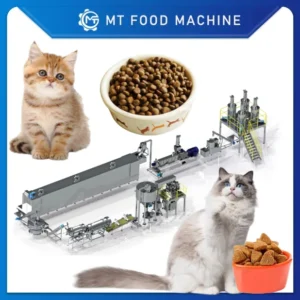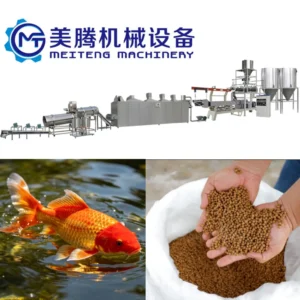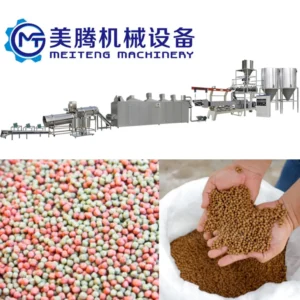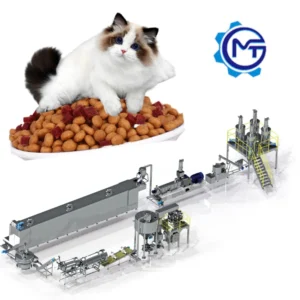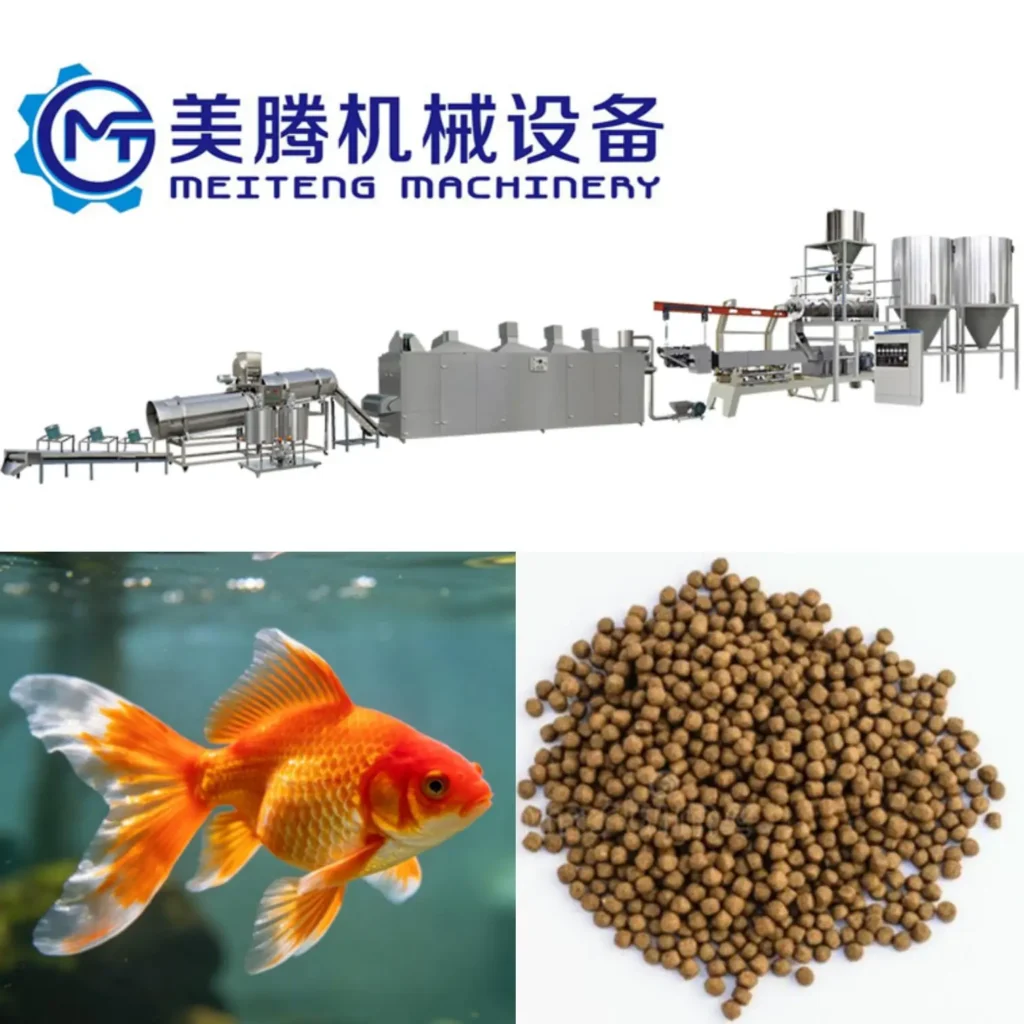
Material-Matched Screw and Die Engineering — Every twin-screw fish feed extrusion technology build here starts with your actual formulation, validated in our testing workshop before the line ships.
Technical Specifications
| Parameter | Value |
|---|---|
| Product Type | Twin-Screw Fish Feed Extrusion Line |
| Output Capacity | Up to 600 kg/h (basis not stated in source — confirm raw material formulation, moisture content and pellet size) |
| Extruder Type | Twin-screw |
| Contact Material | 304 stainless steel (food-grade, extrusion zone) |
| Target Species | Trout, salmon, catfish |
| Control System | To be confirmed (PLC or MCC options available) |
| Screw Diameter / L:D Ratio | To be confirmed based on formulation and capacity target |
| Die Configuration | Engineered per buyer’s pellet density and species requirement |
| Line Stations | Mixing, extrusion, drying, coating, packing — throughput matched per project |
| Voltage & Frequency | Configurable to destination market (confirm before quotation) |
| Certification | CE and ISO available (confirm scope for specific line configuration) |
Application Suitability
| Application | Material or Output |
|---|---|
| Floating pellets for trout and salmon | High-protein fish meal and starch blends requiring controlled expansion and low bulk density |
| Sinking pellets for catfish | Dense formulations with limited starch content requiring minimal expansion at the die |
| Multi-species production on one line | Switchable screw and die setups allowing the same extruder to produce both floating and sinking formats |
| Aquaculture feed scale-up | Lines where extruder output must align with dryer residence time and coating drum capacity |
What Happens When Screw Design Ignores Your Formula
A screw configuration copied from a generic build is the most common reason floating feed sinks and sinking pellets crack on the surface.
I have stood in front of an extruder in a Chilean aquaculture plant watching perfectly engineered pellets drop to the bottom of the water column when they were supposed to float. The problem was not the dryer, not the moisture level, and not the operator. The screw elements had been selected for a standard corn-based recipe, while the actual formulation carried a heavy fish meal load with different gelatinisation behaviour. Three days of reconfiguration followed. With twin-screw fish feed extrusion technology, the screw profile, barrel temperature sequence, and die geometry must all be specified to the buyer’s real formulation — not a catalogue default [NEED_CITE: starch gelatinisation behaviour in high-protein extrusion feeds].
How Screw Configuration Controls Pellet Density
The arrangement of conveying elements, kneading blocks, and reverse-screw sections inside the barrel determines how much mechanical shear the material receives and how long it stays in the extrusion zone. A formulation loaded with fish meal gelatinises differently from a starch-heavy recipe, so the kneading block spacing and pitch must be adjusted accordingly. This is where twin-screw fish feed extrusion technology diverges from generic builds — the screw profile is matched to the specific protein-to-starch ratio the buyer runs, not assumed from a reference product.
Barrel Temperature Profile and Expansion Control
Each barrel section carries independent heating and cooling zones, and the temperature sequence from feed inlet to die face governs how completely the starch fraction gelatinises before the material exits. Floating pellets demand a higher degree of gelatinisation and a controlled pressure drop at the die, while sinking pellets require less expansion and a tighter die opening. Getting this profile wrong means pellets that look correct on the conveyor but fail the water-column test within seconds [NEED_CITE: barrel temperature profiling for aquatic feed extrusion].
Reading the Specifications That Actually Matter
The L:D ratio of the barrel sets the residence time available for mixing, shearing, and cooking inside the extrusion zone. A longer ratio gives more processing length for difficult formulations with high fat or high fibre content, which is common in salmon and trout feeds. The screw diameter directly influences throughput and the shear rate applied to the material — larger diameters move more volume but require careful matching to the downstream dryer capacity. The 304 stainless steel construction in all contact parts prevents corrosion from the salt and mineral content typical in aquatic feed formulations, and it meets the hygiene expectations of feed certification audits. Die configuration is not a single fixed plate but an engineered component whose hole diameter, thickness, and face angle are selected to produce the target pellet size and density for each species.
The Cost of Skipping Formulation-Specific Configuration
When a line is ordered on nominal capacity alone and the screw build is not validated against the buyer’s recipe, the consequences appear during commissioning rather than in the factory. Pellet density drifts outside the market specification, float rates drop below what distributors require, and the extruder may need to run at reduced throughput to maintain any acceptable output. I have seen producers lose an entire production season re-engineering a screw set that should have been correct from day one [NEED_CITE: aquatic feed pellet density specification by market].
Why This Line Is Configured Differently
Every screw and die build is specified to the buyer’s raw material formulation and target pellet density rather than pulled from a standard assembly list. The in-house testing workshop runs trial production on the customer’s actual ingredients before the extruder ships, so the screw configuration, barrel temperatures, and die selection are already documented and proven. Line throughput is calculated station by station — extruder output is matched to dryer residence time, coating drum capacity, and packing speed so that no single station bottlenecks the others. Electrical schematics and voltage specifications are confirmed against the destination market before production begins, eliminating commissioning delays caused by incorrect frequency or control language. The twin-screw platform covers the full range from high-protein salmon feed to starch-based catfish pellets, so one extruder type handles multi-species production without requiring a second machine.
Documentation & Verification
- Trial run report on your raw material confirming pellet density, float rate, and expansion before shipment
- Screw and die configuration record documenting the exact element build matched to your formulation
- Line layout and capacity calculation showing throughput matching across every station from batching to packing
- Electrical schematic with voltage and frequency confirmation for your local grid standard
- Operation and maintenance manual with wear parts list specific to your screw and die set
Installation, Commissioning & Support
- Foundation plan and utility layout provided before equipment arrival to match your workshop floor and drainage
- Power requirements confirmed per local voltage and frequency to prevent motor and heater damage at first startup
- Barrel and screw assembly supervised on site with torque and alignment checks specific to the twin-screw extruder
- First production run guided by an engineer who has already tested your formulation in the factory workshop
- Operator training covering screw element changes, die swaps, and temperature profile adjustments for species switching
- Wear parts list with recommended spare screw elements and die plates for your specific configuration
What We Need to Prepare Your Line Proposal
To configure a twin-screw fish feed extrusion technology line that holds its rated output on your actual recipe, we need your target species list, the raw material formulation including protein and starch percentages, and the pellet diameter and density your market requires. Share your local voltage and frequency standard, available workshop floor area, and whether you need the line to switch between floating and sinking formats on the same extruder. If you can send a sample of your raw material blend, we will run it in the testing workshop and include the results with the proposal.
Frequently Asked Questions
Q: How is the screw configuration matched to a specific fish feed formulation?
A: We review your raw material composition — protein source, starch type, fat content, and moisture level — and select kneading block arrangement, conveying element pitch, and reverse-screw positions to achieve the required shear and residence time. The configuration is documented and tested on your material in our workshop before the extruder ships, so the build is proven rather than assumed.
Q: What controls whether a pellet floats or sinks?
A: Float or sink behaviour depends on the degree of starch gelatinisation, the expansion ratio at the die, and the final bulk density of the pellet. Barrel temperature profile, moisture content at the extruder inlet, and die hole geometry are adjusted together to hit the target density for each species. The trial run confirms the water-column result before dispatch.
Q: Can you test our raw material before the line ships?
A: Yes. Our in-house testing workshop runs your actual formulation through the configured extruder and records pellet density, expansion ratio, float rate, and surface quality. The trial run report is included in the documentation package, so you know the screw and die build is correct before the machine leaves the factory.
Q: How do you prevent bottlenecks between the extruder and downstream stations?
A: Line capacity is calculated station by station. Extruder throughput is matched to dryer belt speed and residence time, coating drum volume and dwell time, and packing line speed. The layout proposal documents the throughput at each station so no single point restricts the rest of the line.