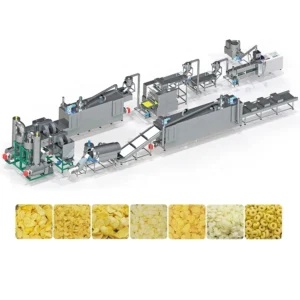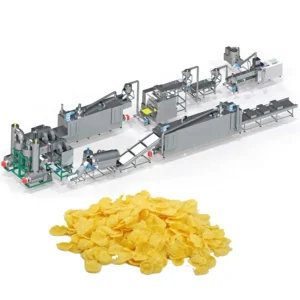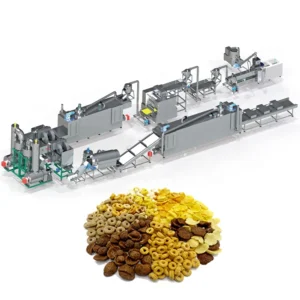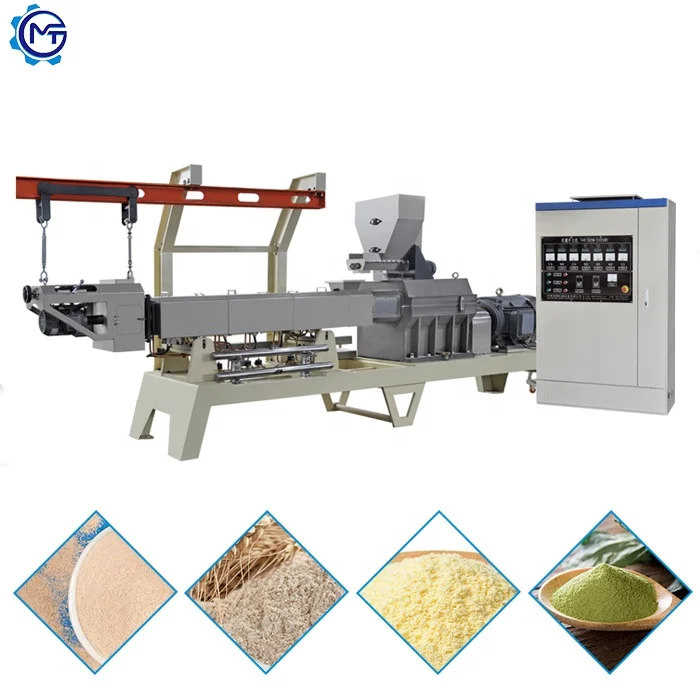
Screw Configuration Matched to Raw Material — MT75 screw profiles and die geometry are specified against your grain blend and moisture target, not copied from a generic breakfast cereal build.
Technical Specifications
| Parameter | Value |
|---|---|
| Model | MT75 |
| Product Type | Twin Screw Extruder for Corn Flakes and Breakfast Cereals |
| Screw Type | Twin-screw |
| Installed Power | 210 kW |
| Power Consumption | 150 kW |
| Output Capacity | 300–500 kg/h (basis not stated in source — confirm raw material, moisture content, and product format) |
| Voltage & Frequency | Customizable; commonly 415V 50/60Hz, 440V 50/60Hz, 220V 60Hz |
| Control System | PLC control with MCC available for full line |
| Overall Dimensions (L×W×H) | 45 × 1.5 × 3.5 m (full line footprint) |
| Extruder Working Principle | Feeding, extruding, cutting, heating, gearing, and controlling systems |
| Screw Construction | Special wear-resistant treatment |
| Lubrication | Automatic lubricating and cooling function |
| Flaking Station | Hydraulic double rollers, double motors for separate driving, infrared sensor temperature control |
| Dryer Heating Source | Gas or electric options |
| Roasting Oven | Hot air roasting with vibrating pan, high-temperature spraying tubes, dual circulating fans, cyclone dust removal |
| Coating System | Double tumble for sugar melting, elevator, coating drum, spraying nozzle |
| Line Stations | Mixing → Extruding → Flaking → Drying → Hot Air Roasting → Sugar Spraying → Sugar Coating → Drying → Cooling → Packing |
| Assembly State | Complete turnkey line |
| Certification | CE, ISO |
Application Suitability
| Application | Material or Output |
|---|---|
| Corn flakes production | Natural and sugar-coated flakes from corn grits or corn flour |
| Breakfast cereal shapes | Ball, tube, stick, ring, fruit loop, star, wheel, flower, heart formats |
| Multi-grain flake production | Rice, wheat, oat, and barley powder blends |
| Instant porridge and nutritional powder | Fortified cereal base powders for adult and infant nutrition |
| Baby food cereal base | Pre-gelatinised starch matrices for infant formula applications |
What Grain Particle Size Reveals About Extrusion Failure
The extruder does not fail — the specification mismatch between your actual raw material and the screw configuration does.
When a corn flakes line arrives at site and the pellets refuse to expand properly, the root cause is almost never mechanical. I have watched a line in South Asia stall for two weeks because the local corn grits were significantly coarser than the flour we ran during factory trials. The screw combination that produced clean, uniform pellets on fine material could not generate enough shear on the coarser feed to achieve proper starch gelatinisation. The corn flakes extrusion technology twin screw setup was correct in principle but wrong in configuration for that specific material stream [NEED_CITE: impact of particle size distribution on extrusion gelatinisation]. This is why every build we ship now runs on the buyer’s actual raw material before it leaves the workshop.
Barrel Temperature Zones and Starch Gelatinisation
Corn flakes require precise control over starch gelatinisation inside the barrel. The MT75 barrel is divided into multiple heating zones, each independently managed, so that moisture and thermal energy are introduced in stages rather than all at once. Early zones hydrate the grain particles while later zones apply the shear and heat needed to fully gelatinise the starch matrix. If the temperature ramp is too aggressive, moisture flashes off prematurely and the pellet exits under-expanded. If it is too gradual, the dough remains sticky and tears during flaking. The corn flakes extrusion technology twin screw design allows operators to adjust each zone independently, matching the thermal profile to the specific grain blend in production.
Die Geometry and the Flaking Interface
The die at the barrel exit determines pellet shape, wall thickness, and internal moisture distribution — all of which directly affect how the pellet behaves when it passes through the flaking rollers. A die with too large an orifice produces pellets that flatten unevenly, resulting in flakes with thick centres and thin, brittle edges that shatter during roasting. A die that is too restrictive forces excessive back-pressure, altering residence time and pushing gelatinisation beyond the optimal window. Die design on the MT75 is specified against the target flake dimensions and the hydraulic flaking station’s roller gap range, ensuring the pellet enters the nip at the correct moisture and temperature for uniform compression [NEED_CITE: die design influence on flake uniformity in cereal extrusion].
Reading the Specification Sheet Against Your Production Reality
The installed power of 210 kW and operational consumption of 150 kW on the MT75 indicate a system designed with thermal and mechanical headroom — the extruder does not run at its limit during normal cereal production. The twin-screw configuration provides self-wiping action, which is critical when processing sticky, high-starch formulations like corn and oat blends; single-screw extruders in this application tend to accumulate dough on the screw root, causing surging and inconsistent output. The special wear-resistant treatment on the screws extends service life when running abrasive materials such as whole grain wheat or mineral-fortified blends. The automatic lubricating and cooling function on the gearbox prevents thermal degradation of the oil during long production runs, reducing unplanned downtime between scheduled maintenance intervals.
The Cost of Skipping the Trial Run
When a line is configured from a generic screw-and-die template and shipped without a trial on the buyer’s actual grain supply, the first production run becomes the trial. I have seen the consequences: the flaking rollers cannot compress the pellets uniformly because the moisture gradient inside the pellet is wrong, the roasting oven produces uneven surface bubbling because flake thickness varies across the batch, and the sugar coating drum generates excessive fines because the base flakes are structurally inconsistent. Every station downstream amplifies the error introduced at the extruder. Correcting this after installation means new screw elements, new die plates, possibly new barrel sections, and weeks of lost production while the line is reconfigured from scratch [NEED_CITE: cost of post-installation extrusion reconfiguration].
Why Engineers Source This Line Here
The screw configuration and die design for the MT75 are specified against your grain formulation and target flake density, not pulled from a standard catalogue build. The in-house testing workshop runs your actual raw material before shipment, so the trial run report documents real expansion, real pellet geometry, and real flake behaviour on your supply. The hydraulic flaking station uses infrared sensor temperature control on both rollers, which maintains uniform surface temperature across the roller face and prevents the edge-to-centre thickness variation that causes downstream roasting inconsistency. The hot air roasting oven is equipped with dual circulating fans and cyclone dust removal, ensuring even heat distribution and surface bubbling across the full width of the vibrating pan. Every station on the line — from the mixing system through to packing — is throughput-matched under one supplier, so the extruder output does not bottleneck at the dryer or the coating drum.
Documentation & Verification
- Line layout and capacity calculation showing throughput balance across all stations from mixing to packing
- Screw and die configuration record documenting the exact build matched to your grain blend
- Trial run report generated on your actual raw material in the testing workshop before dispatch
- Electrical schematic with voltage and frequency confirmation for your installation site
- Operation and maintenance manual covering extruder barrel zones, flaking hydraulics, and roasting oven parameters
- Wear parts list specifying screw elements, die plates, and roller surfaces with replacement intervals
Installation, Commissioning & Support
- Full line footprint of 45 × 1.5 × 3.5 m requires level concrete flooring with utility trenches for gas and electrical runs
- Customizable voltage at 415V, 440V, or 220V requires dedicated circuit with capacity exceeding the 210 kW installed power rating
- Line ships in modular sections; flaking station and roasting oven are assembled and aligned on site
- First-run commissioning includes barrel temperature profiling and die swap if initial pellet geometry does not match target
- Operator training covers PLC interface navigation, screw speed adjustment, and hydraulic roller gap calibration
- Wear-resistant screw elements and die plates stocked for replacement; automatic lubrication system reduces daily maintenance checks
What to Prepare Before Requesting a Quotation
To configure a corn flakes extrusion technology twin screw line that matches your facility, we need your target grain blend composition including particle size distribution, your daily or hourly production target in kilograms, and the available floor space and ceiling height in your production hall. Please confirm your local voltage and frequency standard, the preferred HMI language for the PLC interface, and whether you intend to run sugar-coated variants alongside natural flakes. If you can send a sample of your raw material, we will run it through the testing workshop and include the trial report with the proposal.
Frequently Asked Questions
Q: How is screw configuration matched to different grain blends and moisture levels?
A: The screw element sequence — conveying, kneading, and reverse elements — is arranged based on the starch content, particle size, and target moisture of your grain blend. Coarser materials like corn grits require more intensive kneading zones to achieve full gelatinisation, while finer flours need gentler shear profiles. Each configuration is documented in the screw and die configuration record and validated through a trial run on your actual material before the extruder ships.
Q: What barrel temperature profile is needed for proper starch gelatinisation in corn flakes?
A: Corn flakes typically require a progressive temperature ramp across the barrel zones, starting with moderate heat to hydrate the grain particles and increasing toward the die to complete gelatinisation without premature moisture loss. The exact profile depends on your grain blend’s starch type and initial moisture content. The MT75 independently controlled heating zones allow operators to fine-tune each section during commissioning to match the specific formulation.
Q: How does die design affect flake density and expansion after flaking?
A: The die orifice diameter and land length determine the pellet’s wall thickness and internal pressure at exit, which directly controls how much the pellet expands during roasting. A pellet that is too dense will not puff adequately in the roasting oven, producing a hard, glassy flake. A pellet that is too light will over-expand and collapse. Die geometry is matched to your target flake thickness and the hydraulic roller gap on the flaking station.
Q: Can the extruder handle alternative grains like oat, barley, or multi-grain blends?
A: Yes. The twin-screw configuration and adjustable barrel temperature zones allow the MT75 to process rice, wheat, oat, and barley powder blends alongside standard corn formulations. Each grain has different gelatinisation temperatures and moisture absorption characteristics, so the screw configuration and barrel profile are adjusted accordingly. Multi-grain blends typically require a compromise profile that is validated during the pre-shipment trial run.
Q: What is the relationship between extrusion parameters and final flake crispness after roasting?
A: Flake crispness depends on the moisture content and starch structure of the pellet entering the roasting oven. If the extruder leaves too much residual moisture, the roasting oven must work harder and surface bubbling becomes uneven. If gelatinisation is incomplete inside the barrel, the flake develops a dense, chewy centre rather than a uniform crunch. Screw speed, barrel temperature, and feed rate together determine these conditions, and all three are adjustable via the PLC control system.